


Aleksify AI Chat Assistant
Chat Buddy is a hosted AI chat bot (chat widget) for small businesses. This plugin connects your WordPress site to your Chat Buddy account so you never have to touch a line of code.
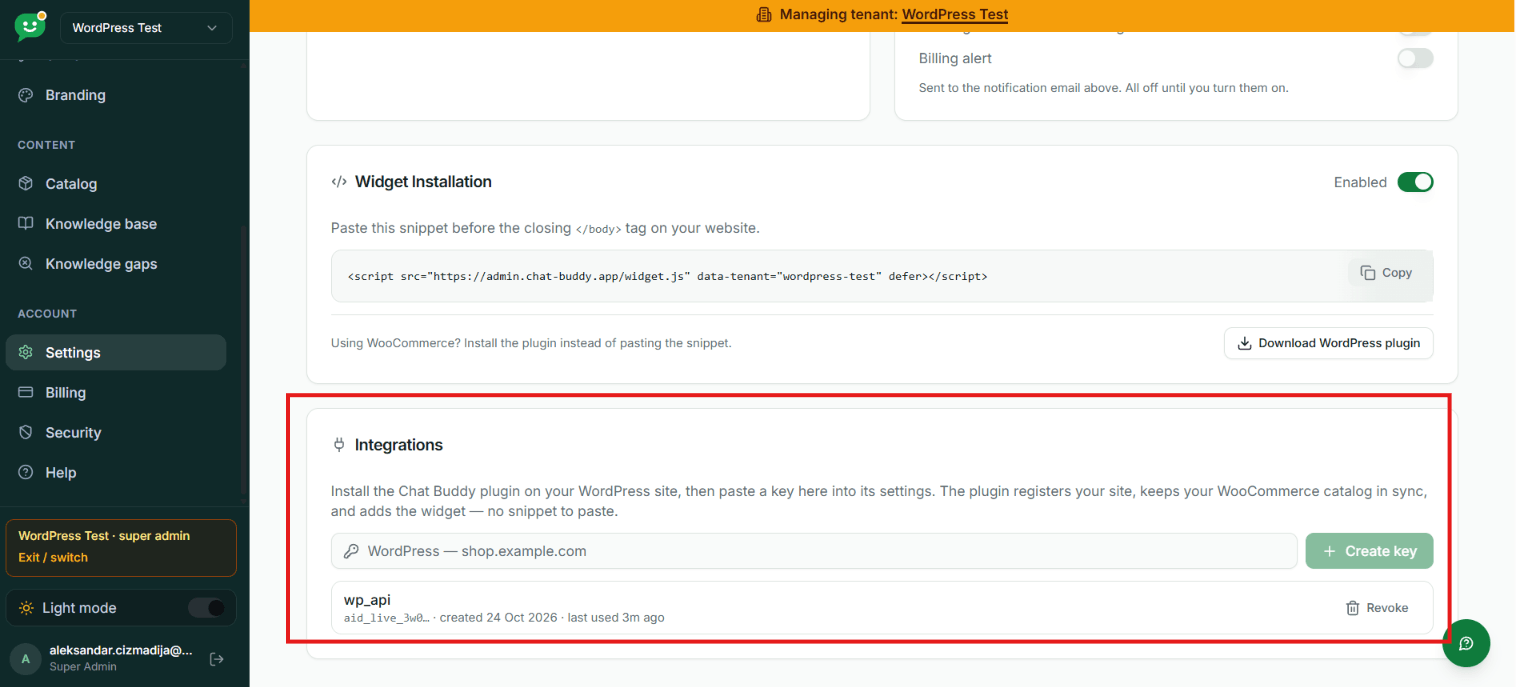
Saving your API key does four things at once:
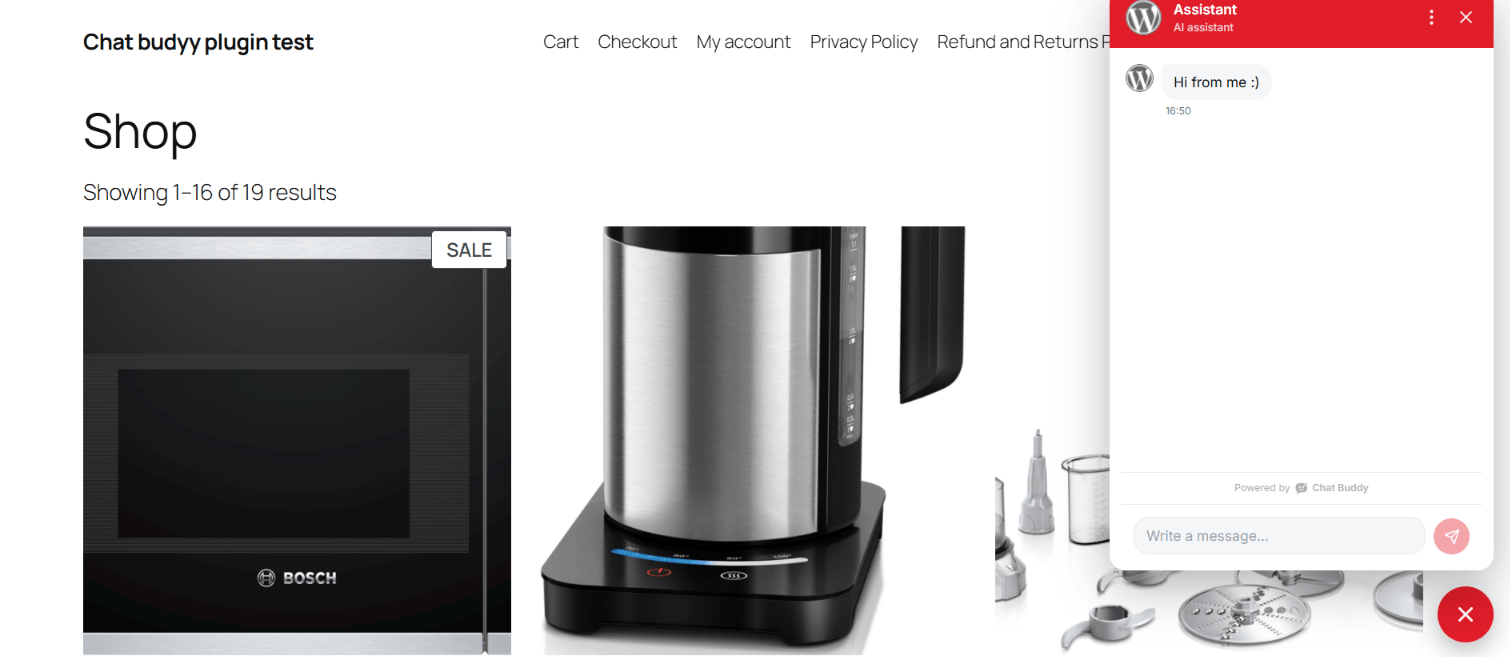
- Installs the widget. No snippet to paste into your theme, no code-snippets plugin.
- Registers your site. The widget only runs on domains you have registered; the plugin claims
this one for you and confirms it automatically. - Syncs your WooCommerce catalog. Products, prices, stock levels, categories and product page
links are pushed to your assistant and kept up to date as you edit them. - Syncs your pages and posts. Delivery, returns, FAQ and similar pages become answerable by the
assistant. You choose which pages and posts are included, and unticking one stops it being used.
What the assistant gets from WooCommerce
For each published, purchasable product: name, SKU, the short and the full description, the price
(decimals included), the regular and sale price when the product is discounted, currency, stock,
primary category, tags and the product page URL. Variations are synced as separate products by
default, because that is where the real SKU, price and stock live.
The full description is what lets the assistant answer detail questions (“is it safe on matte
paint?”), and tags are what help it suggest related products — so they are worth filling in.
Trashing or unpublishing a product removes it from the assistant. Nothing is ever deleted on the
Chat Buddy side, so your order history stays intact.
Multilingual sites
The assistant reads the language from your page’s lang attribute, which every standard WordPress
theme outputs. WPML and Polylang sites therefore work with no configuration in this plugin at all —
just make sure the languages you use are selected in your Chat Buddy dashboard.
External services
This plugin is a connector for Chat Buddy (https://chat-buddy.app), a hosted AI chat assistant
service operated by Aleksify. It cannot do anything on its own: it requires a Chat Buddy account and an API key, and it contacts the service only after you paste that key and save.
- Terms of Use: https://chat-buddy.app/terms
- Privacy Policy: https://chat-buddy.app/privacy
What is sent to Chat Buddy, and when
- Your site’s host name (for example
example.com), when you save your API key, so the service can
register and verify the domain. A verification request is then made back to your site. - WooCommerce products (if WooCommerce is active): name, SKU, short and full description, regular
and sale price, currency, stock, primary category, tags and product URL. Sent when you save a
product, when you click “Sync all products now”, and in a full resync once a week. Trashing or
unpublishing a product removes it from the assistant. - Page and post content (only for the pages and posts you tick in the plugin settings): the
rendered content, up to 50 KB per page. Sent when you save one of those pages, when you run a sync,
and in the weekly resync. - Plugin version, sent in an
X-Chat-Buddy-Plugin-Versionheader with each request.
Every request is authenticated with your API key.
The chat widget. The plugin adds a script served from Chat Buddy (https://admin.chat-buddy.app/widget.js)
to your site’s front end. When a visitor uses the chat, their messages go directly from their browser
to Chat Buddy and never pass through your WordPress server. The plugin itself sends no information
about your site’s visitors or users. Chat Buddy’s handling of visitor data is described in its Privacy
Policy above, and you remain responsible for informing your own visitors about it.
Details

Related plugins
Plugins that also contain the tag ai
SEOPress – On-site SEO & Analytics

AI Engine – The Chatbot, AI Framework & MCP for WordPress
GetGenie – AI Content Writer with Keyword Research & SEO Tracking Tools
SEO Plugin by Squirrly SEO

Website LLMs.txt

Smartsupp – live chat, AI shopping assistant and chatbots


About
Plugin for that tries to help you find the WordPress plugin you are looking for.
| Please enjoy an image of Crush (this awesome turtle) and have a lovely day! |  |
We do not own any plugin listed on this site and do not work for or work with WordPress.com or it's associated companies. We simply provide a searchable list of the available WordPress plugins.