


AryanTech Stock Signals
Most stock plugins show a price or a chart. AryanTech Stock Signals explains what the price action means, and backs it with the stock’s own history, so readers can see the evidence instead of a black-box “buy/sell”.
Built for finance blogs, newsletters, investment clubs and trading-education sites. For each stock you get:
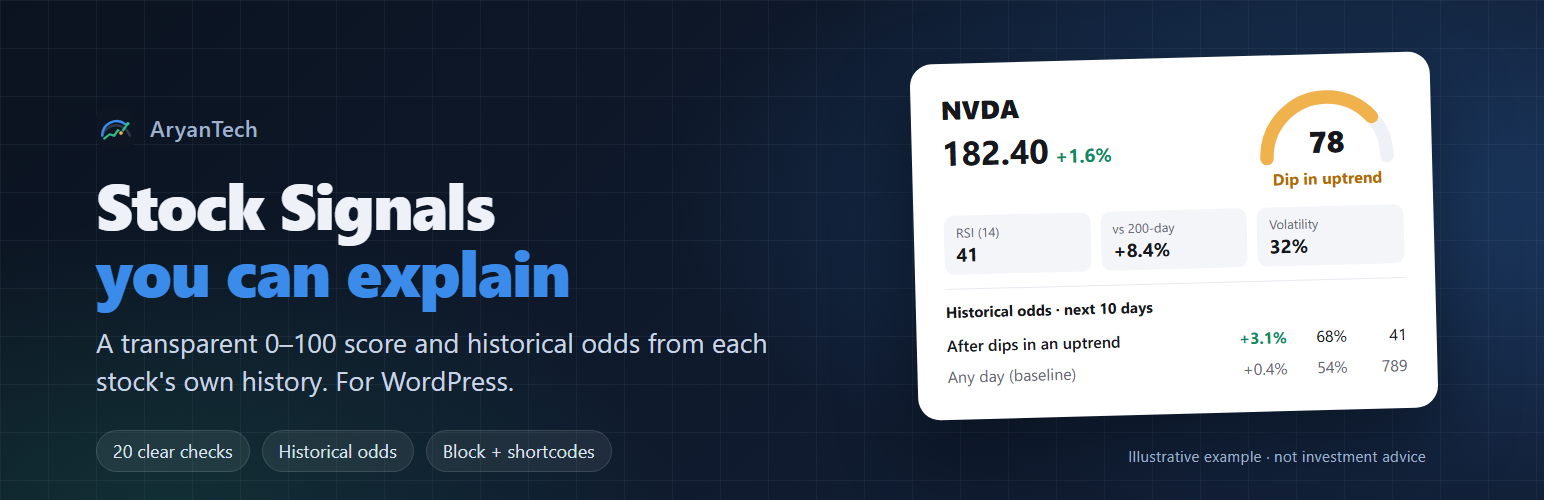
- A 0-100 signal score from 20 transparent checks across trend, momentum, dip setup, risk and relative strength, with the full breakdown one click away.
- A plain-English label: Strong, Positive, Neutral, Weak, Downtrend, or “Dip in uptrend”.
- Historical odds from the stock’s own history: “after dips in an uptrend, this stock averaged X% over the next 10 days, with a Y% win rate”. The number of past cases is always shown, and small samples are flagged.
- A price chart with 50- and 200-day averages and past dip signals marked.
- A screener table that ranks up to 25 stocks by score.
Everything renders server-side as lightweight HTML and SVG: no JavaScript on your pages, no external scripts or fonts, and light and dark modes built in.
Shortcodes
[atss_signal symbol="AAPL"]– signal card (options:odds,chart,checks= yes/no)[atss_chart symbol="NVDA" days="250"]– price chart[atss_screener symbols="AAPL, MSFT, NVDA"]– ranked table (no symbols = your watchlist)[atss_disclaimer]– your disclaimer text
Or add the Stock Signal block in the editor.
Market data
Choose a provider in Stock Signals > Settings:
- Demo data: synthetic prices, works instantly with no account. Clearly labelled as demo data wherever it appears.
- Twelve Data: use your own API key.
- Alpha Vantage: use your own API key (full history needs a premium key).
You are responsible for using a data plan whose licence allows displaying prices publicly on your website. Results are cached (30 minutes by default) and the last good copy is kept if the provider is down. The public REST endpoint only serves symbols your site already shows, so visitors can’t spend your API quota.
Important
This plugin displays information for educational purposes. It is not investment advice. Historical odds describe the past and do not predict future results. Please check what your jurisdiction requires before publishing market signals, for example rules on financial promotions or investment recommendations.
External services
This plugin connects to third-party market-data services only if you choose one in Stock Signals > Settings. With the default “Demo data” provider, no external requests are made.
Twelve Data (https://twelvedata.com): when selected, your server requests daily price history for the symbols shown on your site (the ticker symbol and your API key are sent), at most once per symbol per cache period. Terms of service, Privacy policy.
Alpha Vantage (https://www.alphavantage.co): when selected, your server requests daily price history for the symbols shown on your site (the ticker symbol and your API key are sent), at most once per symbol per cache period. Terms of service, Privacy policy.
Requests are made from your web server, never from your visitors’ browsers, and no visitor data is sent.
Details


Related plugins
Plugins that also contain the tag charts
Visualizer: Tables and Charts Manager for WordPress

Chartify – WordPress Chart Plugin

M Chart

Ninja Charts – Interactive Charts and Graphs

amCharts: Charts and Maps

Chart Block – Visualize Data with Bar, Line, Pie Charts


About
Plugin for that tries to help you find the WordPress plugin you are looking for.
| Please enjoy an image of Crush (this awesome turtle) and have a lovely day! |  |
We do not own any plugin listed on this site and do not work for or work with WordPress.com or it's associated companies. We simply provide a searchable list of the available WordPress plugins.