

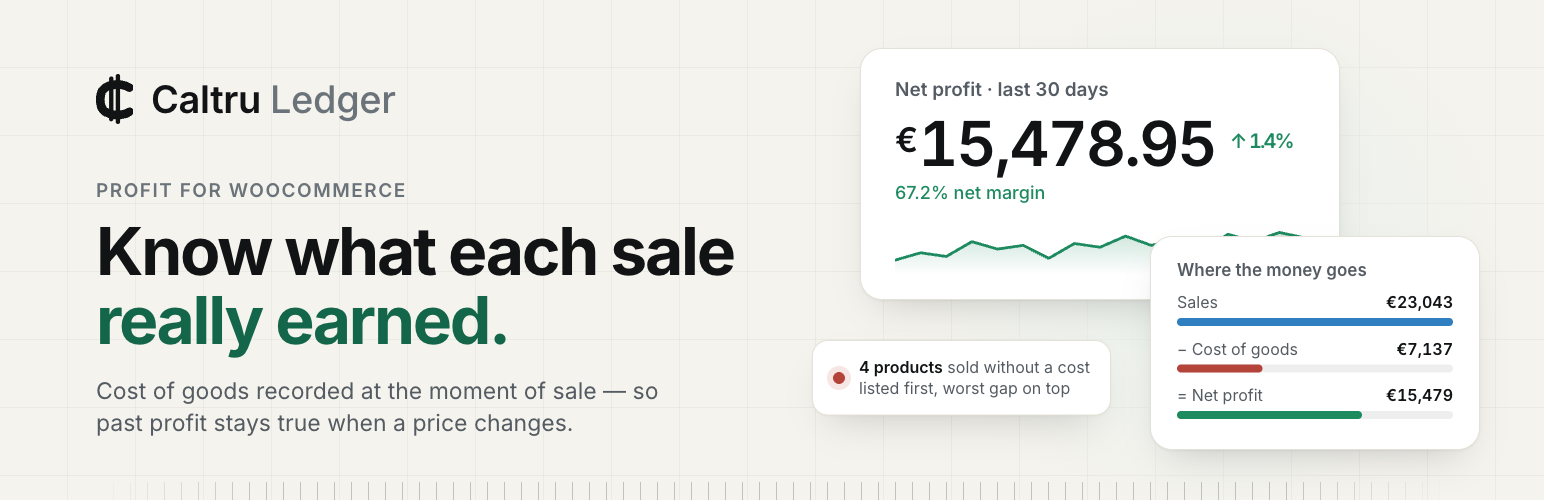

Caltru Ledger – Profit & Cost of Goods for WooCommerce
Calculation. True.
That is what the name stands for, and it is the whole promise. Every profit
figure here is a calculation you can follow back to the order it came from,
and it stays true after the fact.
WooCommerce tells you what you sold. Caltru Ledger tells you what you kept,
after the cost of the goods, the parcel and the payment fee, so you can decide
what to push, what to reprice and what to stop selling on numbers that hold.
What it is worth to your shop
- Put money behind what earns. Profit and margin for every product and category show which ones pay for the shop and which only add to turnover.
- Change prices knowing the margin. Cost, margin and the last 90 days of profit sit on the product list you already use, next to the price you are about to change.
- Price free delivery. Net profit counts what the carrier and the gateway actually charged you, and shows separately what the orders you shipped for free cost you.
- Close a month once. A sale’s cost is recorded when it happens and a refund lands on its own date, so last month reads the same next year, whatever your supplier charges by then.
- Never act on a guess by mistake. A product with no cost is reported as a gap, ranked by how much profit it overstates, not counted as pure profit.
- Keep costs up to date in minutes. Bulk Edit by amount or percentage, or a spreadsheet you download, edit and upload, with every change shown before it is made.
Calculation: every figure can be checked
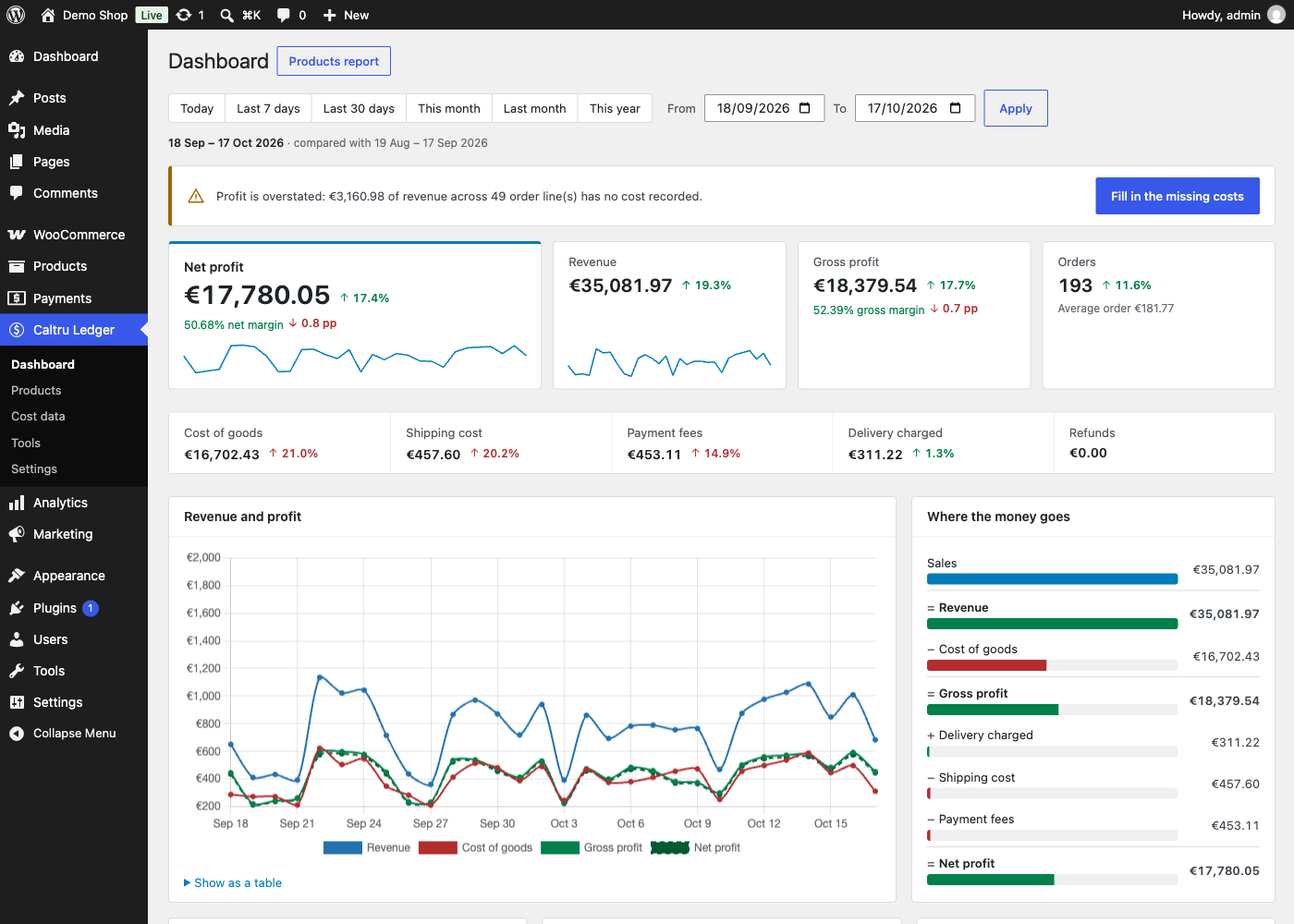
- A profit dashboard: revenue, cost of goods, gross profit and margin, by day or by month, each figure compared with the period before.
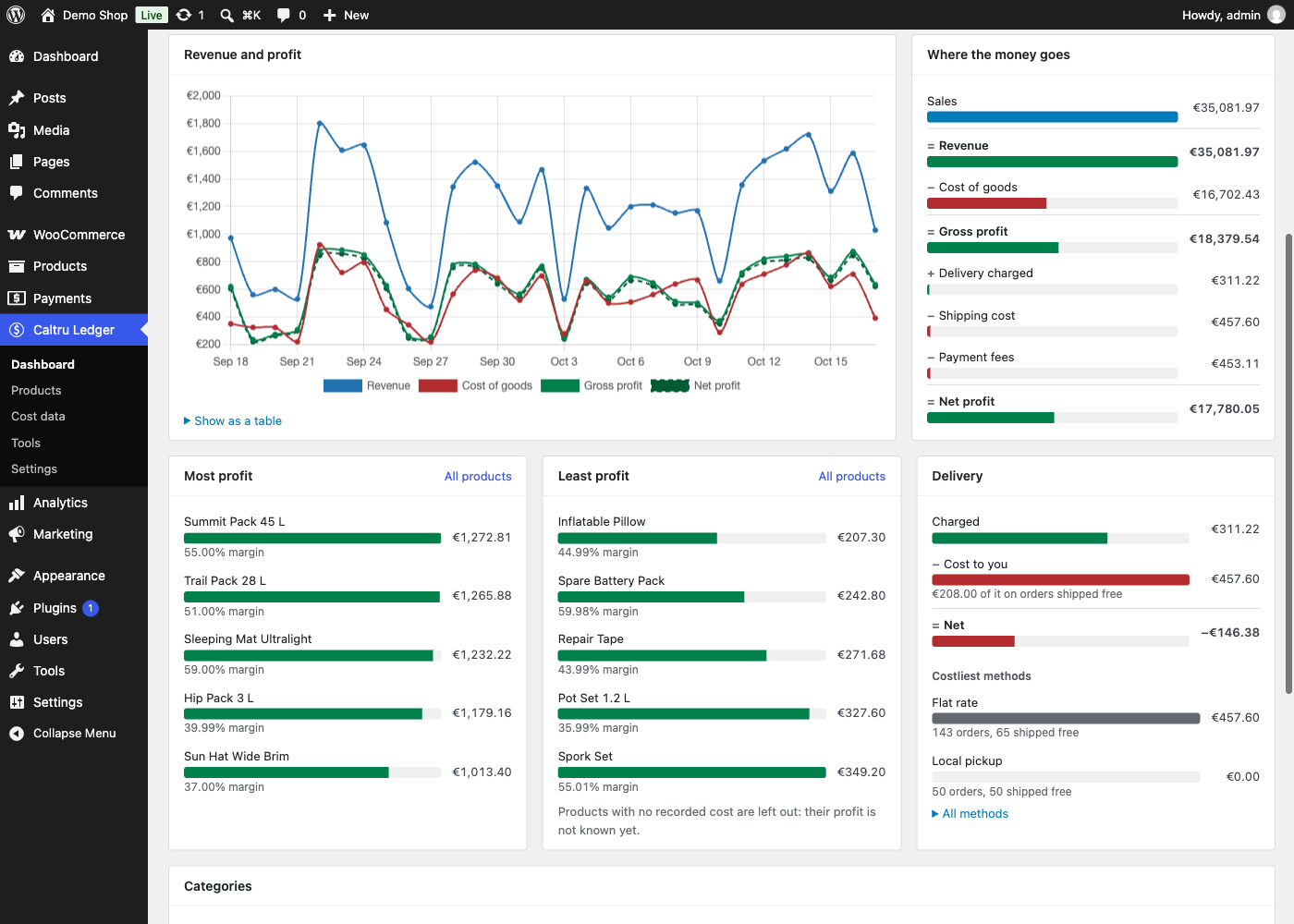
- Where the money goes, step by step from sales to net profit: gross profit less what shipping and the payment gateway cost you, with a breakdown per delivery method.
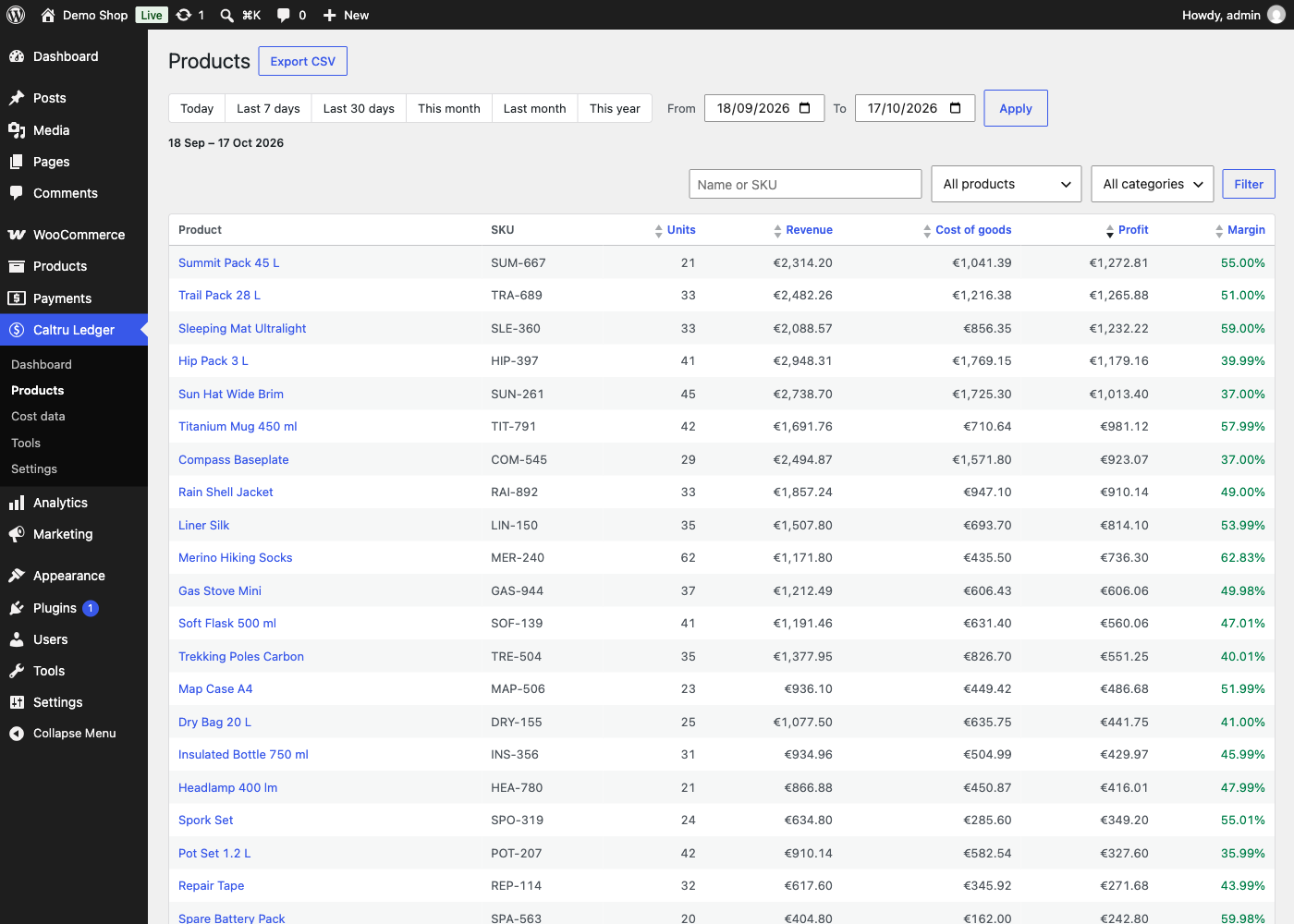
- Per-product and per-category reports, searchable, sortable and exportable.
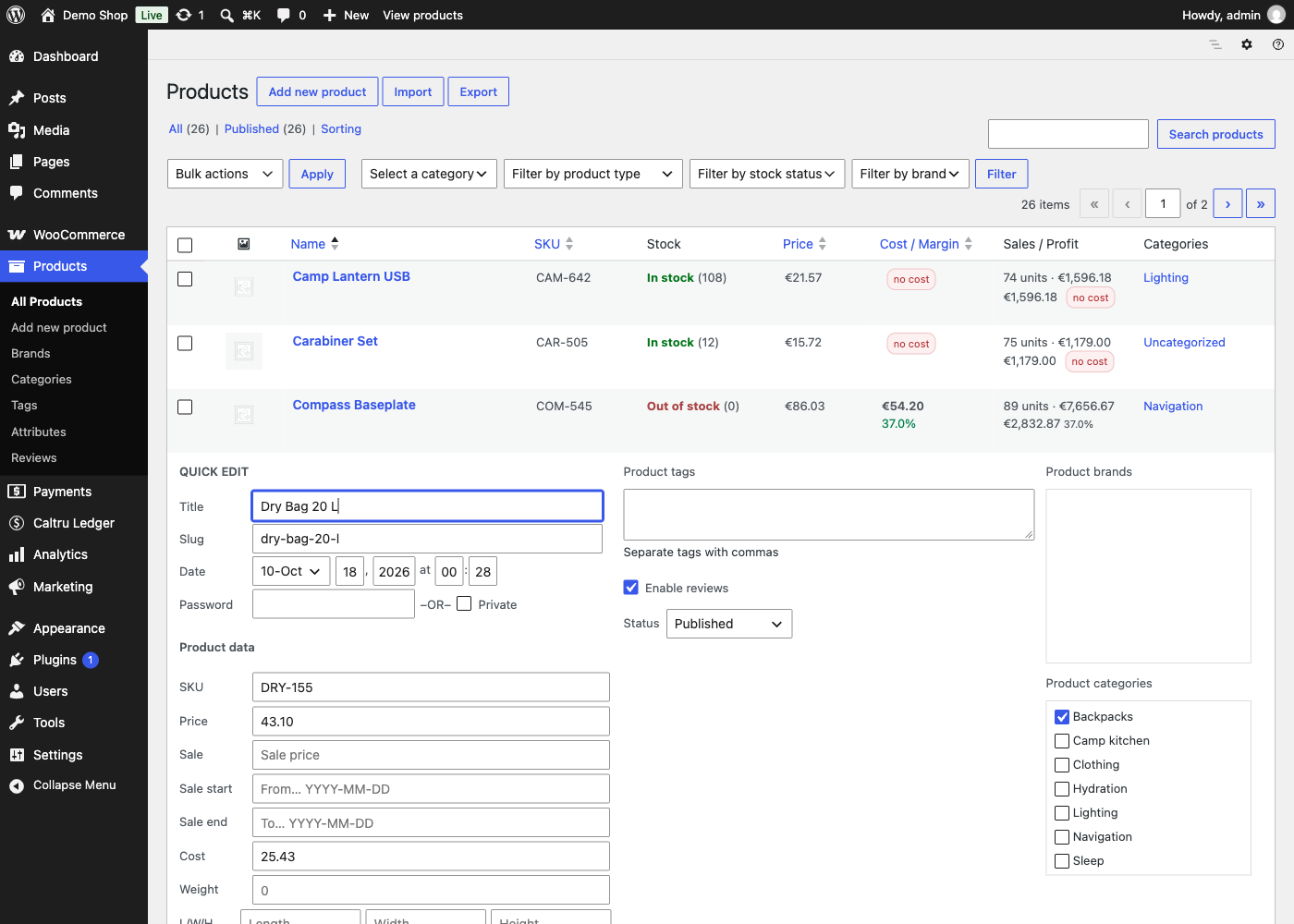
- Cost and margin, and the last 90 days of sales and profit, on your product list: three database queries for the whole page, however long it is.
- Quick Edit and Bulk Edit for costs, with six bulk modes: change to, increase by or decrease by, each as an amount or a percentage.
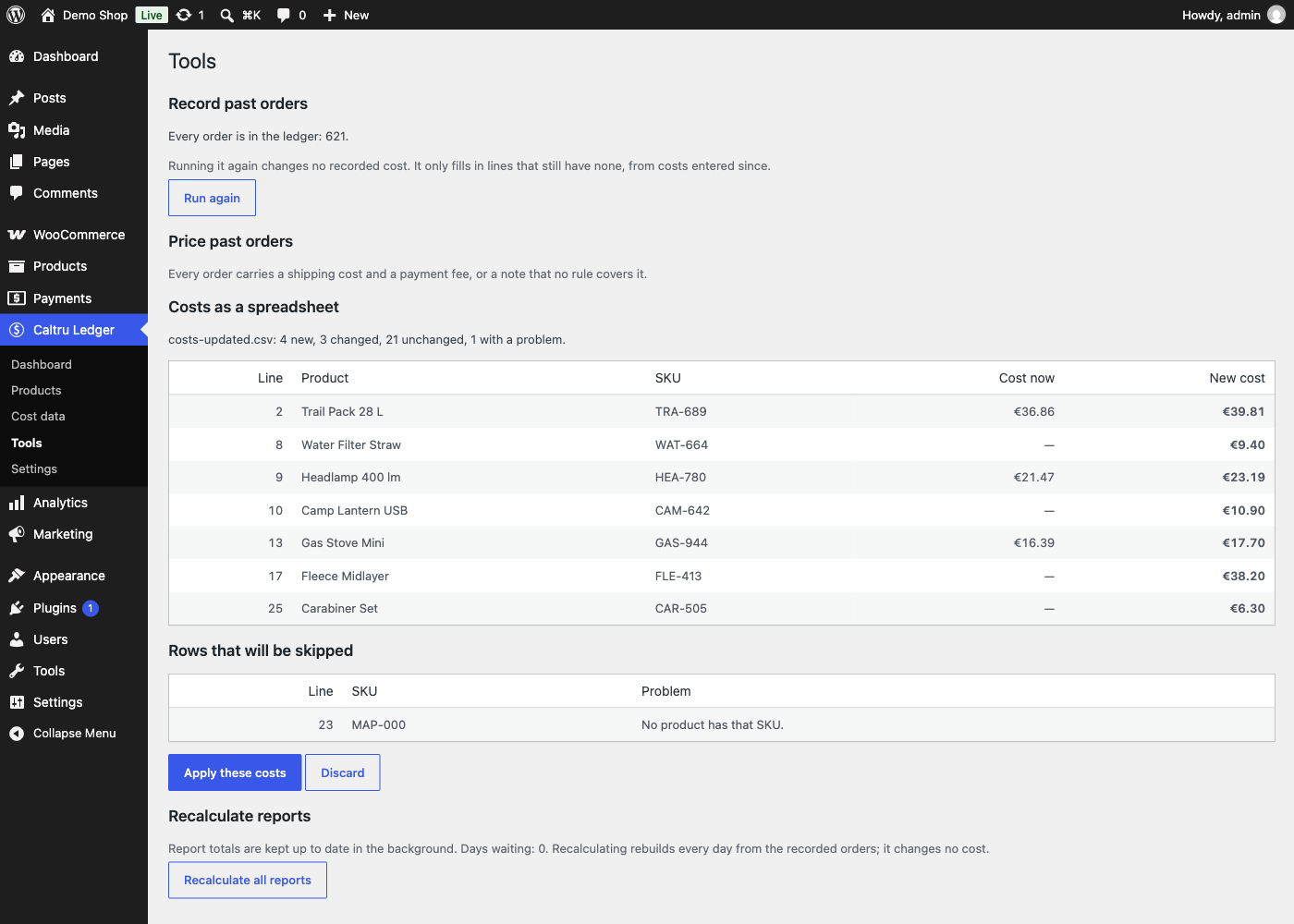
- Costs as a spreadsheet: download, edit, upload, and see exactly what the file would do before any of it happens.
- Variations, and multilingual shops where a product and its translations are one product.
True: what it records stays recorded
The cost of every order line is written down at the moment of the sale.
Change a supplier price tomorrow and last month’s profit does not move. That
is the thing a spreadsheet cannot do for you, and it is what WooCommerce
itself does not do: it works an order’s cost out again from today’s product
cost whenever the order is recalculated.
Refunds work the same way. The sale stays on its date, the refund lands on
the refund’s date, so a closed month never changes underneath you.
What an order cost to deliver is written once too, on the day it was sold.
Your carrier can put its prices up tomorrow without moving last month.
True: it says when it does not know
A profit figure built on missing costs is worse than no figure, so this
plugin never quietly invents one. Revenue with no cost behind it is reported
as its own number and flagged on every product it affects. Costs filled in
after a sale are marked as estimates, and you can exclude them entirely.
The Cost data screen lists the gaps in the order of how much profit each one
is overstating, with a box to type the answer into.
Delivery is treated the same way. WooCommerce does not record what the
carrier charged you, and most gateways never write their fee onto the order.
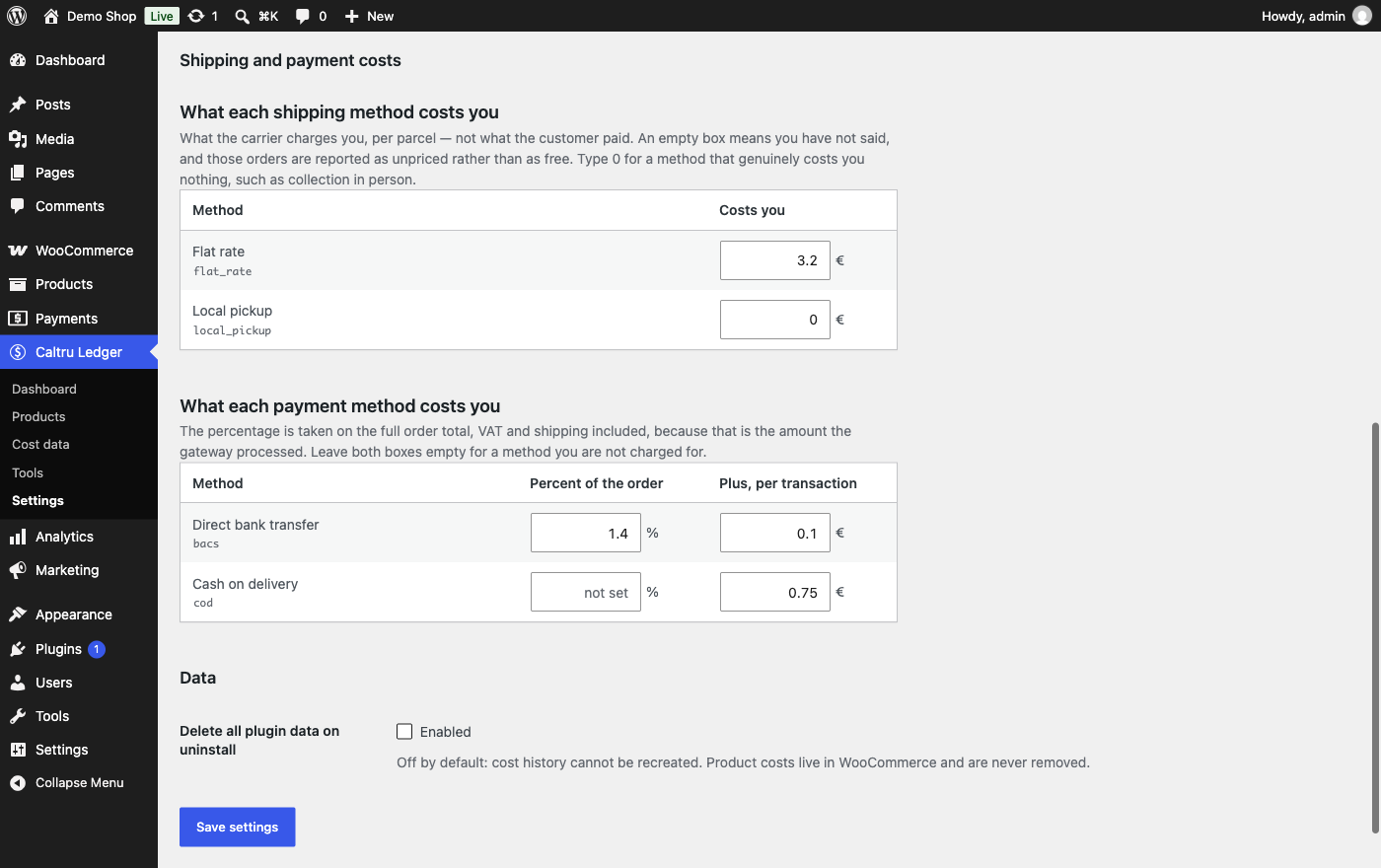
So you tell it once what each shipping method and payment method costs you.
A method you have not priced is reported as not priced, never as free: a
shop giving away delivery on a third of its orders would otherwise read
every one of them as costing nothing, and believe a margin it does not have.
Typing 0 says something different, and is recorded as 0.
Built on WooCommerce’s own cost field
Since 9.5 WooCommerce has a Cost of Goods Sold field of its own. This plugin
writes to that field rather than keeping a private copy, so your costs stay
with your products whatever you do next. It also hands WooCommerce back the
historical figure, so the core order screens show what the order actually
cost, not what the product costs today.
Coming from another plugin
Costs from WPFactory’s Cost of Goods, SkyVerge’s Cost of Goods and ATUM can be
imported, including — where those plugins recorded it — what each past order
cost at the time. That is better evidence than today’s price, and it is
preferred over it.
Nothing here is locked
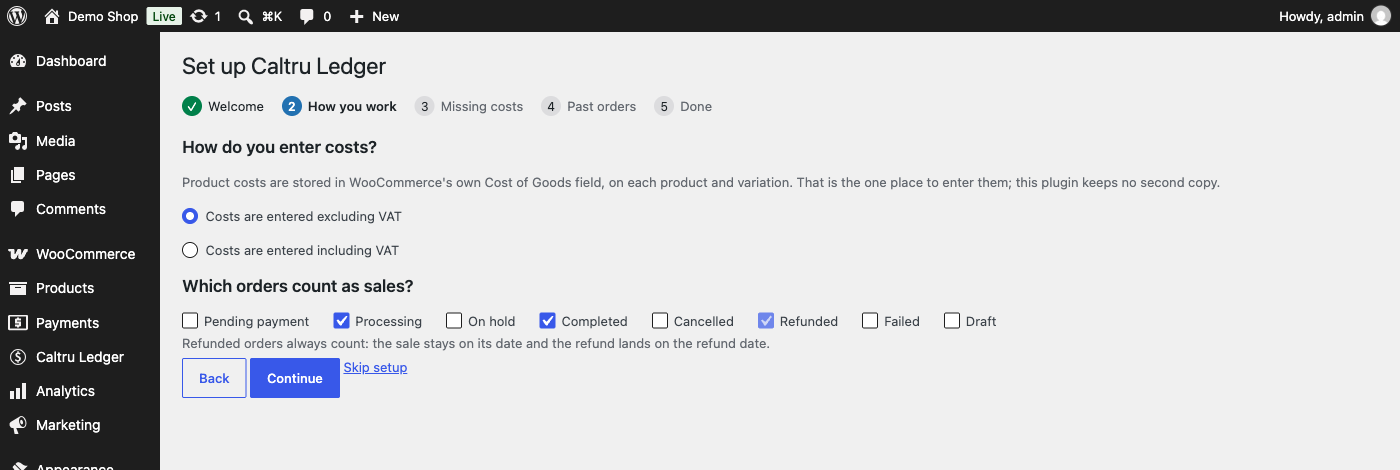
Every feature described above is in this plugin, with no time limit, history
limit or licence key, and it stays that way: nothing published free here will
ever move to a paid version.
Caltru Ledger Pro
A separate add-on for shops that want the work done for them. It adds new
screens, columns and reports; it unlocks nothing in this plugin.
- Stock replenishment — what to reorder, how many, and what the order will cost.
- Profit on the orders list — cost, profit and margin beside every order, with loss-making orders flagged (coming soon).
- Fixed costs and true net profit — rent, salaries, advertising and software, spread over the period, with your break-even point (coming soon).
- A weekly email report and alerts — the week’s profit against the last, best and worst products, what to reorder, and an alert when margin drops (coming soon).
- Inventory value — what your stock is worth at cost, month by month (coming soon).
Third-party code
Charts are drawn with Chart.js 4.5.1 (MIT licence, https://www.chartjs.org),
bundled unmodified in assets/vendor.
Details

Related plugins
Plugins that also contain the tag cost-of-goods
Cost of Goods: Product Cost & Profit Calculator for WooCommerce

F4 Total Stock Value for WooCommerce
Ni Cost of Goods for WooCommerce

Cost of Goods Manager for WooCommerce

Profit Margin Calculator for WooCommerce
Pihlfelt Cost & Margin Pricing for WooCommerce


About
Plugin for that tries to help you find the WordPress plugin you are looking for.
| Please enjoy an image of Crush (this awesome turtle) and have a lovely day! |  |
We do not own any plugin listed on this site and do not work for or work with WordPress.com or it's associated companies. We simply provide a searchable list of the available WordPress plugins.