



Cliq Store Locator
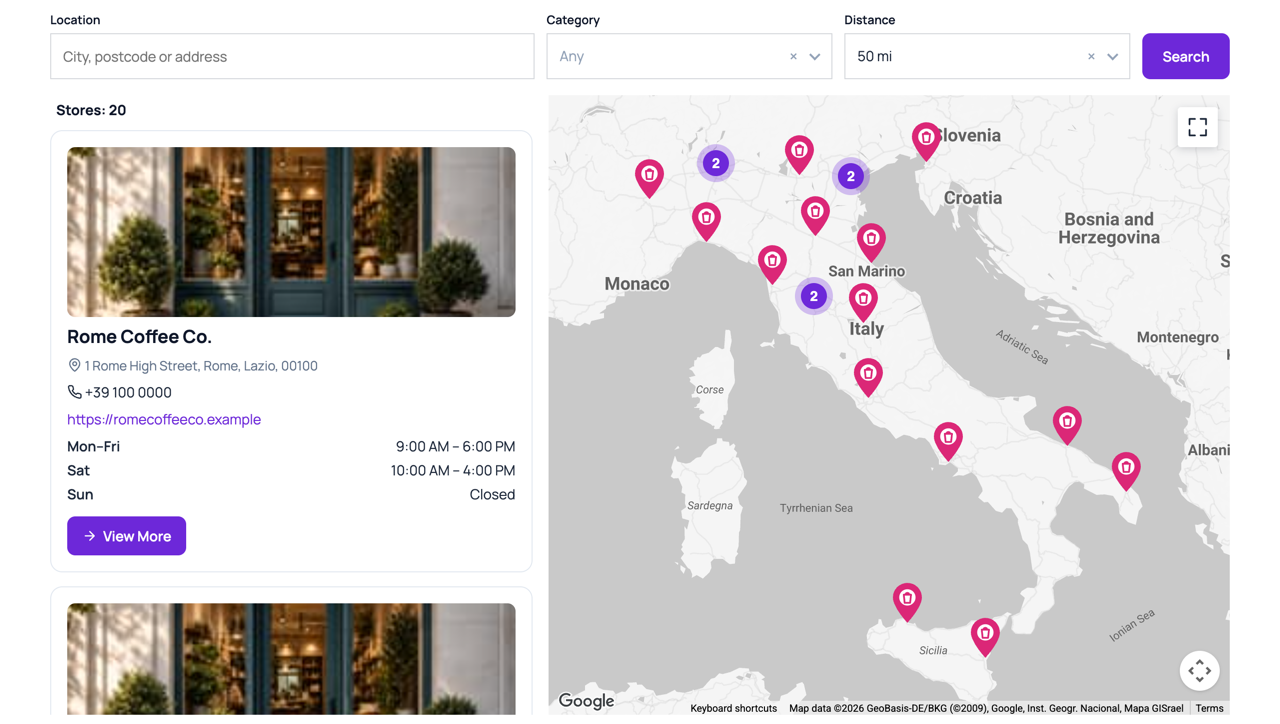
Cliq Store Locator turns a list of addresses into a store finder your visitors can actually use. Add your locations in the WordPress admin, drop a block or shortcode on a page, and visitors type an address to see the nearest stores ranked by distance, plotted on an interactive map.
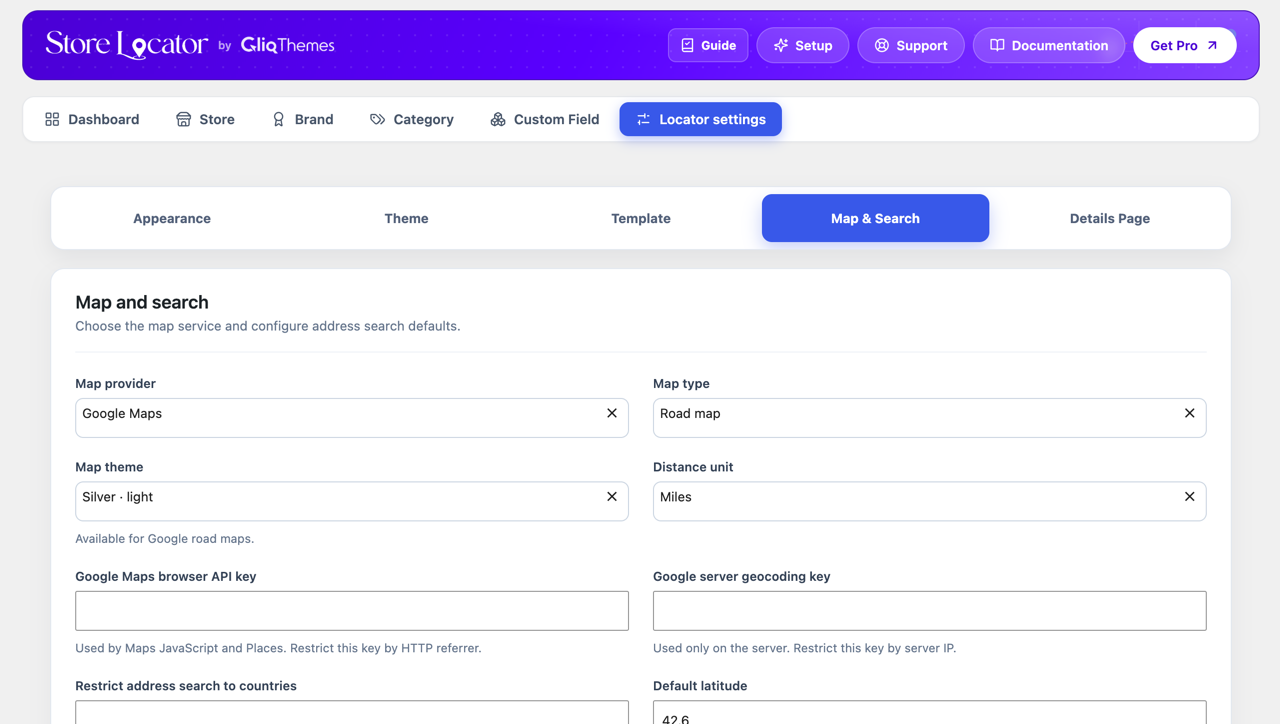
It works on activation. There is no account to create, no key to paste, and no trial clock. The default map is Leaflet with OpenStreetMap tiles and the default address lookup is Nominatim, both of which run without an API key. Google Maps is there if you would rather use it.
Whether you run one shop or a few hundred branches, the aim is the same: a fast, readable locator that fits your theme without writing code.
Locations and content
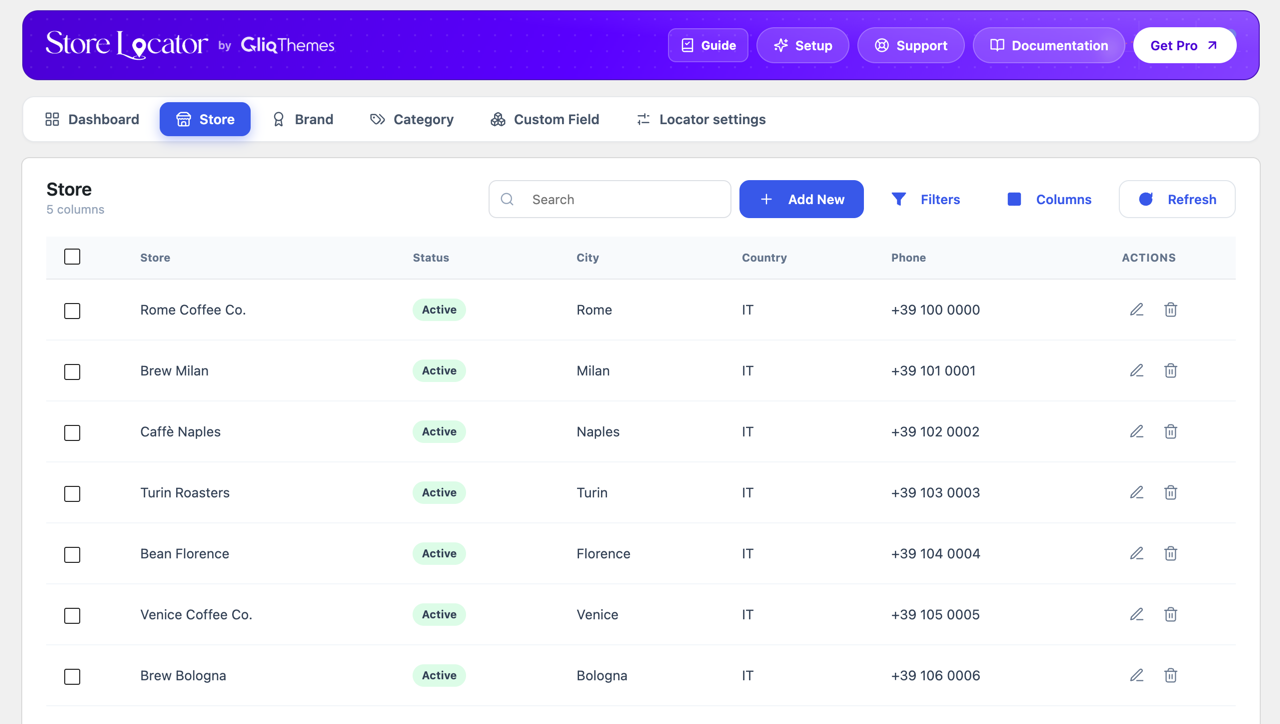
- Unlimited stores, each with address, phone, email, website, description and photo.
- Opening hours per store, shown on the store card and its own page.
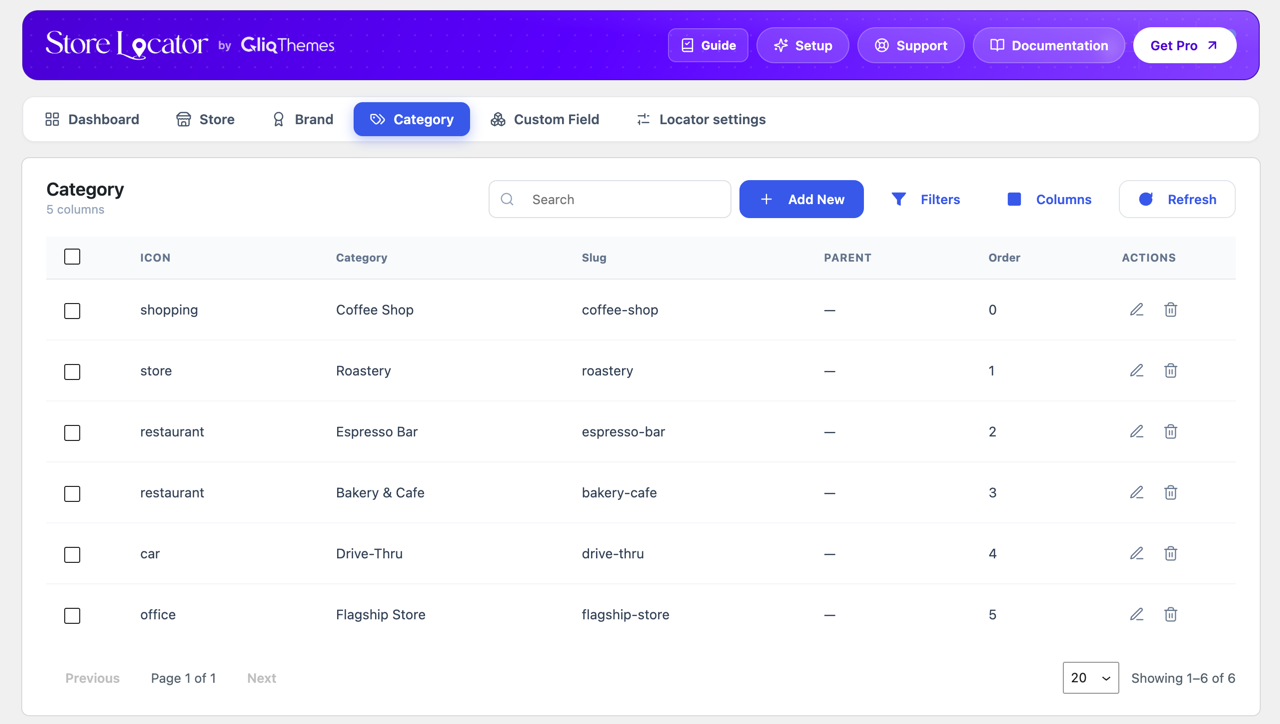
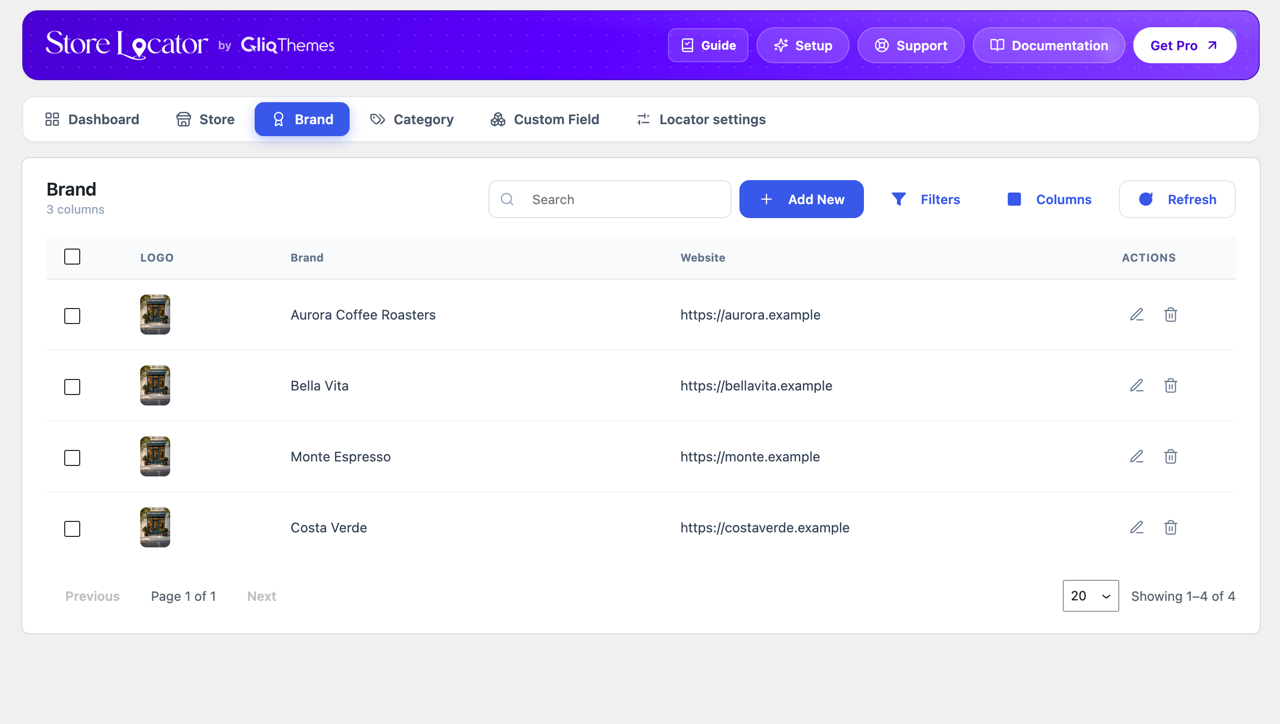
- Categories and brands to group locations, with a category filter on the search form.
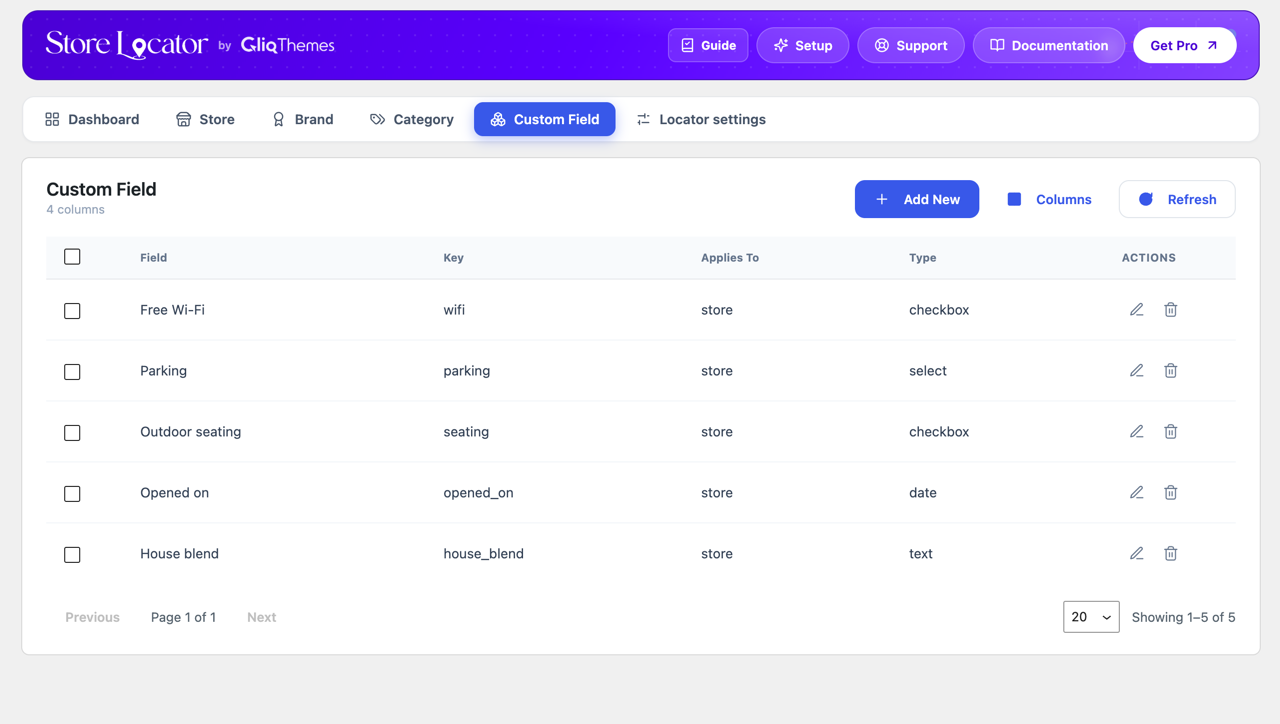
- Your own custom fields for anything the built-in fields do not cover.
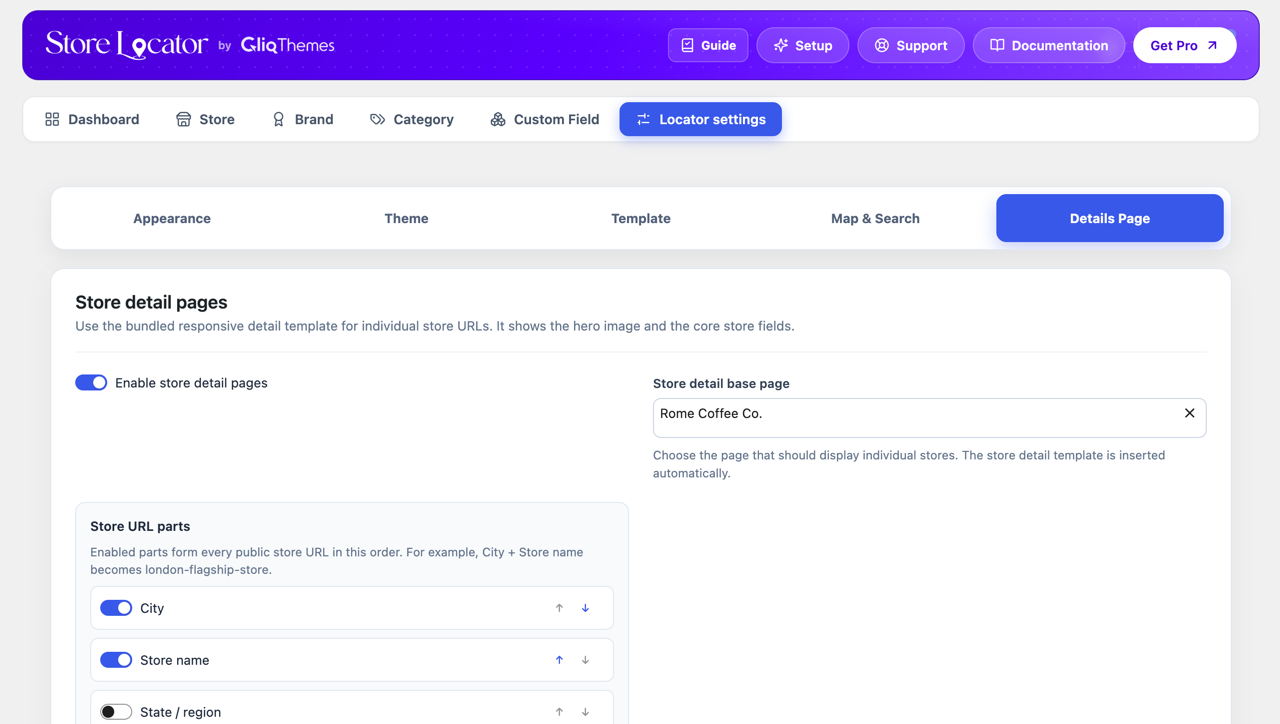
- A dedicated page for every store, with a clean URL.
Search
- Address search with a distance radius, results sorted nearest-first.
- Distances in kilometres or miles, following your setting.
- “Use my location” for visitors who would rather not type an address.
- Category filtering alongside the address search.
Maps
- Leaflet with OpenStreetMap by default — no API key, no billing account.
- Google Maps as an alternative when you have a key.
- Marker clustering, so a dense city stays readable as visitors zoom out.
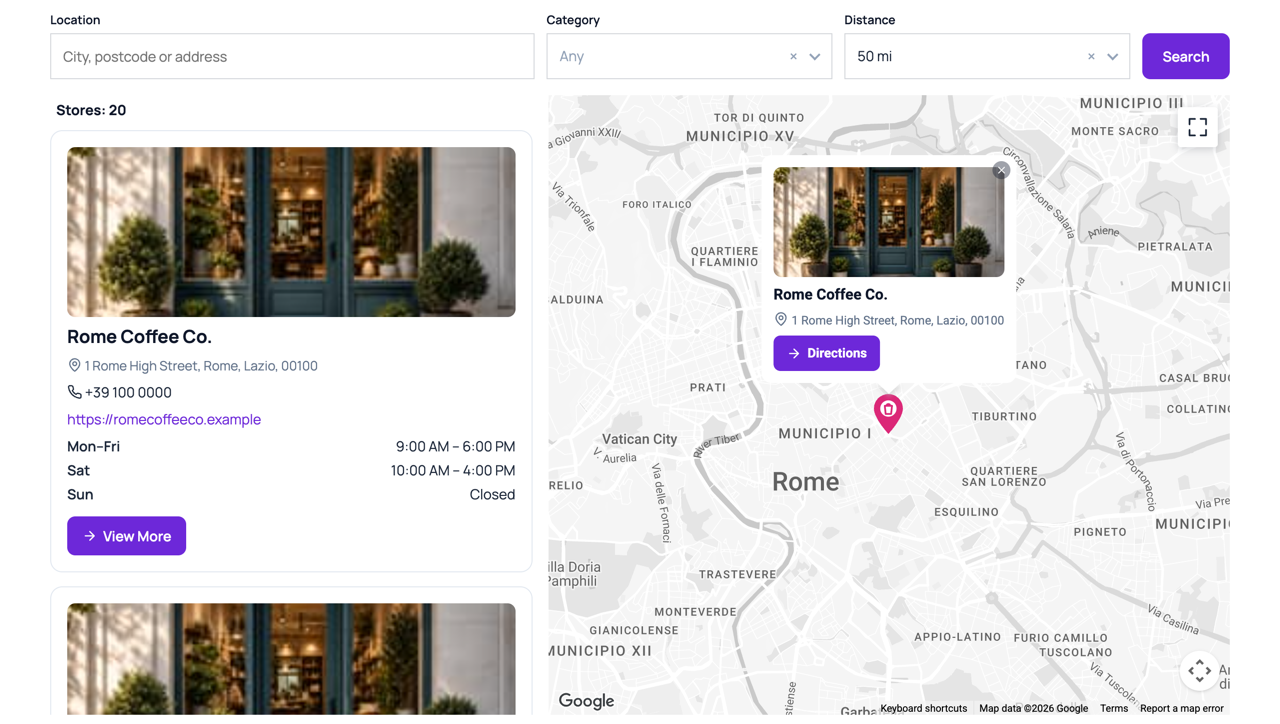
- Driving directions and a map popup for each location.
- Four bundled marker styles.
Appearance
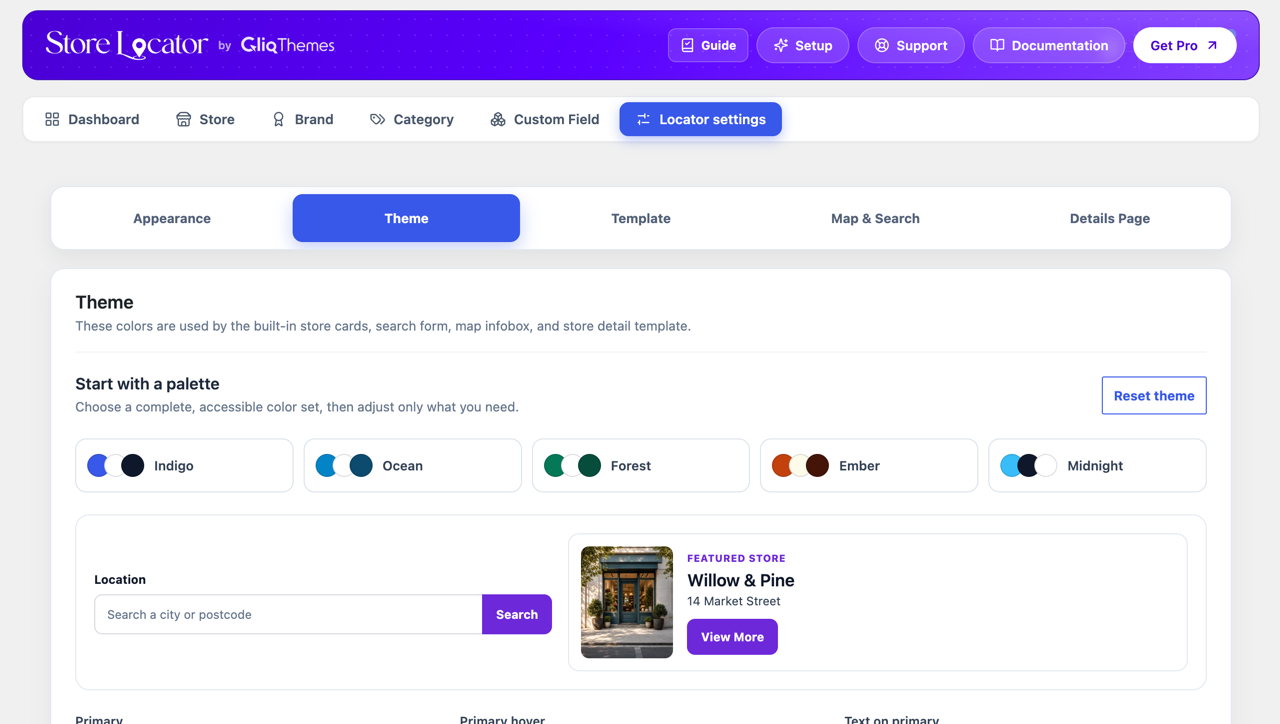
- Five colour schemes — Indigo, Ocean, Forest, Ember and Midnight — plus a palette editor if none of them fit.
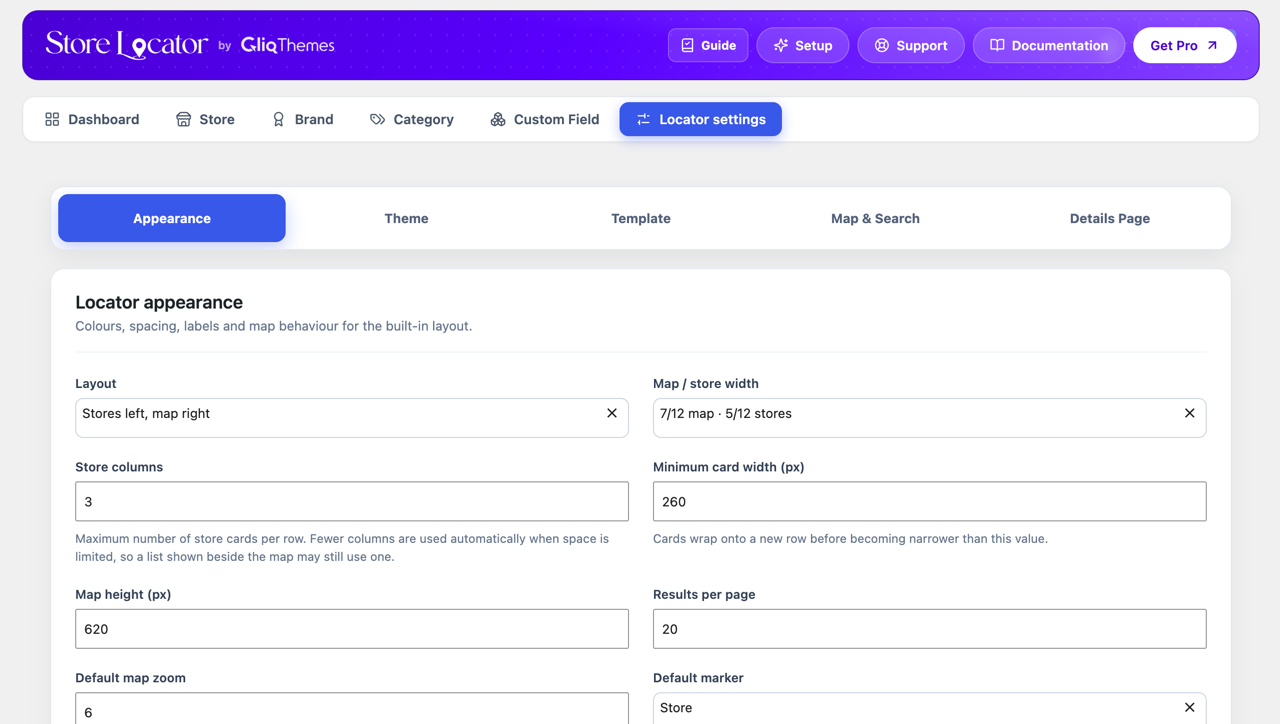
- Map on the right, on the left, or no map at all.
- Map height, default zoom, and how many results load at a time.
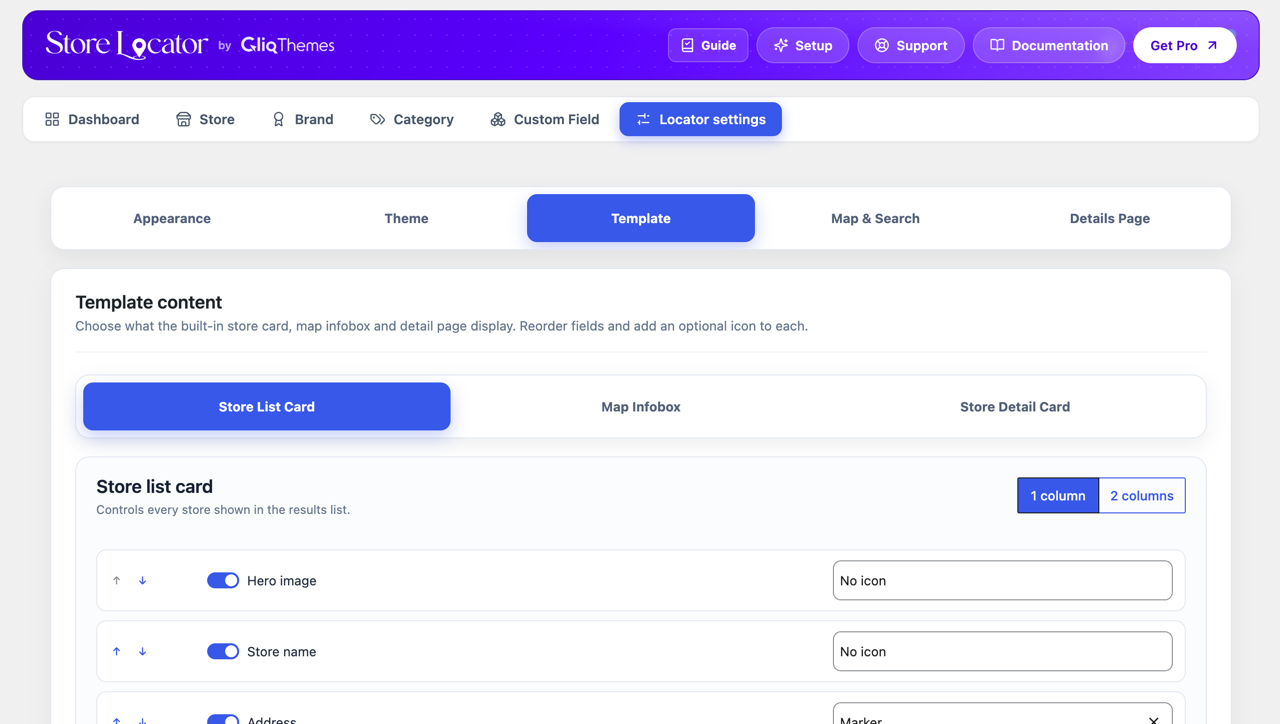
- Choose which fields appear on a store card, in a map popup, and on a store page.
- Rewrite the labels on buttons and fields to match your own wording.
Findable and translatable
- A title, description and Schema.org LocalBusiness data for each store page.
- Translated store content through WPML and Polylang.
- Right-to-left layouts supported.
Privacy by default
- No visitor submissions are stored and no analytics are recorded.
- External services are contacted only when the feature that needs them is used, and each one is listed under External Services below.
- Deleting the plugin removes everything it created, unless you ask it to keep your data.
See it in action
The demo site runs this plugin on one shared set of sample stores, so what changes between demos is the layout, not the data.
A few to start with:
- Nordic Minimal — list beside a paper-style map
- Corporate Trust — results grouped into collapsible city sections
- Coastal Airy — category tiles that drill down into stores
- Atlas Fullscreen — full-bleed map with the search floating over it
- Monochrome Grid — a three-up card grid with no map
- Accordion Directory — a name-only list that expands in place
- Harbour Teal — photo markers and a map-led layout
- Midnight Luxe — a dark kit with a scrolling list
This plugin gives you the list-and-map layout with the settings described above. The demos that rearrange the card, the search form or the map popup are built with the separate Pro plugin’s layout builder.
How it works
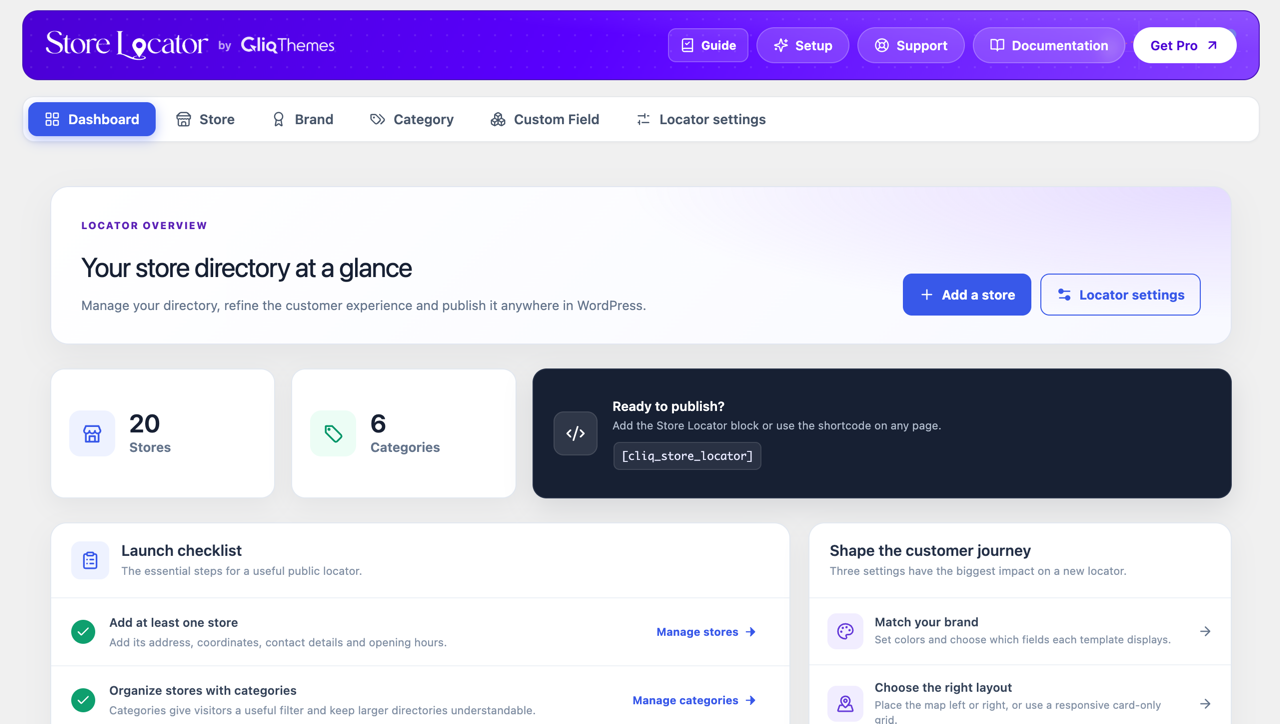
- Install and activate. A setup panel offers to create 20 sample stores so you can see the shape of it; skip it if you would rather start with your own.
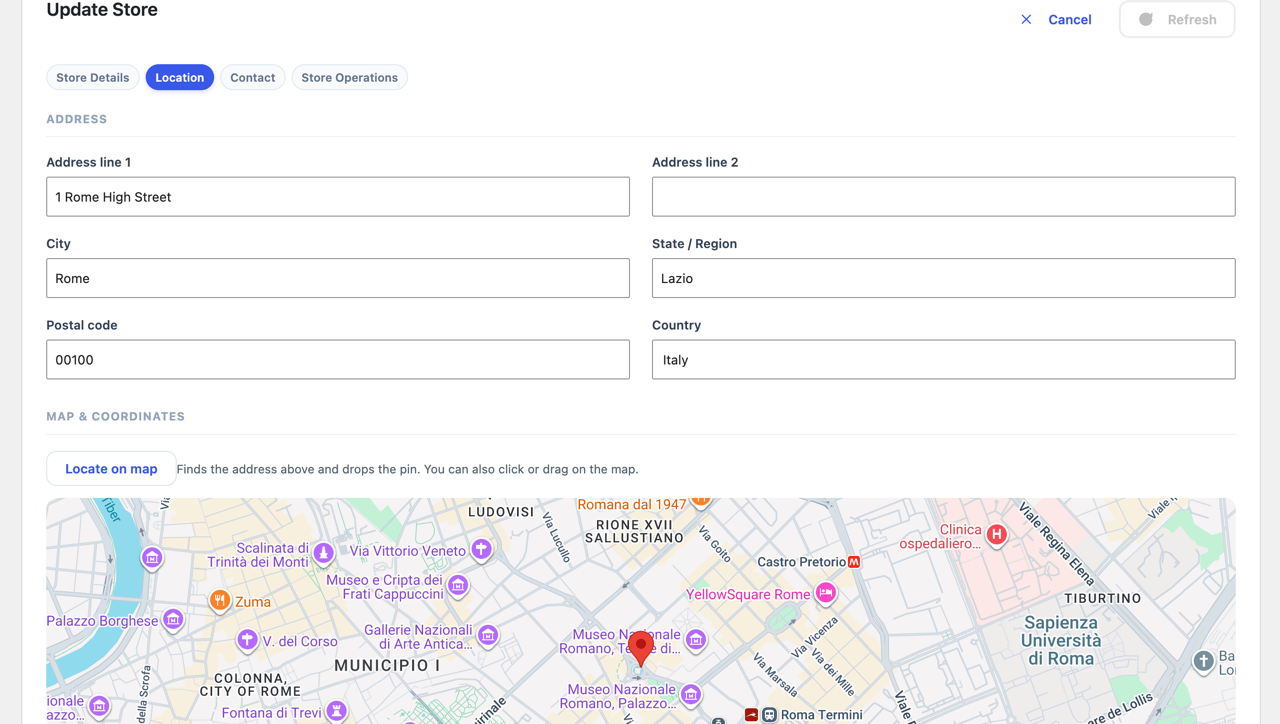
- Add your stores. Under Store Locator Store, fill in the address, then use the Pin Location map to look up coordinates from that address or drag the pin to place it exactly.
- Put it on a page. Add the Store Locator block, or use
[cliq_store_locator]in any page, post or widget. - Make it yours. Set the layout, colour scheme, map height and visible fields under Store Locator Locator settings.
Who it suits
Any business whose customers need to find a physical place:
- Retail chains and single shops
- Dealer and distributor networks
- Bank, insurance and agency branches
- Service and repair centres
- Restaurants, cafés and takeaways
- Clinics, pharmacies and healthcare providers
- Hotels and venues
- Gyms, studios and clubs
- Schools, campuses and training centres
- Franchise networks of any size
Cliq Store Locator Pro
Everything above is free and stays free. A separate Pro plugin, sold on our site, adds:
- A drag-and-drop layout builder for the card, search form, map popup and store page, with sixteen ready-made layouts to start from.
- A custom marker editor, plus per-category markers.
- CSV import and export for bulk store management.
- Lead-capture and store-registration forms with administrator approval.
- Visitor analytics — searches, store views and direction requests.
Details: cliqthemes.com/store-locator
External Services
The plugin communicates with an external service only when the related feature is used or configured.
OpenStreetMap tile service
When Leaflet is selected, the visitor’s browser requests map tiles from OpenStreetMap. Tile coordinates, the visitor’s IP address, and normal browser request information are sent to the service.
- Service: https://www.openstreetmap.org/
- Tile usage policy: https://operations.osmfoundation.org/policies/tiles/
- Privacy policy: https://osmfoundation.org/wiki/Privacy_Policy
Nominatim
Nominatim is the default geocoder. The address or coordinates being looked up, the requester’s IP address, and normal request information are sent when a visitor searches for a location or an administrator geocodes a store.
- Service: https://nominatim.openstreetmap.org/
- Usage policy: https://operations.osmfoundation.org/policies/nominatim/
- Privacy policy: https://osmfoundation.org/wiki/Privacy_Policy
Google Maps Platform
When an administrator selects Google Maps or Google geocoding and supplies the required key, the plugin loads Google Maps JavaScript and Places in the browser and/or sends addresses and coordinates to the Google Geocoding API. Google receives normal request information such as the visitor’s IP address and browser details.
- Service and terms: https://cloud.google.com/maps-platform/terms
- Privacy policy: https://policies.google.com/privacy
OSRM routing
When a visitor requests driving directions on a Leaflet map, the origin and destination coordinates are sent to the public OSRM routing service to calculate the route. The visitor’s IP address and normal request information are also sent. Directions on a Google map use the Google service described above instead.
- Service: https://project-osrm.org/
- Usage policy: https://github.com/Project-OSRM/osrm-backend/wiki/Api-usage-policy
GeoJS approximate location
If the administrator enables IP-based location fallback, and a visitor opens the locator without sharing a browser location, the visitor’s browser requests approximate coordinates from GeoJS based on their IP address. The request is sent without cookies and without a referrer, and the result is only used to centre the map near the visitor.
- Service: https://www.geojs.io/
- Privacy policy: https://www.geojs.io/
Google Fonts
When an administrator selects a non-system font for the locator, the visitor’s browser requests that stylesheet and its font files from Google Fonts. Google receives the visitor’s IP address and normal browser request information. The default is a system font, which contacts nothing.
- Service: https://fonts.google.com/
- Terms: https://developers.google.com/fonts/terms
- Privacy policy: https://policies.google.com/privacy
CliqThemes support email
The support form on the plugin’s own admin screen sends the name, email address, message, section, and site URL an administrator types into it to support@cliqthemes.com, using this site’s configured WordPress mail system. Nothing is sent unless an administrator submits that form.
- Service operator: https://cliqthemes.com/
Privacy
Store, category, brand, and settings data are stored in this site’s WordPress database. The plugin keeps no visitor submissions and records no analytics, so it registers no personal-data exporter or eraser. It does supply suggested text for the WordPress Privacy Policy Guide describing the external services listed above.
Deleting the plugin removes its database tables, its options, and the capability it added, unless Keep data on uninstall is enabled in its settings. It schedules no recurring tasks.
Third-Party Libraries
The plugin bundles the following open-source libraries, each unmodified, at the version shown, and each GPL-compatible.
- Leaflet 1.9.4 (BSD-2-Clause) — https://leafletjs.com/ —
resources/frontend/vendor/leaflet/ - Leaflet.markercluster 1.5.3 (MIT) — https://github.com/Leaflet/Leaflet.markercluster —
resources/frontend/vendor/leaflet.markercluster/ - @googlemaps/markerclusterer 2.5.3 (Apache-2.0) — https://github.com/googlemaps/js-markerclusterer —
resources/frontend/vendor/googlemaps-markerclusterer/, shipped unminified - @cliqthemes/glide-dropdown 0.3.0 (MIT) — https://www.npmjs.com/package/@cliqthemes/glide-dropdown —
resources/frontend/vendor/glide-dropdown/, shipped with its source map - Preact 10.29.3 (MIT) — https://preactjs.com/ — compiled into
resources/frontend/build/ - Lucide React 0.378.0 (ISC) — https://lucide.dev/ — compiled into the admin bundles
- enshrined/svg-sanitize (GPL-2.0-or-later) — https://github.com/darylldoyle/svg-sanitizer — full source in
vendor/enshrined/svg-sanitize/
Every npm package above is resolved from the public npm registry by the package-lock.json in the plugin root, so npm ci reproduces exactly these versions.
Development and Build
The human-readable source for every compiled asset ships inside the plugin, beside the build directory it compiles to: resources/frontend/src, resources/locator-admin/src, resources/admin-common/src, resources/shared, and vendor/cliqthemes/ui/resources. PHP source is in includes, and Composer dependency source in vendor.
To rebuild the bundled assets, install Node.js 18 or newer, change to the plugin directory, run npm ci, then npm run build. The package.json, package-lock.json, and webpack.config.js used for that build are in the plugin root. npm run build writes resources/frontend/build, resources/locator-admin/build, and vendor/cliqthemes/ui/resources/admin/build — the same files this plugin ships.
Details
Related plugins
Plugins that also contain the tag geolocation
SlimStat Analytics

Price Based on Country for WooCommerce

Geolocation IP Detection

IP Location Block

HivePress Geolocation

Country Based Restrictions for WooCommerce


About
Plugin for that tries to help you find the WordPress plugin you are looking for.
| Please enjoy an image of Crush (this awesome turtle) and have a lovely day! |  |
We do not own any plugin listed on this site and do not work for or work with WordPress.com or it's associated companies. We simply provide a searchable list of the available WordPress plugins.