


DinoAI Audit
DinoAI Audit brings practical AI tools into the WordPress dashboard. It is built by WPDINO to help you audit and optimize WordPress sites.
DinoAI Audit is not a generic chatbot. It focuses on WordPress workflows:
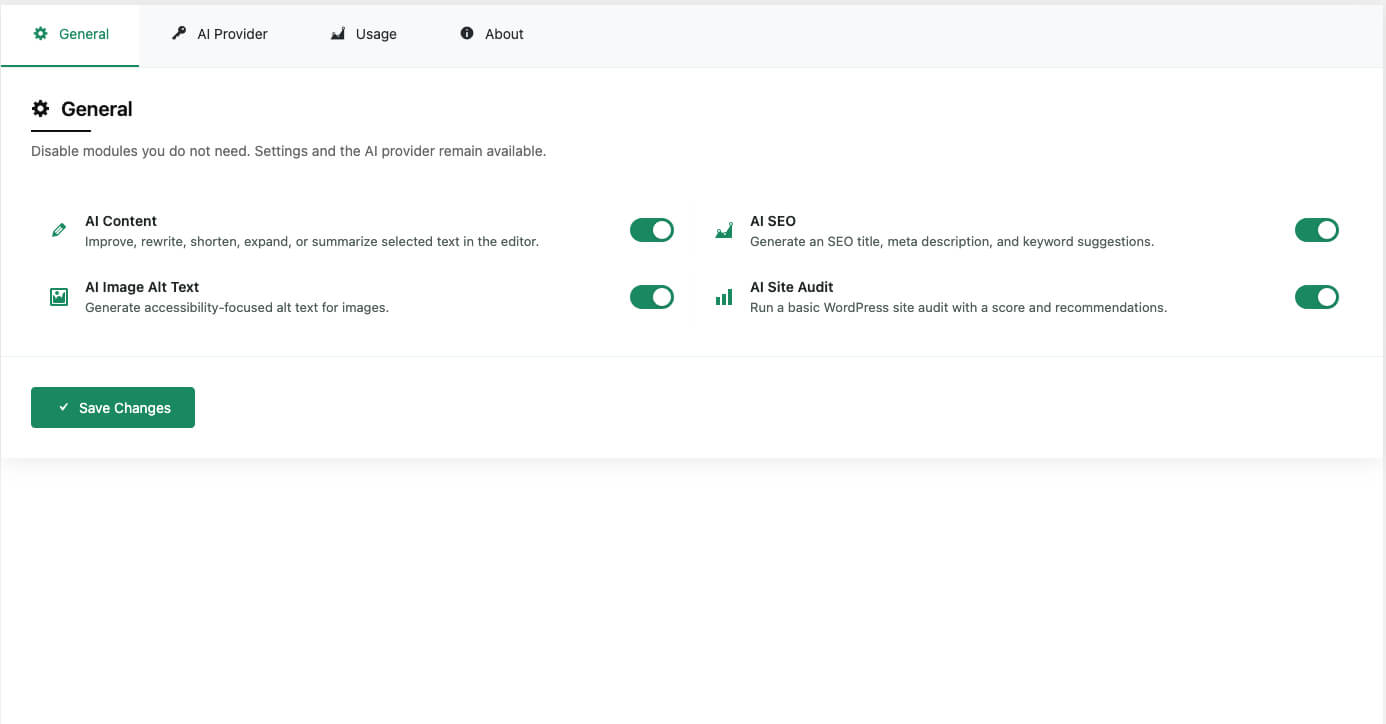
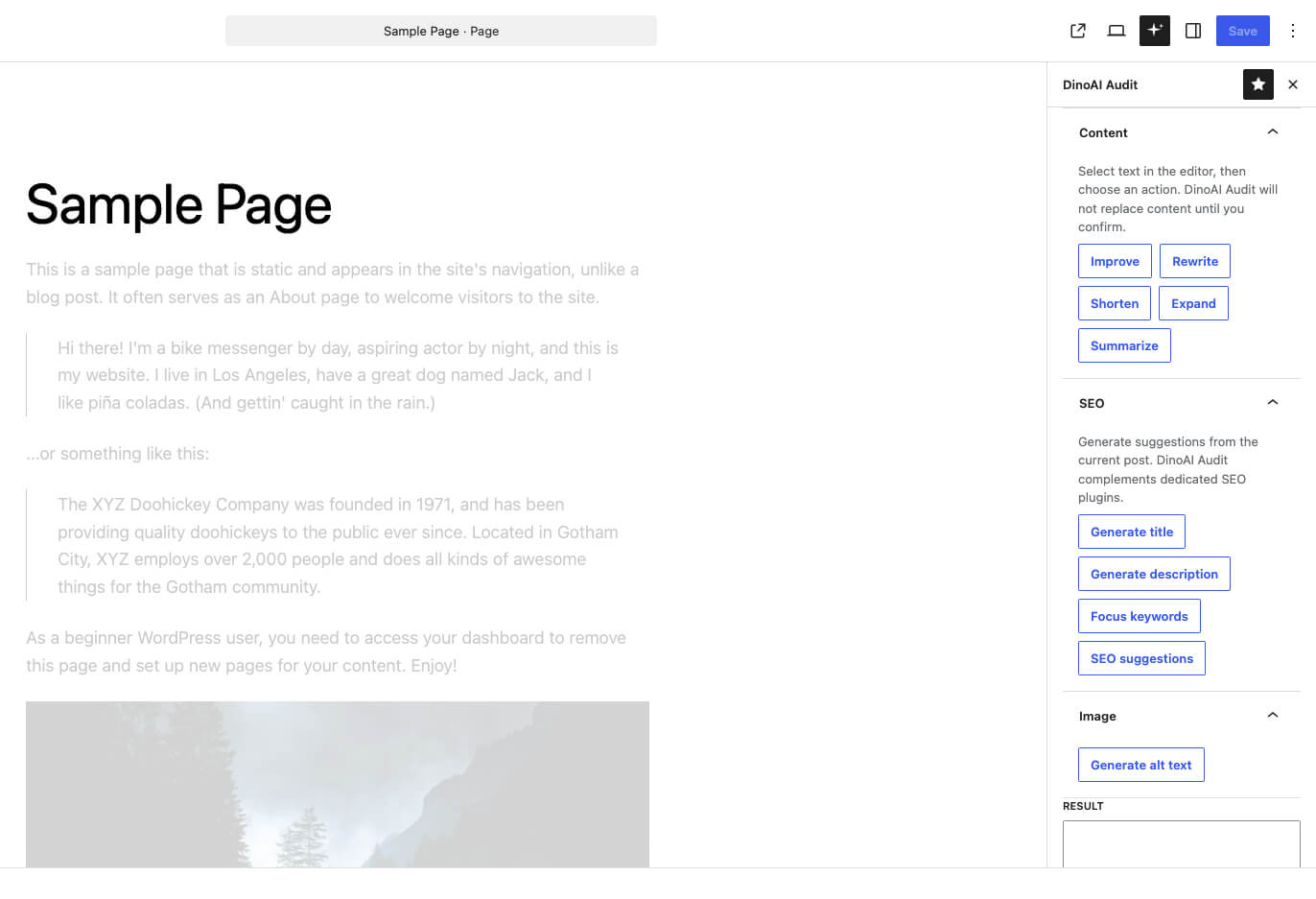
- Improve, rewrite, shorten, expand, or summarize selected content
- Generate an SEO title, meta description, and keyword suggestions
- Generate accessibility-focused image alt text
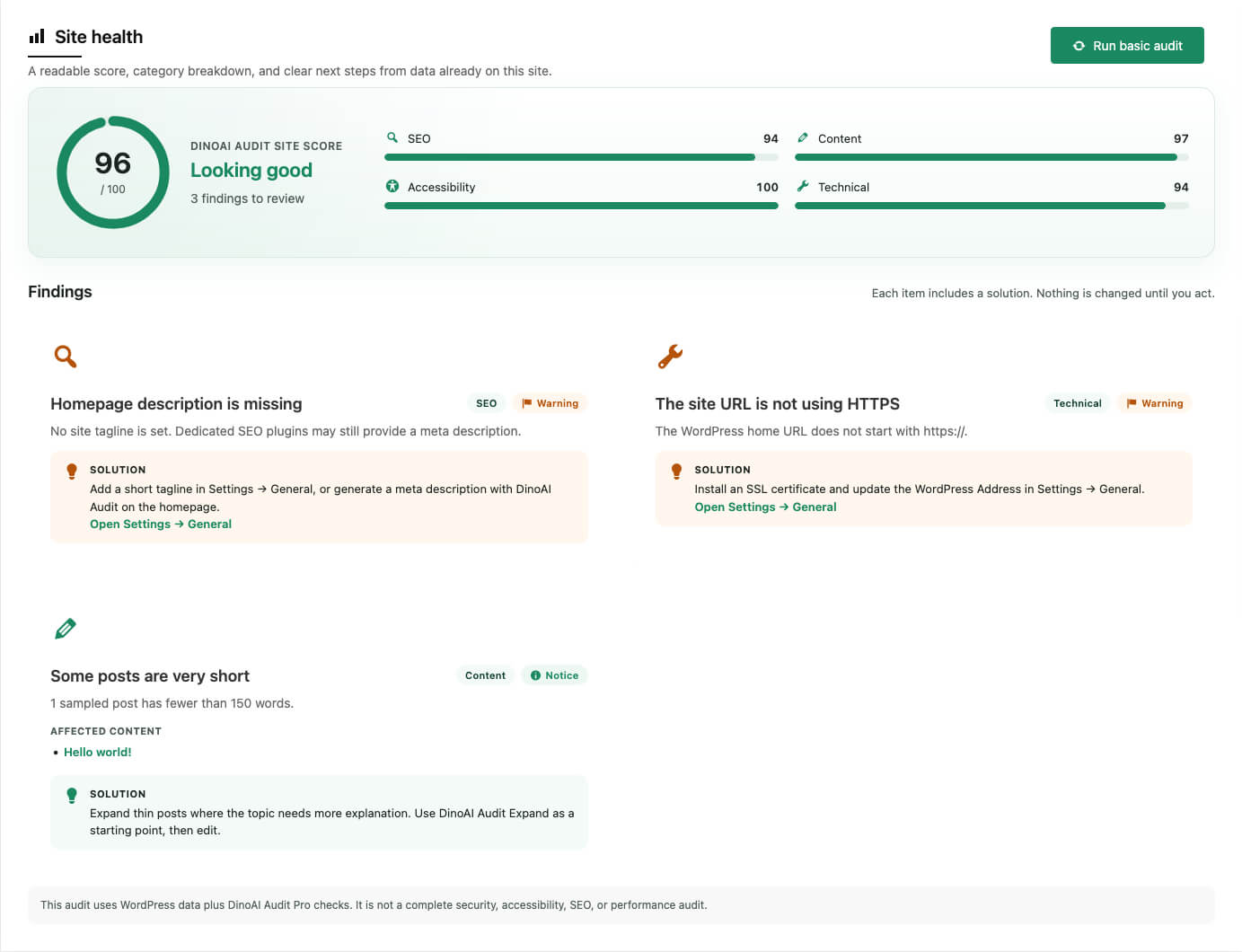
- Run a basic site audit with a simple score and recommendations
How it works
- Connect your own OpenAI API key in DinoAI Audit Settings.
- Test the connection.
- Open a post, select text, and choose a DinoAI Audit action.
- Review the result, then copy, insert, or replace the selection yourself.
DinoAI Audit never replaces content automatically.
This plugin connects to OpenAI only after you save your own API key. See External Services and Privacy Policy below.
What this plugin does not do
The basic audit is not a complete security, accessibility, SEO, or performance scan. DinoAI Audit complements dedicated SEO plugins rather than replacing them.
External Services
This plugin uses the following third-party/external service:
OpenAI API Service
What the service is and what it is used for:
OpenAI provides artificial intelligence services through their API. DinoAI Audit uses the OpenAI Chat Completions API to improve or rewrite selected text, draft SEO titles, meta descriptions, and keyword ideas, generate image alt text, and test that your API key works.
What data is sent and when:
– Selected or pasted text – Only when you run a content action (Improve, Rewrite, Shorten, Expand, or Summarize)
– Post title and post content – Only when you generate an SEO title, meta description, or keyword ideas (plain text, truncated)
– Image data – Only when you generate alt text (image sent as a data URL or image URL, plus optional caption)
– Test prompt – Only when you click Test connection (a short “OK” check)
– API key – Your OpenAI API key (stored in the WordPress database, transmitted only to OpenAI when making API requests)
When data is sent:
Data is only sent when:
1. You have saved an OpenAI API key in DinoAI Audit Settings
2. A logged-in user with the required capability starts an action or clicks Test connection
3. The request is made from the WordPress admin or editor (not from public site visitors)
The basic site audit runs on your WordPress site and does not send post content to OpenAI.
Service provider information:
– Service provided by: OpenAI, L.L.C.
– API Endpoint: https://api.openai.com/v1/chat/completions
– Terms of Use: https://openai.com/policies/terms-of-use
– Privacy Policy: https://openai.com/policies/privacy-policy
– API Documentation: https://platform.openai.com/docs/
– Pricing: https://openai.com/pricing
Important notes:
– This service is only used when you configure an OpenAI API key in the plugin settings
– No data is sent to external services unless you explicitly configure the OpenAI integration
– Content generation must be manually triggered by a logged-in user
– DinoAI Audit never replaces post content automatically
– All data transmission is encrypted using HTTPS
– All data processing is handled by OpenAI according to their terms and privacy policy
– OpenAI may use API data to improve their services (see OpenAI’s privacy policy for details)
– You are responsible for ensuring compliance with OpenAI’s usage policies
– API usage may incur costs based on OpenAI’s pricing (see https://openai.com/pricing)
Privacy Policy
This plugin does not collect, store, or share any personal data by default. All data remains on your website and is not transmitted to external servers unless you configure the OpenAI integration.
Data Transmission:
– OpenAI Integration: When configured, selected text, post title and content used for SEO drafts, or an image used for alt text is sent to OpenAI’s API. A short test prompt is sent when you click Test connection. OpenAI may use this data to improve their services as outlined in their privacy policy.
– Site Audit: The basic audit uses WordPress data on this site only. It does not send post content to OpenAI.
Data Storage:
– API keys are stored in your WordPress database
– Usage counts (request totals, module, model, approximate token usage, and timestamps) are stored on this site
– Full prompts and full AI responses are not stored
– No visitor or analytics data is collected by the plugin
User Control:
– The OpenAI integration is optional and must be explicitly configured
– Actions must be started by a logged-in user with the required capability
– You can disable individual modules in DinoAI Audit Settings
– You can remove the API key at any time
Suggested privacy policy text is also added under Settings Privacy in WordPress.
Details
Related plugins
Plugins that also contain the tag accessibility
Ally – Web Accessibility & Usability

Auto Image Attributes From Filename With Bulk Updater (Add Alt Text, Image Title For Image SEO)

Accessibility by UserWay

WP Dark Mode – Improve Accessibility with AI Powered Dark Theme

AccessibleWP – Accessibility Toolbar

Alt Text AI – Automatically generate image alt text for SEO and accessibility


About
Plugin for that tries to help you find the WordPress plugin you are looking for.
| Please enjoy an image of Crush (this awesome turtle) and have a lovely day! |  |
We do not own any plugin listed on this site and do not work for or work with WordPress.com or it's associated companies. We simply provide a searchable list of the available WordPress plugins.