



DU – Libro de Reclamaciones Perú
Updated in 2026, this plugin is designed with reference to Peru’s complaints-book regulations and Indecopi’s official sheet format. The year refers to the software update; the specific regulatory sources and research limitations are described under Legal scope and in docs/requisitos-pe.txt.
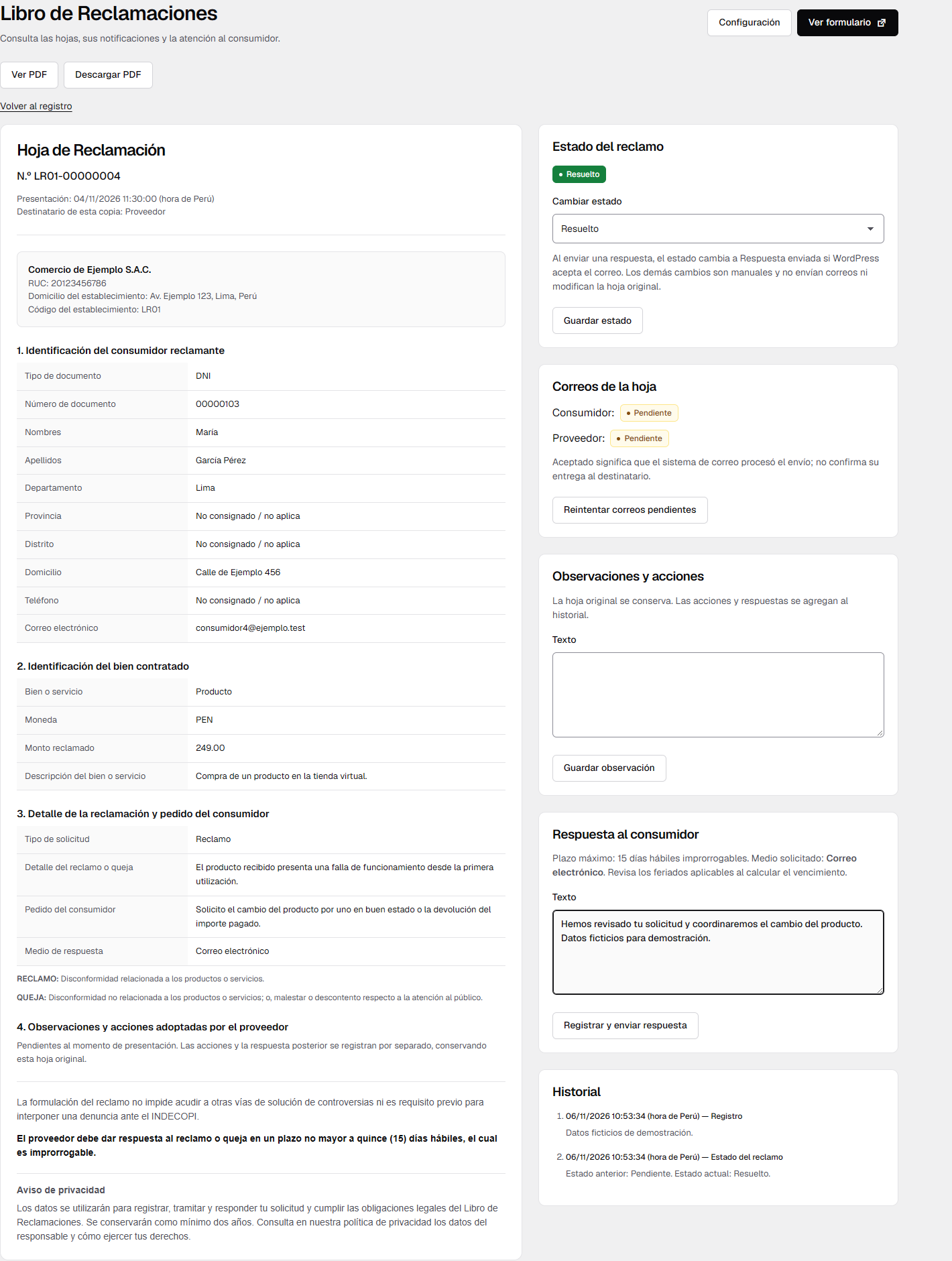
DU – Libro de Reclamaciones Perú provides a virtual complaints book for Peruvian businesses, developed by dudesign (https://dudesign.pe/). It includes notices and definitions from the official complaints-sheet format used by Indecopi (Annex I of DS 101-2022-PCM), numbered sheets, PDF copies and email notifications through WordPress. Consumers can submit a complaint without creating an account. Each saved record receives a sequential number and server-generated date and time displayed in America/Lima.
The form includes consumer identification and contact details, a representative for minors, product or service details, an optional amount and currency, the complaint and the requested solution. New submissions use email for the response, with a visible explanation next to the submission fields and no reply-channel selector. Historical sheets retain their recorded reply channel, including postal replies. Lima, all other Peruvian departments, Callao and an address-abroad option are available. Province and district are optional text fields.
Public selectors use a locally styled dropdown with keyboard navigation. The department field supports search with or without accents. Native select controls remain the non-JavaScript fallback and the server validates the same submitted values. Fields use an inset focus indicator; the administrator page picker opens and closes with a subtle transition that respects reduced-motion preferences.
After saving a record, the plugin sends the full HTML sheet and an attached PDF to the consumer and separately to the configured internal recipients. Both messages use wp_mail() and the site’s existing mail transport. The private receipt page includes PDF view/download actions and browser printing. Administrators can also view and download the PDF from each record.
The private registry displays an internal claim status: Pendiente, En revisión, Respuesta enviada or Resuelto. Sending a written response automatically sets Respuesta enviada only when wp_mail() accepts it; a failed send preserves the previous status. This does not confirm inbox delivery. The other status changes are manual. All transitions append to history without altering the original sheet, email or PDF; changing a status manually does not send notifications. Records without a status change display Pendiente, including historical records; no response or resolution is inferred from prior mail logs.
Administrators can view private records, add observations, record written responses and retry pending sheet notifications. Original sheets preserve the business details as they were at submission; later settings changes do not rewrite them.
The interface is in Spanish and is translation-ready. The public form, plugin administration, email sheets and printable receipts share a restrained monochrome design. Geist is bundled locally under the SIL Open Font License 1.1; mail applications use their available system-font fallback. No paid service, activation key, trial period or usage-based license is required. Business details and mail recipients are configured by each site administrator.
The Spanish notices and definitions of complaint (reclamo) and grievance (queja) reproduce the official Annex I of DS 101-2022-PCM, available at https://spij.minjus.gob.pe/Graficos/Peru/2022/Agosto/16/DS-101-2022-PCM_ANEXO.pdf. The same texts appear in the form, sheets, emails and PDFs. The operator’s configured privacy notice is displayed separately and is not presented as text supplied by Indecopi. Previously delivered files and messages remain unchanged.
Legal scope
This is independent software, not affiliated with, approved by or certified by Indecopi, SUNAT or the Peruvian government. It does not submit complaints to those institutions or provide official identity or tax-status verification.
The form states the general response period of 15 non-extendable business days. The business must determine applicable deadlines, holidays and sector-specific rules, actually respond, retain evidence, maintain availability, provide the required public notice and meet privacy and recordkeeping obligations. See docs/requisitos-pe.txt for the source-backed Spanish implementation notes and research limitations.
Multiple companies and establishments
Create books under Reclamaciones > Configuracion. Each book has its own business identity, RUC, establishment address, unique code, page, privacy notice and mail recipients. Different companies can use different RUCs; different establishments can share the same company and RUC. All WordPress administrators with manage_options can manage all books; this feature does not create separate company user roles.
Use the explicit shortcodes shown in each book’s settings, for example [dudesign_lr_libro_reclamaciones libro=”2″] for its form and [dudesign_lr_libro_aviso libro=”2″] for its notice. These are numeric book IDs, not RUCs. Without an attribute the shortcodes use the book assigned to the current page, or book 1 elsewhere. A page cannot be assigned as the main page of two books. Block content and saved Elementor shortcodes support book selection.
The private registry can filter all books or a single book together with search, request type and dates. The book name appears beneath each sheet code. Email copies, responses and retries use the corresponding book’s mail settings. The original provider snapshot remains unchanged after settings edits.
Details




Related plugins
Plugins that also contain the tag complaints
Conecta-Reclamos

Formulario para Libro de Reclamaciones en Perú

Reclamio

Sell.AI Returns – Zwroty i Reklamacje


About
Plugin for that tries to help you find the WordPress plugin you are looking for.
| Please enjoy an image of Crush (this awesome turtle) and have a lovely day! |  |
We do not own any plugin listed on this site and do not work for or work with WordPress.com or it's associated companies. We simply provide a searchable list of the available WordPress plugins.