



LlamaHire – Job Board & Careers
LlamaHire brings job publishing, a careers page, and application management into WordPress. Use it for one company’s hiring or for a multi-employer job board.
Publish and discover jobs
- Create jobs with departments, physical or remote locations, employment details, salary ranges, deadlines, and organization information.
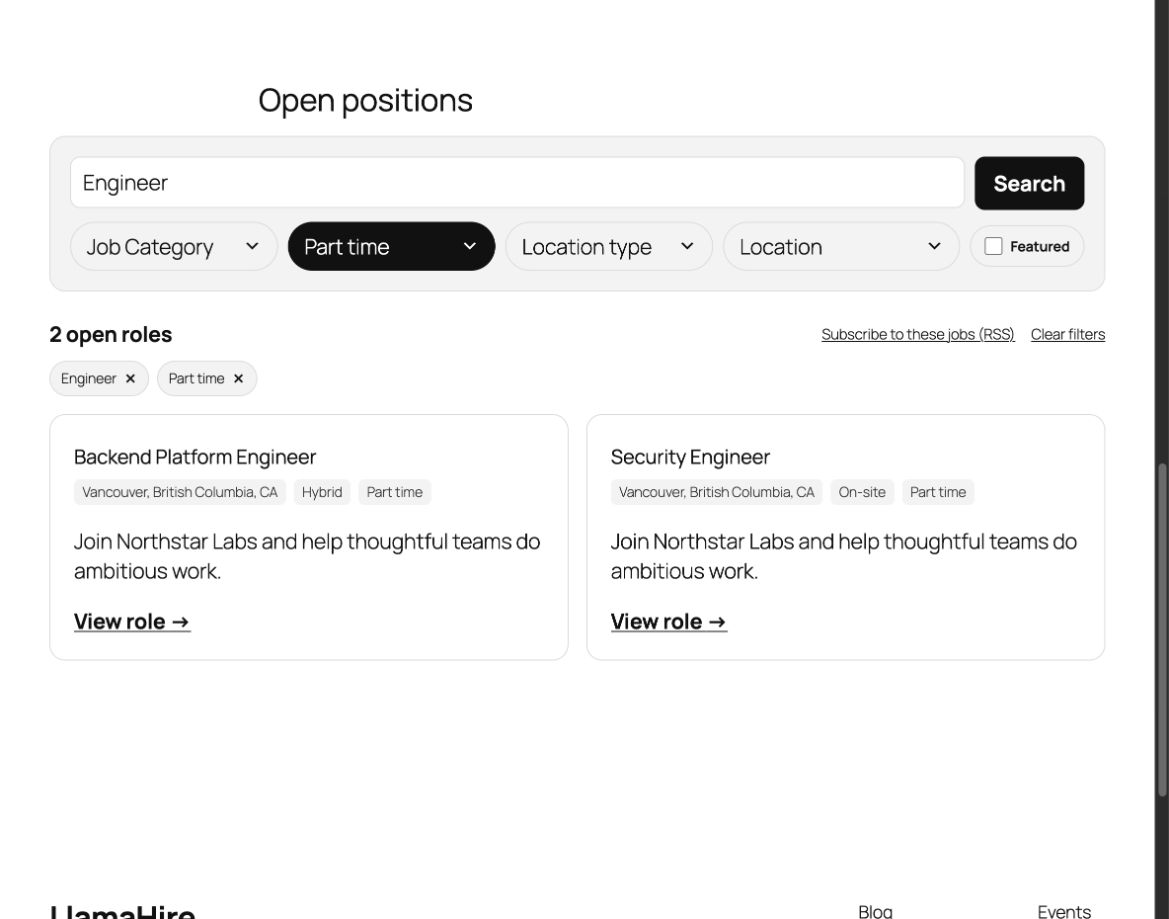
- Build a careers page with WordPress blocks and patterns. Combine the job search, filters, directory, job cards, and featured jobs to fit your theme.
- Let visitors filter and share job results through URLs. Open jobs can appear in the job RSS feed and WordPress XML sitemaps.
- Show job facts and JobPosting structured data from the same saved fields. Closed and expired jobs remain available as historical pages without accepting new applications.
Collect and review applications
- Add an application form to published jobs or place the Application Form block on a page.
- Choose whether phone, resume, and cover letter fields are required, optional, or hidden. Optional Turnstile or reCAPTCHA challenges can be enabled by an administrator.
- Review applications in a searchable, filterable inbox; update statuses, add private notes, and export CSV files. Granular permissions limit who can view candidate data.
- Configure candidate and hiring-team emails, delivery previews, retention, and the privacy notice shown beside application forms. Resumes are stored privately and downloaded through an authorized endpoint.
Run a multi-employer job board
Job-board mode adds email-verified employer registration, optional operator approval, frontend job submission and editing, “My Jobs” and “Employer Account” pages, and an employer workspace for applications to their own jobs. Operators can configure active-listing limits and listing duration. Company careers mode keeps the simpler workflow for one organization.
Source code and support
Source code and build instructions. The bundled admin JavaScript and CSS are built from the unminified src/ files with npm ci and npm run build.
For setup help, use the WordPress.org support forum. To report a bug, open an issue on GitHub.
External services
All external integrations are optional and disabled by default.
Optional usage reporting
With administrator consent in Setup or Settings, LlamaHire sends PostHog a random installation ID, site URL, site mode, LlamaHire, WordPress, and PHP versions, aggregate job counts, active plugin and theme names and versions, locale, and multisite status. Events occur when reporting starts, on reactivation, and in snapshots scheduled every 15 days. No applicant, employer-account, visitor activity, individual job, or page-view data is included. Disable reporting in Settings to stop future events.
Service | Privacy | Reporting details
Google Geocoding API
Adding a Google Geocoding API key enables lookups of saved physical and hybrid job addresses, including draft and pending jobs. Street, locality, region, postal code, and country are sent with the API key to obtain coordinates for JobPosting structured data; fully remote jobs are excluded. Remove the key to stop future lookups.
Cloudflare Turnstile
When configured and enabled for applications or employer registration, forms load Cloudflare’s widget with the form context and send the verification token and secret key for validation; Cloudflare may also receive visitor IP addresses and browser information.
Google reCAPTCHA
When configured and enabled for applications or employer registration, forms load Google’s widget and send the verification token and secret key for validation; Google may also receive visitor IP addresses and browser information.
Details


Related plugins
Plugins that also contain the tag applications
Add To Home Screen

Sewn In Notifications
Trionix Recruitment Manager

IQ Jobs Manager

Post2Hire Job Board & Applications

WeldPress


About
Plugin for that tries to help you find the WordPress plugin you are looking for.
| Please enjoy an image of Crush (this awesome turtle) and have a lovely day! |  |
We do not own any plugin listed on this site and do not work for or work with WordPress.com or it's associated companies. We simply provide a searchable list of the available WordPress plugins.