


Mawsim – Sales Goals & Marketing Calendar for WooCommerce
Every dashboard tells you that you are behind. Few of them tell you what would fix it.
Mawsim sets a sales goal for your store, watches your WooCommerce pace against it, and when you fall short it names the next occasion that could close the gap and the date you would need to start preparing for it.
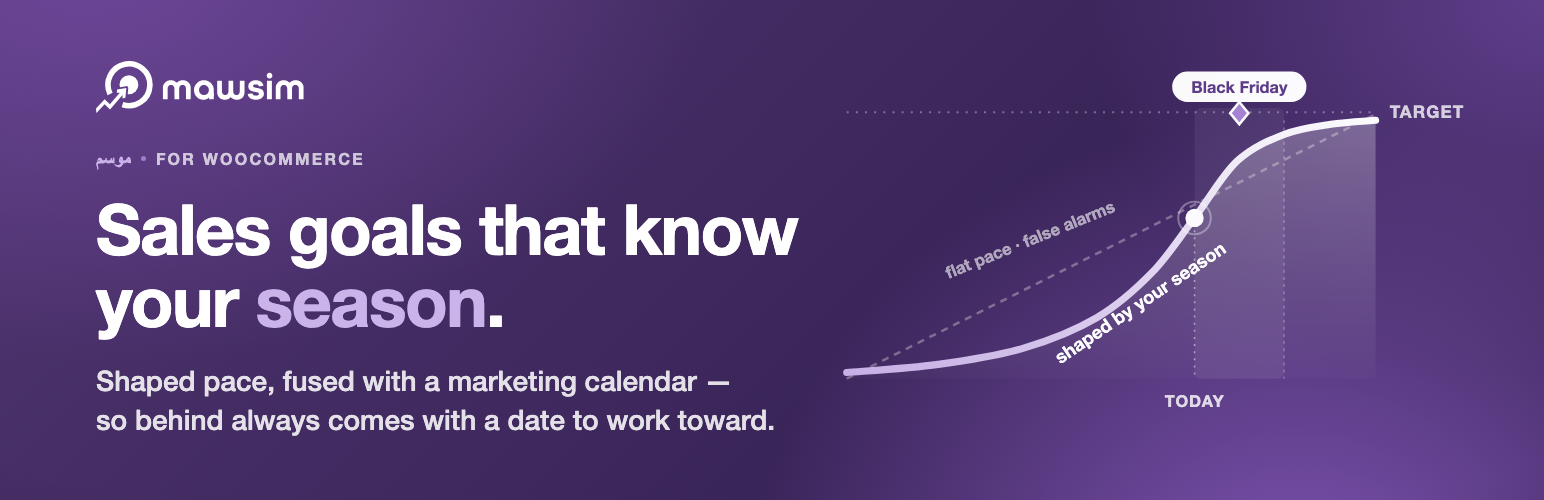
Getting the pace right is what makes that possible. A flat target assumes every day of November earns the same as every other. It does not: the days around Black Friday carry the month. Mawsim reads the shape of your season from your own trading last year, so the quiet weeks stop raising false alarms, and you hear about the window that matters while there is still time to act on it.
What you get
- Goals that tell you what to do, not just where you stand. When a goal needs attention, the card says what closing the gap takes: a daily rate, pointed at the next occasion that can deliver it, and its lead time.
- Shaped pace with a named source. Your own last year, when your store has one. A flat line as the honest floor when it does not. The label always names which shape is running.
- A marketing calendar of the commercial occasions for your country, sorted by how soon they start, with a prep line that turns amber as the lead time runs out.
- Occasion detail, and history that builds itself. What this window did for your store last year, a suggested play computed from your own coupon history, and a snapshot of every window as it closes. Next year, “last Black Friday” is a measured number rather than a guess.
- A forecast on every goal, drawn against the target so the gap is visible before it closes.
- An Analytics Overview widget and a Dashboard goal tracker, each showing a goal against its pace marker. Clone the tracker once per goal you want to watch.
- A monthly digest and occasion prep emails. Strictly opt-in, sent by your own store to your admin address, with one-click unsubscribe.
Your figures are WooCommerce’s figures
Revenue and orders are read through WooCommerce Analytics’ own reporting layer, never recomputed beside it. That includes your date-type setting (order date vs paid date) and your excluded order statuses. Change those on Analytics > Settings and Mawsim follows. Two screens that disagree about revenue cost you trust in both.
What stays on your store, and what is sent
Your goals, results, occasion history and shaped-pace curves live in your own database and run without a network. To fetch and refresh the occasion calendar, Mawsim registers your store with its service and sends your site address, admin email, store country, store title and store industry (see External services). Your orders, customers and revenue never leave your site. A store with no network keeps everything except calendar updates.
Multisite
Both activation styles work, and each site keeps its own goals, calendar and history: on a network, Mawsim is one independent store per site. Network activation installs Mawsim on every site and on any site created afterwards. Very large networks are installed one site at a time, on first dashboard view. Deactivating network-wide clears the scheduled tasks and deletes nothing.
External services
Mawsim fetches its occasion calendar from Mawsim’s service at https://api.mawsim.store. This is required for the calendar: the plugin registers your store and receives the calendar in one request, refreshed automatically by a scheduled background task (never during a page load).
Nothing is sent until you turn this on, and you decide on step 1 of setup. That step carries a checkbox, “Get occasions and updates from the Mawsim service”, which arrives ticked, with the list of what would be sent shown above it. Untick it before pressing Continue and nothing leaves your store. Pressing “Skip setup”, or never opening setup at all, also sends nothing. Turning it off later in Settings > Your marketing calendar stops every request from then on.
What is sent on each request: your site address, admin email, store country, store title and store industry. Nothing about your orders, customers or revenue is ever sent. Requests carry the plugin name and version as their User-Agent and no other identifier. The base URL can be overridden with the MAWSIM_API_BASE constant or the mawsim_api_base filter.
The service returns a registration token together with the calendar data. The token is stored on your site, never shown in your browser, and sent back to the service on later requests so it knows the refresh is for your store. If another WordPress installation is already registered to your site address, the service says so and Mawsim keeps working with the calendar it already has. It simply stops receiving updates until that address is released.
Removing your registration
Settings > Your marketing calendar carries a “Disconnect from the calendar service” button, shown whenever calendar updates are on or your store holds a registration. It stops the daily requests and asks the service to delete what it holds: your site address, admin email, store country, store title and store industry. The disconnect happens on your site first, so it takes effect even if the service cannot be reached at the time. If it could not be reached, the screen says so, and support can confirm the deletion for you. If your store had never registered, the screen says that instead. There is nothing there to delete. Your goals, results and occasion history stay in your own database, and so does the calendar you already have. It simply stops updating.
Uninstalling without disconnecting first leaves the service’s copy in place until its retention window expires.
Terms, privacy and support
By using the plugin you send the data above to this service. How it is handled is set out in:
Goals, shaped pace and WooCommerce Analytics figures are computed on your own store and are not sent anywhere. Emails are sent by your own site through wp_mail().
Details


Related plugins
Plugins that also contain the tag analytics
Site Kit by Google – Analytics, Search Console, AdSense, Speed

MonsterInsights – Google Analytics Dashboard for WordPress (Website Stats Made Easy)

WP Statistics – Simple, privacy-friendly Google Analytics alternative

GA Google Analytics – Connect Google Analytics to WordPress

Head, Footer and Post Injections

ExactMetrics – Google Analytics Dashboard for WordPress (Website Stats Plugin)


About
Plugin for that tries to help you find the WordPress plugin you are looking for.
| Please enjoy an image of Crush (this awesome turtle) and have a lovely day! |  |
We do not own any plugin listed on this site and do not work for or work with WordPress.com or it's associated companies. We simply provide a searchable list of the available WordPress plugins.