

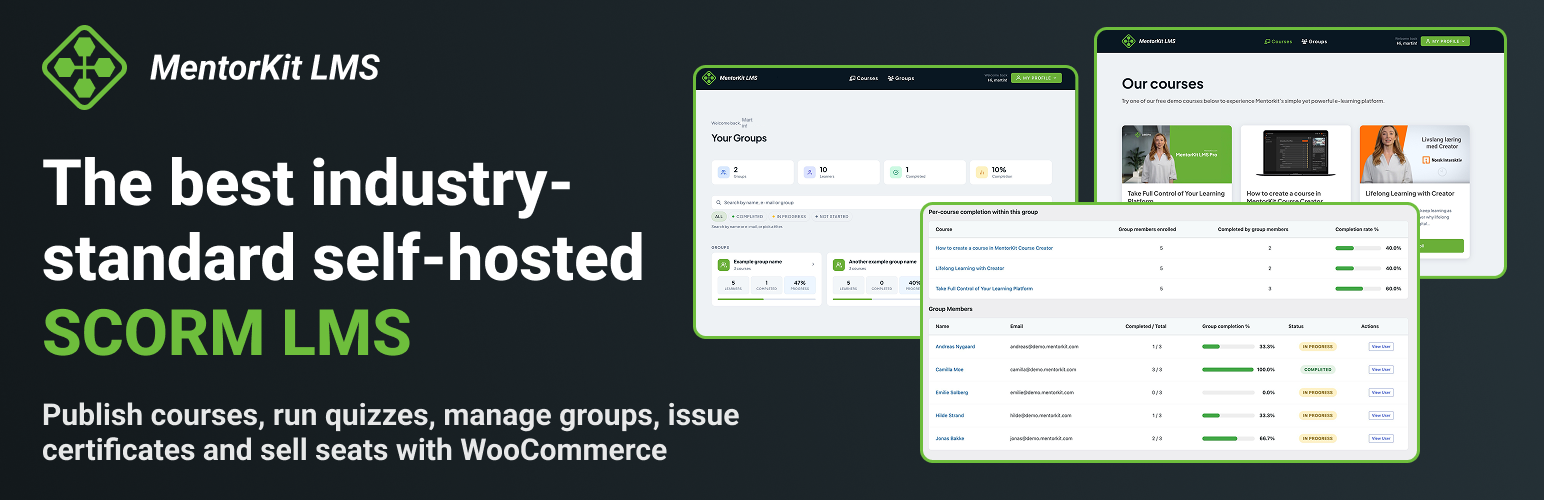

MentorKit LMS: SCORM, Quizzes, Groups & Certificates
Publish SCORM courses from MentorKit Course Creator, enrol learners, track progress, run quizzes and issue certificates. Build learning paths for onboarding, HSE and safety courses, compliance refreshers, and customer or partner training.
Self-hosted, with no plugin commission
Host content and learner records on your WordPress site with no plugin sales commission. Hosting, Creator and payment-provider terms apply separately. See External Services for data sharing.
Explore the LMS demo | Try MentorKit Course Creator for free.
Publish and play SCORM courses
- SCORM 1.2 and SCORM 2004 runtime support, with background package imports.
- Progress, completion and runtime data stored per learner and course.
- Resume, retakes and optional locking after a learner passes.
- Player embedding through shortcodes and a Gutenberg block.
Publish from Course Creator. Manual ZIP uploads require the separate MentorKit LMS Pro add-on.
Quizzes and question banks
- Standalone or course-linked quizzes and reusable questions.
- Yes/no, single-choice, multiple-choice and manually graded free-text questions.
- Overall and critical-question pass thresholds, attempt and time limits.
- Random exam draws with mandatory questions and hidden answer keys.
- Required assessments for certificates; attempt and question reports.
Certificates
- Canvas designer with text, images, shapes, backgrounds and paper settings.
- Learner, course, group, date and certificate-number fields, with PDF export.
- Automatic issuance, expiry reminders, revocation and learner certificate views.
Groups and learning paths
- Course and quiz bundles or sections, with optional sequential progression.
- Group progress, certificates, enrolments and scoped administration tools.
- Access modes, seat limits, email-domain restrictions and access dates.
Automatic buyer subgroups and the frontend group-leader dashboard require Pro.
Sell courses with WooCommerce
With WooCommerce, sell courses or groups and grant access by order status. Cancelled, refunded or failed orders revoke access.
Includes offline-payment settings, invoice-recipient fields, printable invoices with Norwegian KID references and a learner purchase view. Your WooCommerce gateways process payments.
Learners, reporting and branding
- Immediate or scheduled invitations with status tracking. New invitees have dormant accounts until activation. Scheduling uses WordPress cron.
- Audited, reversible manual completions and CSV reporting.
- Branded login, registration and learner screens, with optional Astra styling.
- Email verification, translated emails, Norwegian translations and Polylang support.
- Authentication rate limits and optional Cloudflare Turnstile.
- Signed webhooks with delivery retries.
Shortcodes and blocks
[mklms_courses_grid], `[mklms_groups_grid]`, `[mklms_my_courses]`, `[mklms_my_profile]`, `[mklms_user_certificates]`, `[mklms_player id="123"]`, `[mklms_course_launcher]`, `[mklms_quiz]`, `[mklms_analytics]`, `[mklms_user_menu]`, `[mklms_logged_in_only]`, `[mklms_guest_only]`.
Set course or quiz IDs where required. The course launcher requires WooCommerce.
External Services
MentorKit Course Creator and MentorKit.com
MentorKit / Norsk Interaktiv AS provides publishing and setup services. Setup links open account/integration pages with the platform, requested tab and wizard return URL.
On publication or update, the plugin downloads a SCORM ZIP and optional cover from supplied URLs, possibly containing access tokens. It reports the import to Creator or the supplied callback URL with LMS customer ID, Creator course/customer-course IDs, WordPress course ID/URL, status, action date and token. Demo imports download packages and images from MentorKit.com.
Freemius Insights
Freemius, Inc. provides optional lifecycle analytics at freemius.com, requiring administrator opt-in from wp-admin. This version prompts fresh installations only. Administrators can opt out later.
After opt-in, SDK synchronisation and activation/deactivation/uninstall requests may send site URL/title/language, plugin/WordPress/PHP versions, administrator name/email, lifecycle events and voluntary deactivation feedback to assess compatibility and usage. These data are not anonymous. Freemius does not handle licensing, payments, paid plans, support or updates here.
Sentry error reporting
Functional Software, Inc. dba Sentry provides error reporting at ingest.de.sentry.io. It is off until administrator opt-in through Setup or MentorKit LMS > Settings > Privacy, where consent can be withdrawn. While off, errors stay in local logs.
After opt-in, plugin errors/monitored failures may send versions, environment, release, site host, stack traces, paths, routes/actions, messages and context. Callback failures may include URL, HTTP status, truncated response, LMS customer ID and Creator course ID. Default personal-data collection is off, but diagnostic text may contain site-entered data.
Unrelated error/performance events are filtered. Local installs are skipped, except for a best-effort report if a live site is detected as misconfigured as local, still subject to consent.
Google Fonts
Google LLC serves certificate fonts through fonts.googleapis.com and fonts.gstatic.com. Editing, viewing, previewing, printing or downloading certificates using these fonts may load stylesheets/font files. Browser requests include font family, IP address, user agent and referrer. This applies to administrators and learners.
Cloudflare Turnstile
Cloudflare, Inc. protects plugin login, registration, lost-password and password-reset forms. It is off until enabled with valid keys.
Protected forms load Cloudflare’s script from challenges.cloudflare.com, exposing normal browser request information. Submissions send the response token, secret key, optional visitor IP and idempotency key to its Siteverify API. An administrator-triggered health check sends a dummy token to verify the configured key.
Gravatar
The admin Invited Users tab uses WordPress avatars. If avatar display is enabled and no local provider replaces Gravatar, the browser requests images from Automattic’s secure.gravatar.com. Requests include an email hash, image size, default/rating settings, possibly name-derived initials, and browser information such as IP address, user agent and referrer. The plain email address is not sent. Disable avatars under Settings > Discussion or use a local avatar provider.
The learner profile uses initials by default. Its custom-avatar filter accepts only URLs on the site’s own origin or root-relative URLs.
Admin-configured webhooks
No webhook destination is contacted by default. After an administrator configures an endpoint and events, selected events or manual tests send data to that URL, including retries. The destination provider’s terms and privacy policy apply.
Requests contain event ID/type/version/time, site URL/name, and event-specific data. This may include user IDs, names and email addresses; course/group/certificate IDs, titles and URLs; tracking status, previous status, scores and attempts; selected course IDs; enrolment source/context; certificate data and test text. Headers include delivery ID, timestamp, event type and an HMAC signature. Local delivery logs retain status, HTTP code, truncated response, errors, attempts and timestamps.
Details


Related plugins
Plugins that also contain the tag certificates
Sensei LMS Certificates

Academy Certificates – Certificate Builder for Academy LMS

Accredible LearnDash Add-on

My Certificates Wall

EntryFoundry – PDF Builder for Formidable Forms

Sigilet


About
Plugin for that tries to help you find the WordPress plugin you are looking for.
| Please enjoy an image of Crush (this awesome turtle) and have a lovely day! |  |
We do not own any plugin listed on this site and do not work for or work with WordPress.com or it's associated companies. We simply provide a searchable list of the available WordPress plugins.