



Merchlint – Product Image Size Checker for Google Merchant Center
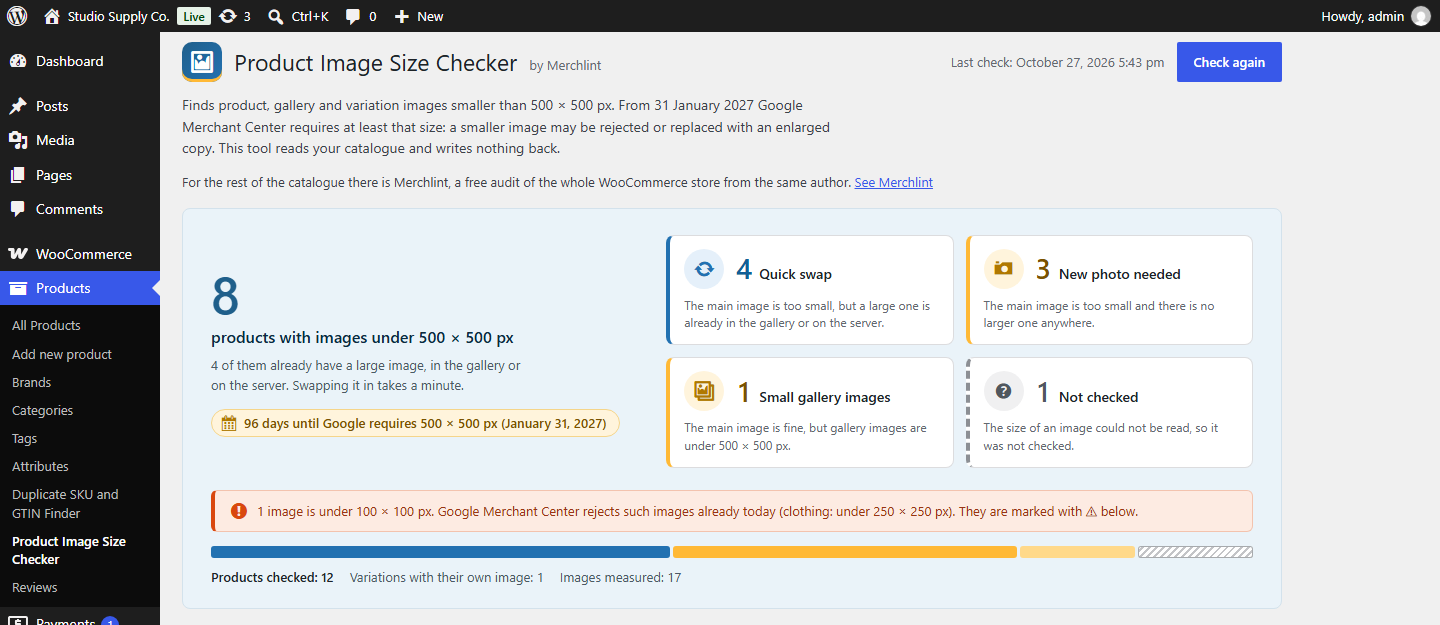
From 31 January 2027 Google Merchant Center requires product images of at least
500 × 500 pixels, for the main image (image_link) and for the additional images
(additional_image_link).
Merchant Center already shows the warning “Image too small for upcoming enforcement” on offers
whose images are smaller. Google may reject such an image or replace it with an enlarged copy.
A shop that has been adding products for years can have hundreds of such images and no way to see
them: WordPress shows every picture as a neat thumbnail. This plugin measures every image that goes
to Google and tells you which products need attention, and how much work each one is.
What it checks
- The main image of every published product and the own image of every variation.
- Gallery images, up to 10 per product — Google takes up to 10 additional images.
- A product with no main image: the first gallery image, because that is the one Google for
WooCommerce sends as the main image.
The size is read from the image file itself, the full-size file that feeds send to Google.
A verdict for every product
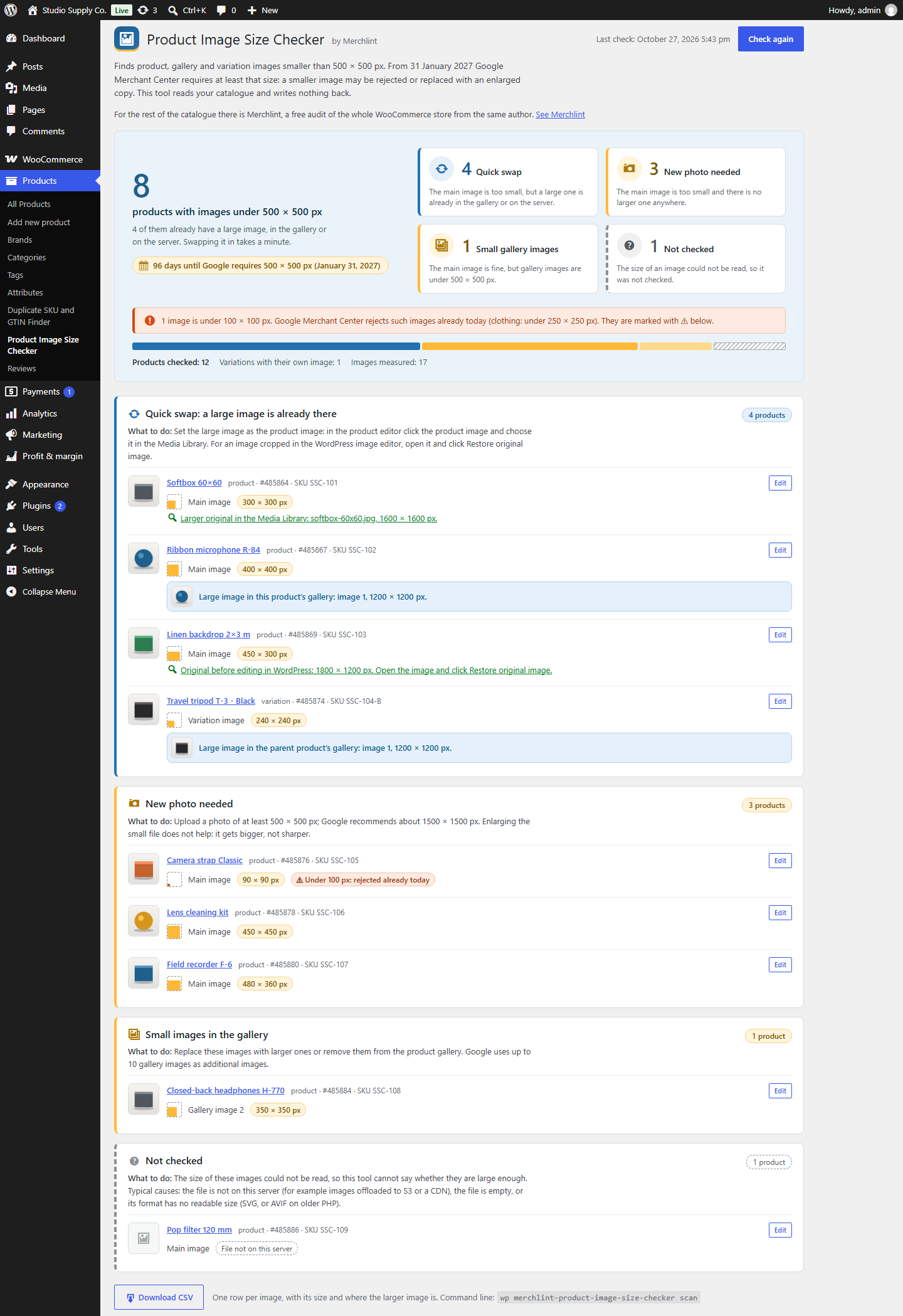
- Quick swap — the main image is too small, but a large one is already there: in the product
gallery or on the server. - New photo needed — the main image is too small and there is no larger one anywhere.
- Small gallery images — the main image is fine, but some gallery images are under 500 × 500 px.
- Not checked — the size of an image could not be read, so the plugin does not guess.
Images under 100 × 100 px are marked separately: Google Merchant Center rejects those already today
(clothing: under 250 × 250 px).
Larger originals already on the server
Very often a small product image is a thumbnail — a file whose name ends in -300x300 — that was
uploaded or imported as an image of its own, while the full picture is still there. The plugin
looks for:
- the full image with the same name in the Media Library;
- the full image as a file in the same folder, outside the Media Library;
- an image cropped in the WordPress image editor, whose untouched original WordPress keeps
(“Restore original image”).
Where you see the result
- One screen under Tools: the number of products to fix, the days left until 31 January 2027,
and a card for each verdict with thumbnails, sizes, where the large image is, and a link to edit
the product. - A CSV file with one row per image: product, SKU, size, verdict and where the larger image is.
Semicolon separated, opens in Excel and Google Sheets. - WP-CLI:
wp merchlint-product-image-size-checker scan, with--export=file.csvfor the full
list.
What it does not do
It never changes your products or images. It does not enlarge images and does not add frames:
an enlarged small picture gets bigger, not sharper. Every finding shows the size that was read, so
you can check the claim before you act on it.
The check runs in a single request, so on a very large catalogue it can run into your host’s time
limit — the screen says so when that becomes likely, and the WP-CLI command has no such limit.
A small part of Merchlint
This plugin comes from the author of Merchlint, a free
audit of the whole WooCommerce catalogue: products that sold in the past year and can no longer be
bought, products with no price or no photo, duplicate SKUs, sale prices that should have ended and
images with no alt text, each with the money at stake. This plugin carries its own copy of the
scanning engine with its own class names, so both can run side by side.
Details


About
Plugin for that tries to help you find the WordPress plugin you are looking for.
| Please enjoy an image of Crush (this awesome turtle) and have a lovely day! |  |
We do not own any plugin listed on this site and do not work for or work with WordPress.com or it's associated companies. We simply provide a searchable list of the available WordPress plugins.