

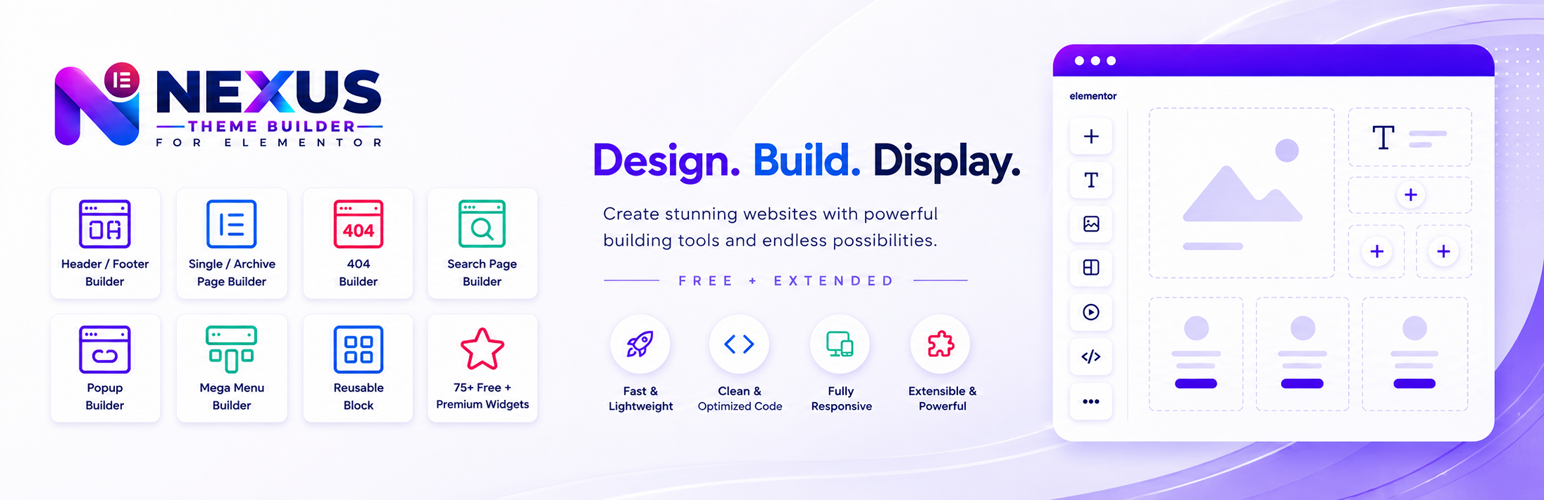

Nexus Theme Builder for Elementor
Nexus Theme Builder for Elementor lets you build Elementor headers, footers, single templates, archives, search results, 404 pages, and reusable blocks with display conditions. Elementor is required; Elementor Pro is not required for the Free Theme Builder features.
The free plugin also includes a focused Elementor widget library and a dashboard where individual widgets can be enabled or disabled. WooCommerce-dependent widgets are registered only when WooCommerce is active.
An optional Pro extension is distributed separately and is not bundled or artificially locked inside this free WordPress.org package.
Free Theme Builder
The Free Theme Builder lets you design site templates with Elementor and control where each published template is used. Templates are created and managed from the Nexus Builder area in the WordPress admin.
Free template types
The Free edition supports the following template types:
- Header — build a custom Elementor header and assign it to the entire site or selected locations.
- Footer — build a custom Elementor footer and assign it globally or conditionally.
- Single content templates — create Elementor layouts for posts and supported public custom post types.
- Archive — design archive layouts for supported WordPress archive contexts.
- Search Results Page — create an Elementor template for WordPress search-result pages.
- 404 Page — replace the normal theme 404 output with an Elementor-designed template.
- Custom Block — build reusable Elementor content that can be inserted where supported, including through the Nexus template shortcode.
The Theme Builder works with supported public post types and public taxonomies when they meet the plugin’s targetable-content requirements. This allows compatible third-party content types to participate without hard-coding every post type into the plugin.
Display conditions and template assignment
Every supported Theme Builder template can use assignment rules so a design appears only where it is intended.
Display Location
Display Location defines where a template is eligible to appear. Depending on the template type and available WordPress content, locations can include:
- Entire site.
- Singular content.
- Posts and supported public post types.
- Specific pages, posts, or supported custom content.
- Front page.
- Posts page.
- Archives.
- Author archives.
- Date archives.
- Public taxonomy archives and supported taxonomy terms.
- Search results.
- 404 context.
Exclude Location
Exclude Location creates exceptions to a broader Display Location rule. For example, a Header can target the entire site and exclude one landing page, or a Single template can target a post type while excluding selected content.
When a matching exclusion rule exists, the exclusion takes precedence over the matching display rule.
User Roles
Templates can also be restricted according to the current visitor. Supported choices include:
- All users.
- Logged-in users.
- Logged-out visitors.
- Individual WordPress roles available on the site.
This is useful for role-aware headers, account experiences, member areas, or layouts that should differ for signed-in and signed-out visitors.
Priority
Priority resolves situations where more than one published template matches the same visitor and location. When multiple eligible templates match, the template with the lowest Priority number wins.
This makes it possible to create a broad site-wide template and then create more specific templates that intentionally take precedence.
Custom Blocks and template shortcode
Published Nexus templates can be rendered through the template shortcode where shortcode output is appropriate:
[netb_template id="123"]
Replace 123 with the WordPress post ID of the published Nexus template you want to display.
Custom Blocks are useful for reusable sections, calls to action, information panels, promotional sections, or other Elementor-built content that should be maintained in one place and reused elsewhere.
Widget management
The Nexus Builder > Dashboard provides widget management for the Nexus widget library.
Free widgets can be enabled or disabled from the dashboard. A disabled widget is not registered with Elementor, helping site administrators keep the Elementor widget panel focused on the components they actually use.
Widget frontend assets are loaded according to the plugin’s widget/dependency logic rather than treating every optional feature as permanently active. WooCommerce-dependent widgets are registered only when WooCommerce is available.
Free Elementor widgets
The Free edition includes the following Elementor widgets.
1. Site Logo
Dynamically display your WordPress site logo anywhere.
2. Page Title
Display context-aware page and content titles dynamically.
3. Site Tagline
Dynamically display your configured WordPress site tagline.
4. Site Title
Dynamically display your WordPress site title.
5. Post Meta Info
Display contextual post metadata in Elementor layouts.
6. Breadcrumbs
Display contextual breadcrumb navigation for easier site exploration.
7. Copyright
Add customizable copyright information to footer layouts.
8. Reading Time Count
Display estimated reading time for posts and articles.
9. Search
Create customizable search with optional live results.
10. Counter
Display animated manual or dynamic numerical counters.
11. Info Card
Create attractive information, feature, and call-to-action cards.
12. Social Share
Add customizable social sharing buttons to your content.
13. Static/Dynamic Table
Create manual or dynamic data tables in Elementor.
14. Interactive Card
Create engaging interactive cards with visual effects.
15. Animated Heading
Create engaging headings with customizable animated text.
16. Logo Grid
Showcase logos in clean, responsive grid layouts.
17. Animated Link
Create stylish links with customizable hover animations.
18. Navbar
Build responsive navigation with branding, search, and actions.
19. Advanced Progress Bar
Display customizable progress bars with labels and values.
20. Post Grid
Display WordPress content in customizable responsive grids.
21. WooCommerce Categories
Display WooCommerce product categories in customizable layouts.
OPTIONAL EXTENDED / PRO EDITION
Nexus Theme Builder for Elementor Pro is a separate extension. It requires the Free plugin and extends the existing Nexus Builder architecture rather than replacing it.
The following information is provided so users can clearly understand what belongs to the optional extension. These Pro widgets and features are not included as locked executable functionality inside the Free WordPress.org package.
Pro Theme Builder extension
Mega Menu template type
When the Pro extension is active and its Mega Menu functionality is available, Pro registers the dedicated Mega Menu Theme Builder template type. This allows Elementor-built Mega Menu content to be maintained as a Nexus template and used by the Pro Mega Menu system without exposing a disabled premium template type in the Free edition.
Popup Builder template type
The Pro extension registers a dedicated Popup Builder template type. Popup layouts are designed with Elementor and reuse the existing Display Location, Exclude Location, and User Role assignment system. Pro adds page-load, delay, and exit-intent triggers together with visit-frequency controls for every visit, first visit, after a configured number of visits, or once per session.
Pro Elementor widgets
1. Advanced Button
Create customizable buttons with icons, badges, and effects.
2. Advanced Heading
Create advanced headings with highlights, decorations, and effects.
3. Advanced Icon Box
Create feature boxes with icons, images, and actions.
4. Advanced Image Gallery
Build customizable image galleries with advanced layouts and controls.
5. Cart
Display and customize WooCommerce cart information anywhere.
6. Charts
Visualize structured data using customizable chart layouts.
7. Comparison List
Create clear feature, service, or pricing comparisons.
8. Countdown Timer
Create customizable countdown timers for events and promotions.
9. Dynamic Content
Display dynamic WordPress content using flexible layouts.
10. FAQ
Create organized, interactive FAQ sections with flexible content.
11. Logo Carousel
Showcase logos using customizable responsive carousel layouts.
12. Mega Menu
Build advanced responsive menus with rich content support.
13. Offcanvas
Create flexible slide-in panels with dynamic content sources.
14. Post Gallery
Showcase WordPress content in image-focused gallery layouts.
15. Post List
Display WordPress content in flexible customizable lists.
16. Post / Custom Timeline
Display posts or custom content in chronological timelines.
17. Price Table
Create attractive pricing plans with features and actions.
18. Scrollnav
Create smooth section navigation for long Elementor pages.
19. Tabs
Organize manual or dynamic content into interactive tabs.
20. Testimonial
Showcase customer testimonials with ratings and reviewer details.
21. Vertical Menu
Build customizable vertical navigation with submenu support.
22. Video Player
Display customizable videos with flexible playback controls.
23. WooCommerce Products
Display WooCommerce products in flexible grids or carousels.
24. Changelog
Present product or project updates in structured layouts.
25. Image Masking
Create creative image presentations using customizable masking effects.
26. Custom Carousel
Create flexible carousels for custom slide-based content.
Pro WooCommerce Theme Builder widgets
When WooCommerce is active, Pro adds dedicated WooCommerce Single and Archive widget groups for Elementor-based product and shop/archive templates.
The WooCommerce Single group includes Breadcrumbs, Sale Badge, Product Title, Product Gallery, Product Price, Product Rating, Short Description, Add To Cart, Stock, Product Meta, Product Tabs, Description, Additional Information, Reviews, Upsells, Related Products, and Product Navigation.
The WooCommerce Archive group includes Breadcrumbs, Archive Title, Archive Description, Archive Products, Archive Categories, and Archive Filters. These work alongside the Pro Cart and WooCommerce Products widgets.
Pro extended Elementor features
In addition to Pro widgets, the extension adds supported Elementor-level visual features.
Background Image Parallax
Add smooth scroll-based motion to Elementor background images.
Animated Gradient Background
Create animated gradient backgrounds for Elementor elements.
Scroll Driven Motion
Add scroll-responsive motion and visual effects to elements.
Dynamic Text Highlight
Highlight selected text using creative customizable visual effects.
Free versus Pro summary
Free provides:
- Theme Builder core.
- Header and Footer templates.
- Single-content templates.
- Archive templates.
- Search Results templates.
- 404 templates.
- Custom Blocks.
- Display Location rules.
- Exclude Location rules.
- User-role/login-state targeting.
- Template Priority.
- Template shortcode reuse.
- Widget enable/disable management.
- 21 Free Elementor widgets.
- WooCommerce Categories widget when WooCommerce is active.
Optional Pro adds:
- Mega Menu Theme Builder template type and Mega Menu integration.
- Popup Builder template type with Elementor-designed content, assignment rules, triggers, and visit-frequency controls.
- Additional Pro Elementor widget library.
- Advanced dynamic-content displays.
- Advanced navigation widgets.
- Additional post/list/gallery/timeline displays.
- Pricing, comparison, FAQ, testimonial, chart and countdown widgets.
- Advanced image, heading, icon-box, button, tab, video and carousel widgets.
- WooCommerce Cart and Products widgets plus dedicated Single Product and Archive Theme Builder widget groups.
- Background Image Parallax.
- Animated Gradient Background.
- Scroll Driven Motion.
- Dynamic Text Highlight controls available in every Elementor widget Content tab.
Getting started with Nexus Builder
A typical workflow is:
- Decide what part of the site you want to design, such as a Header or Footer.
- Create the corresponding Nexus template.
- Assign a Display Location, for example Entire Site.
- Add exclusions if certain pages should retain another template.
- Choose User Roles only when visitor-based targeting is required.
- Use Priority to control which template wins when rules overlap.
- Open the template in Elementor.
- Add normal Elementor widgets and/or Nexus widgets.
- Publish the template.
- Test the relevant pages on desktop, tablet, and mobile.
For reusable content rather than a site-level Header/Footer/Single/Archive assignment, create a Custom Block and use it where supported, including with the [netb_template id="..."] shortcode.
External services
The Social Share widget can open third-party sharing services only after a visitor explicitly clicks the corresponding share button. The plugin does not contact these services on page load. Depending on the selected network, the service receives the current page URL and, where applicable, the page title or optional share text so it can compose the share.
- Facebook — receives the page URL when the Facebook share action is clicked. Terms: https://www.facebook.com/legal/terms Privacy: https://www.facebook.com/privacy/policy/
- X — receives the page URL and optional share text when the X share action is clicked. Terms: https://x.com/en/tos Privacy: https://x.com/en/privacy
- LinkedIn — receives the page URL when the LinkedIn share action is clicked. Terms: https://www.linkedin.com/legal/user-agreement Privacy: https://www.linkedin.com/legal/privacy-policy
- Pinterest — receives the page URL and optional share text when the Pinterest share action is clicked. Terms: https://policy.pinterest.com/en/terms-of-service Privacy: https://policy.pinterest.com/en/privacy-policy
- Reddit — receives the page URL and page title when the Reddit share action is clicked. Terms: https://redditinc.com/policies/user-agreement Privacy: https://redditinc.com/policies/privacy-policy
- WhatsApp — receives the page URL and optional share text when the WhatsApp share action is clicked. Terms: https://www.whatsapp.com/legal/terms-of-service Privacy: https://www.whatsapp.com/privacy
- Telegram — receives the page URL and optional share text when the Telegram share action is clicked. Terms: https://telegram.org/tos Privacy: https://telegram.org/privacy
The Email share action uses a local mailto: link and does not send data to a service selected by this plugin. The Native Share action uses the browser/operating system Web Share interface and sends the page URL/title/text only to the destination explicitly chosen by the visitor. The Copy Link action uses the browser clipboard locally. The Custom share action uses the URL template configured by the site administrator; any data handling by that destination is governed by the administrator’s chosen service.
The Static/Dynamic Table widget also has an optional administrator-configured CSV URL data source. When that source is enabled, the WordPress server sends an HTTP GET request to the URL entered by the site administrator so the CSV can be displayed. The request necessarily exposes the site’s server IP address and normal HTTP request metadata to that administrator-selected host. Because the destination is chosen by the site administrator rather than hard-coded by the plugin, its terms and privacy policy depend on the selected provider and should be reviewed by the site administrator before use.
Source code
All custom JavaScript and CSS shipped with this plugin is included in human-readable form inside the plugin package under assets/js/ and assets/css/. The plugin does not require a compilation or minification step to regenerate those distributed assets.
Details


Related plugins
Plugins that also contain the tag elementor
Elementor Website Builder – More Than Just a Page Builder

Starter Templates – AI-Powered Templates for Elementor & Gutenberg

Ultimate Addons for Elementor

Essential Addons for Elementor – Popular Elementor Templates & Widgets

Premium Addons for Elementor – Powerful Elementor Templates & Widgets

Royal Addons for Elementor – Addons and Templates Kit for Elementor


About
Plugin for that tries to help you find the WordPress plugin you are looking for.
| Please enjoy an image of Crush (this awesome turtle) and have a lovely day! |  |
We do not own any plugin listed on this site and do not work for or work with WordPress.com or it's associated companies. We simply provide a searchable list of the available WordPress plugins.