

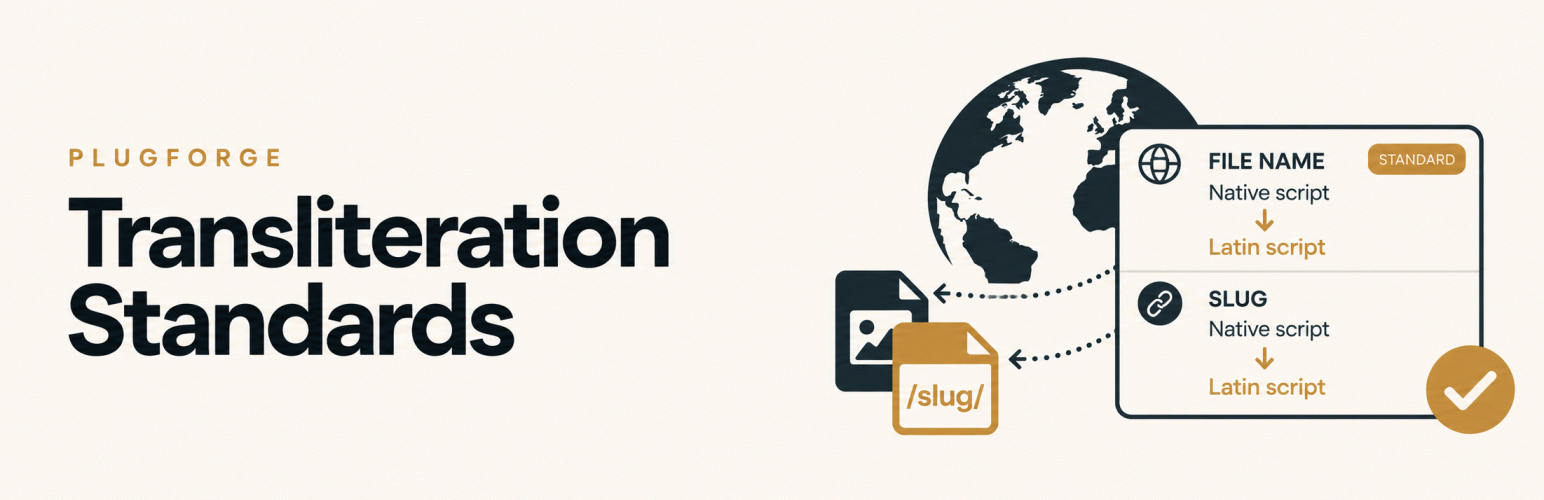
PlugForge Transliteration Standards
Cyrillic, Greek, Georgian or Armenian in a URL gets percent-encoded, and a link
that reads %d0%ba%d0%b8%d1%97%d0%b2 is no use to anyone. Transliteration
fixes that. The question is which Latin letters to use, and tables written so
the Latin can be turned back into the original produce addresses no one would
type, such as shhastya or czokol.
PlugForge Transliteration Standards uses the romanisation standards that countries and the
United Nations publish: a resolution of Ukraine’s Cabinet of Ministers,
Bulgaria’s Transliteration Act, Georgia’s national system and others. Some of
them change a letter by its place in the word. Bulgarian ия is ia at the end of
a word and iya inside one, and the plugin follows rules like that as written.
Nothing changes until you choose a standard for a language.
Features
- 13 standards for 11 languages, each linked to its source document.
- New posts, pages, terms, products and uploaded files get readable addresses.
- Exceptions for brand names and established spellings, as whole words or
whole phrases. - The language of each post with Polylang.
- A report of what your existing post slugs would become, with a CSV download.
- Nothing loaded on the public site, and no outbound requests.
Supported standards
- Ukrainian: Resolution no. 55 of the Cabinet of Ministers, 27 January
- Київ
kyiv. All 76 worked examples in its annex come out exactly.
https://zakon.rada.gov.ua/laws/show/55-2010-п
- Київ
- Russian: Three standards, because Russian has three and they disagree.
Pick the one your paperwork names. ICAO Doc 9303, what a Russian passport
uses: Южноiuzhno. BGN/PCGN 1947, what English-language publishing uses:
Южноyuzhno. ГОСТ 7.79-2000 system B, the reversible scheme described
above, for matching addresses your site already has: Цокольczokol.
https://www.icao.int/sites/default/files/publications/DocSeries/9303_p3_cons_en.pdf - Bulgarian: The Transliteration Act of 2009, an act of parliament.
Софияsofia.
https://www.mrrb.bg/static/media/ups/articles/attachments/TRANSLITERATION%20ACT48938c89238d30492f9d6456d4b8ee7e.pdf - Serbian: The United Nations system of 1977, which is Gaj’s Latin
alphabet. Шабацsabac. https://arhiiv.eki.ee/wgrs/rom1_sr.htm - Macedonian: The United Nations system of 1977. Ќесендре
kesendre.
https://arhiiv.eki.ee/wgrs/rom1_mk.htm - Belarusian: The United Nations system of 2012, based on the national
łacinka of 2007. Віцебскviciebsk. https://arhiiv.eki.ee/wgrs/rom1_be.htm - Greek: ELOT 743, what Greece prints on passports and road signs.
Άγγελοςangelos. https://arhiiv.eki.ee/wgrs/rom1_el.htm - Georgian: The national system of 2002, approved by presidential decree
in 2011. თბილისიtbilisi.
https://matsne.gov.ge/ka/document/view/1216954?publication=0 - Kazakh: BGN/PCGN 1979, for Kazakh written in Cyrillic. Kazakhstan
publishes no romanisation of its own. Қызылордаqyzylorda. - Armenian: BGN/PCGN 1981, for eastern Armenian. Երևան
yerevan.
https://assets.publishing.service.gov.uk/media/636cd40ad3bf7f164de3c9f3/ROMANIZATION_OF_ARMENIAN_2022_final.pdf - Mongolian: MNS 5217:2012, Mongolia’s own standard. Улаанбаатар
ulaanbaatar.
An address keeps plain letters only. WordPress folds diacritics away, so
Serbian Ћирилица and Чирилица both end up as cirilica, and the apostrophes
the Georgian and Armenian standards write are dropped.
Existing URLs
Installing the plugin changes no existing address.
The “What would change” screen lists your existing posts whose slug does not
match the standard you chose, with the address each has now, the address it
would get and the language of the post. A row that would collide with another
is marked and left for you to resolve by hand. Reading the list or downloading
it as a CSV changes nothing.
A button under the list rewrites the posts on that page, after you tick a box
to confirm. WordPress keeps each old post slug and redirects it to the new one,
so links already published go on working.
Pages, categories, tags and media files already on your site are never
converted. WordPress keeps no record of their old addresses, so nothing would
redirect them.
Exceptions
Whole words and whole phrases for brand names and for spellings someone’s
passport already carries. One per line: the word or phrase, an equals sign,
what it becomes.
вордпрес = wordpress
Жуковський = Zhukovsky
Matching ignores case, and spaces, hyphens and underscores between words count
as the same join. Only whole words are replaced. Digits and symbols that belong
to a name, as in Формула 1 or AT&T, have to be written as they appear.
Multilingual sites
On a site with one language, the standard follows the site language. With
Polylang, it follows the language set on each post or term, so two posts in the
same admin can go through two different standards. On such a site, a slug that
carries no language, such as one created by WP-CLI, is left alone.
The language is never guessed from the text: Гора is hora in Ukrainian and
gora in Russian, and the letters are identical.
WPML is not supported, because it has not been tested with this plugin.
WooCommerce
Tested with WooCommerce 11. New product slugs, product categories and tags,
shipping classes, attribute names and terms, downloadable files and product
images are all transliterated. Coupon codes are left alone, because customers
type them and codes already printed have to go on working. So is the product
permalink base, which you set yourself.
Privacy and performance
- No outbound requests: no update server of its own, no licence check, no usage
statistics. - No background jobs. A conversion you start runs while you watch it.
- No stylesheet and no script on any public page.
- Files already uploaded are never renamed.
- One dashboard notice, for administrators, and only if the PHP mbstring
extension is missing.
For developers
translit_standards_language: The language code to transliterate by. Return
an empty string to leave a string alone.translit_standards_result: The transliterated string, with the text the
engine was given and the standard key.translit_standards_site_languages: The language codes the settings screen
offers a row for.
Details


Related plugins
Plugins that also contain the tag cyrillic
Cyr-To-Lat

Cyrlitera – transliteration of links and file names
Cyr to Lat Reloaded – Transliteration of Links and File Names
Filenames to latin

Transliterator – Multilingual and Multi-script Text Conversion
Bulglish Permalinks


About
Plugin for that tries to help you find the WordPress plugin you are looking for.
| Please enjoy an image of Crush (this awesome turtle) and have a lovely day! |  |
We do not own any plugin listed on this site and do not work for or work with WordPress.com or it's associated companies. We simply provide a searchable list of the available WordPress plugins.