



Raqvio Agent Guardrails for WooCommerce
AI agents can now work on your WordPress site directly. Since WordPress 6.9, plugins register abilities — “update a product”, “change an order status” — and agents such as Claude Desktop or your own scripts can discover and run them over the REST API or MCP. WooCommerce exposes products and orders this way too.
That is powerful, and a little unnerving. Out of the box there is no way to say “this agent may read orders but never refund one”, no off switch, and no record of what an agent actually did.
Raqvio Agent Guardrails adds that missing layer. It sits in front of every ability your site runs, works out which agent is calling, decides whether the call is allowed, and writes it down.
Features
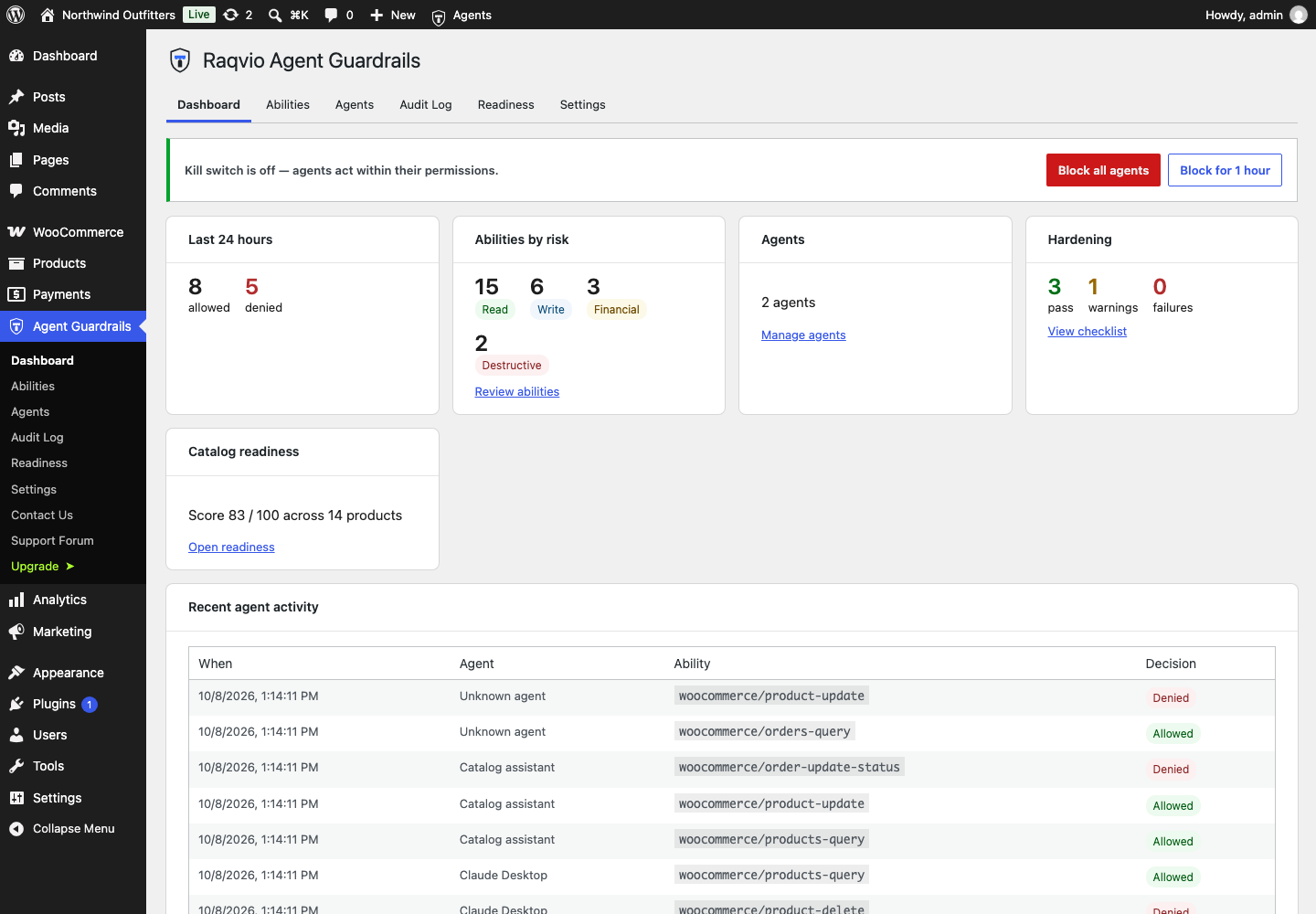
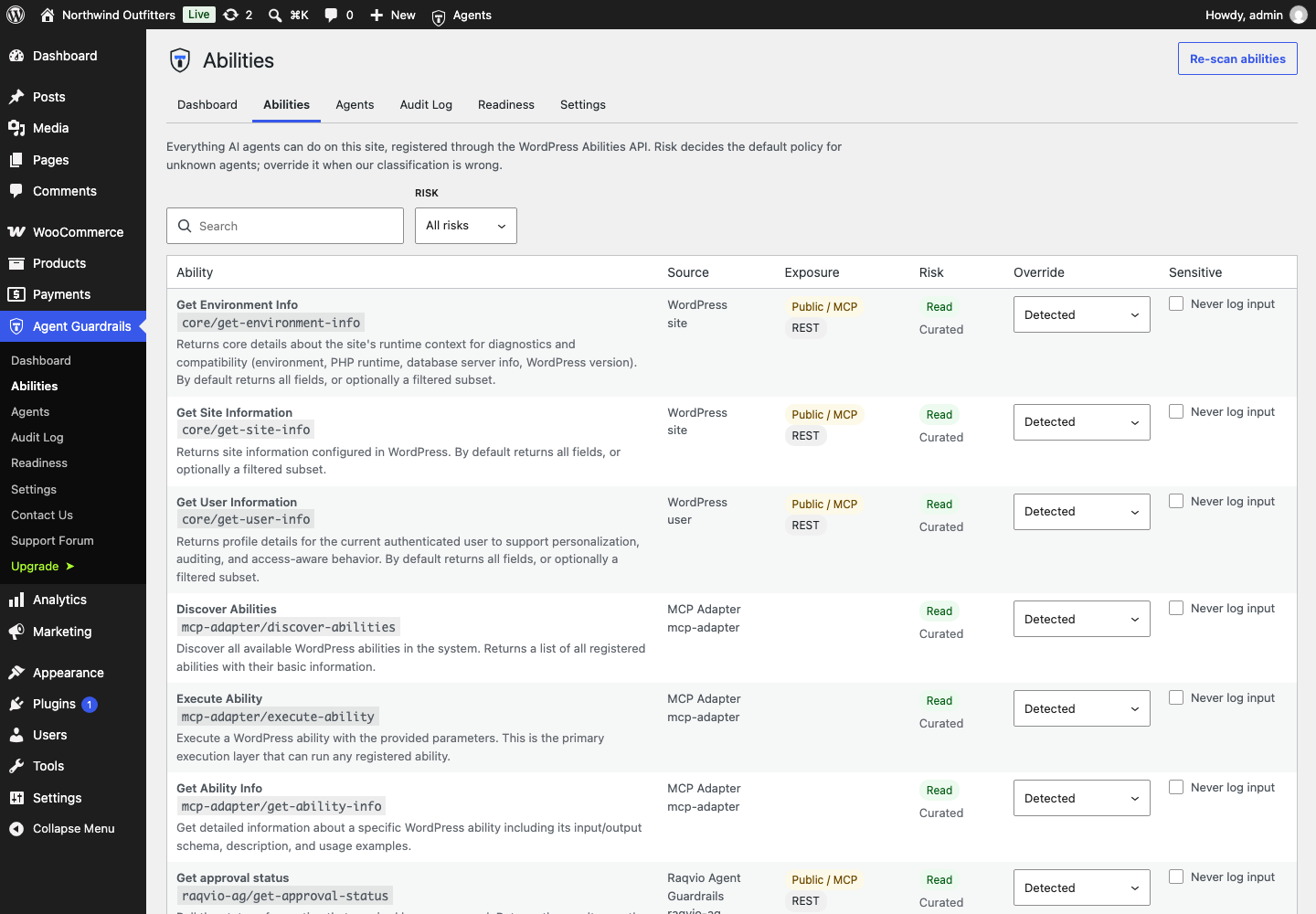
- See every ability on your site. Abilities from WordPress, WooCommerce and other plugins are listed in one place, each classified as Read, Write, Financial or Destructive. Disagree with a classification? Override it. Mark an ability as sensitive and its input is never logged.
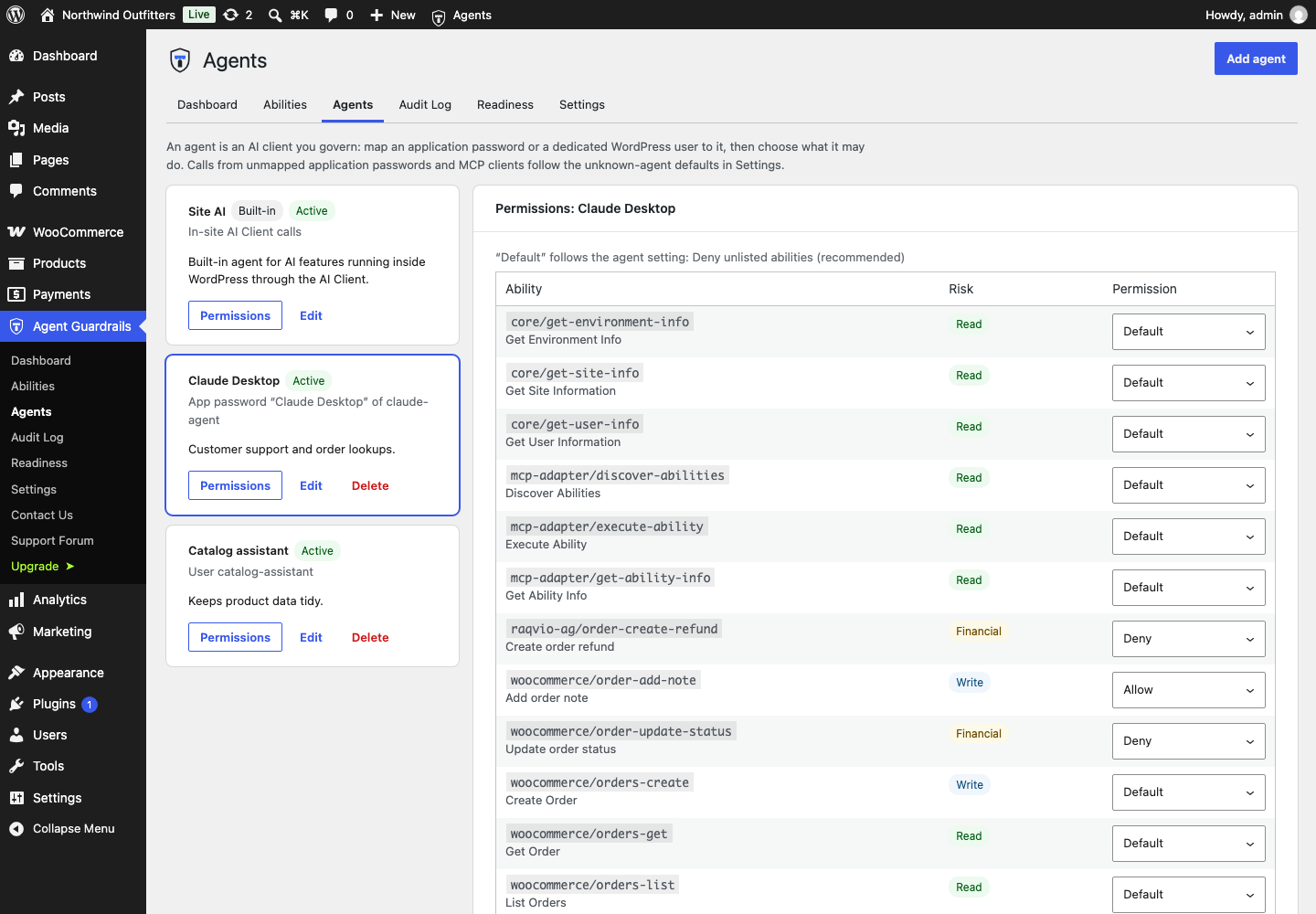
- Name your agents. Tie an application password, or a dedicated WordPress user, to a named agent. Add as many agents as you need. A built-in “Site AI” agent covers AI features running inside WordPress.
- Allow or deny per agent. Choose, ability by ability, what each agent may do. Agents you haven’t set up get safe defaults: they can read, but anything that writes, moves money or deletes is denied.
- An emergency kill switch. One click in the admin bar blocks every agent at once. From the dashboard you can also block agents for one hour, after which the switch turns itself off.
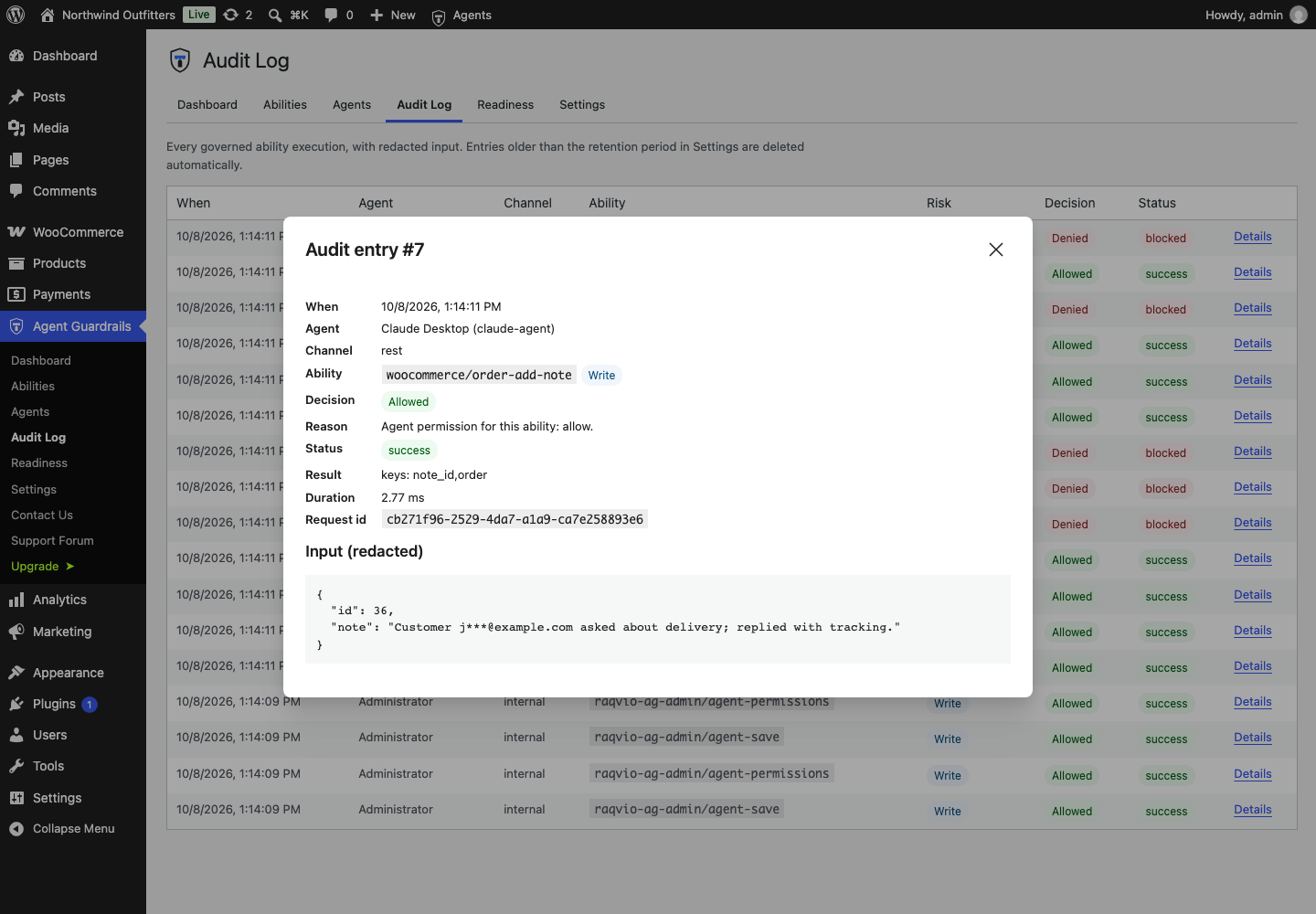
- A redacted audit log. Every agent call is recorded with the agent, the channel (MCP, REST or internal), the decision and the result. Before anything is stored, values in fields named like passwords, tokens, keys or card data are removed, and emails, phone numbers and addresses are masked. You choose how long entries are kept, from 1 to 365 days (30 by default).
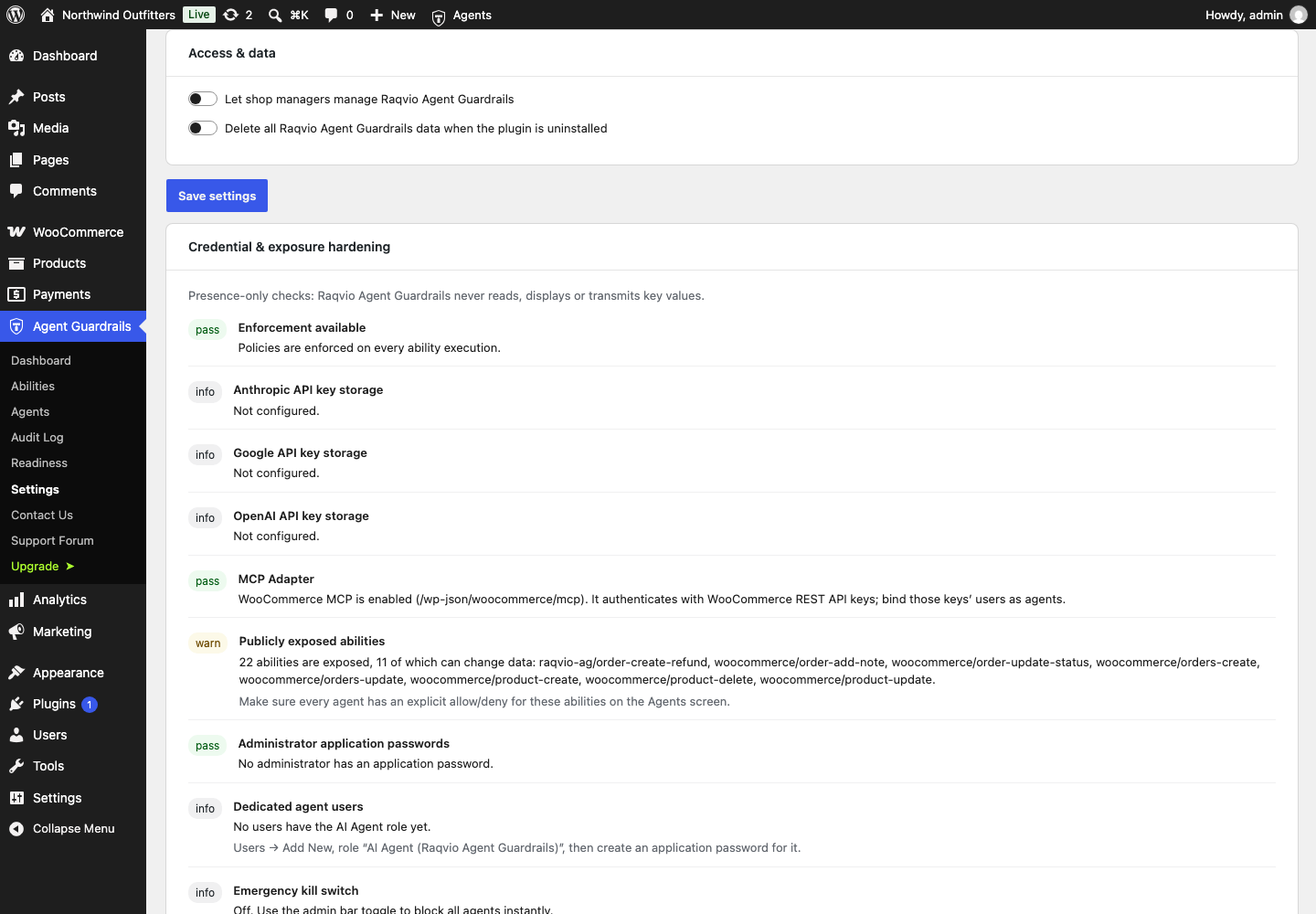
- A credential and exposure check. Find out whether your AI provider keys live in the database or safely in
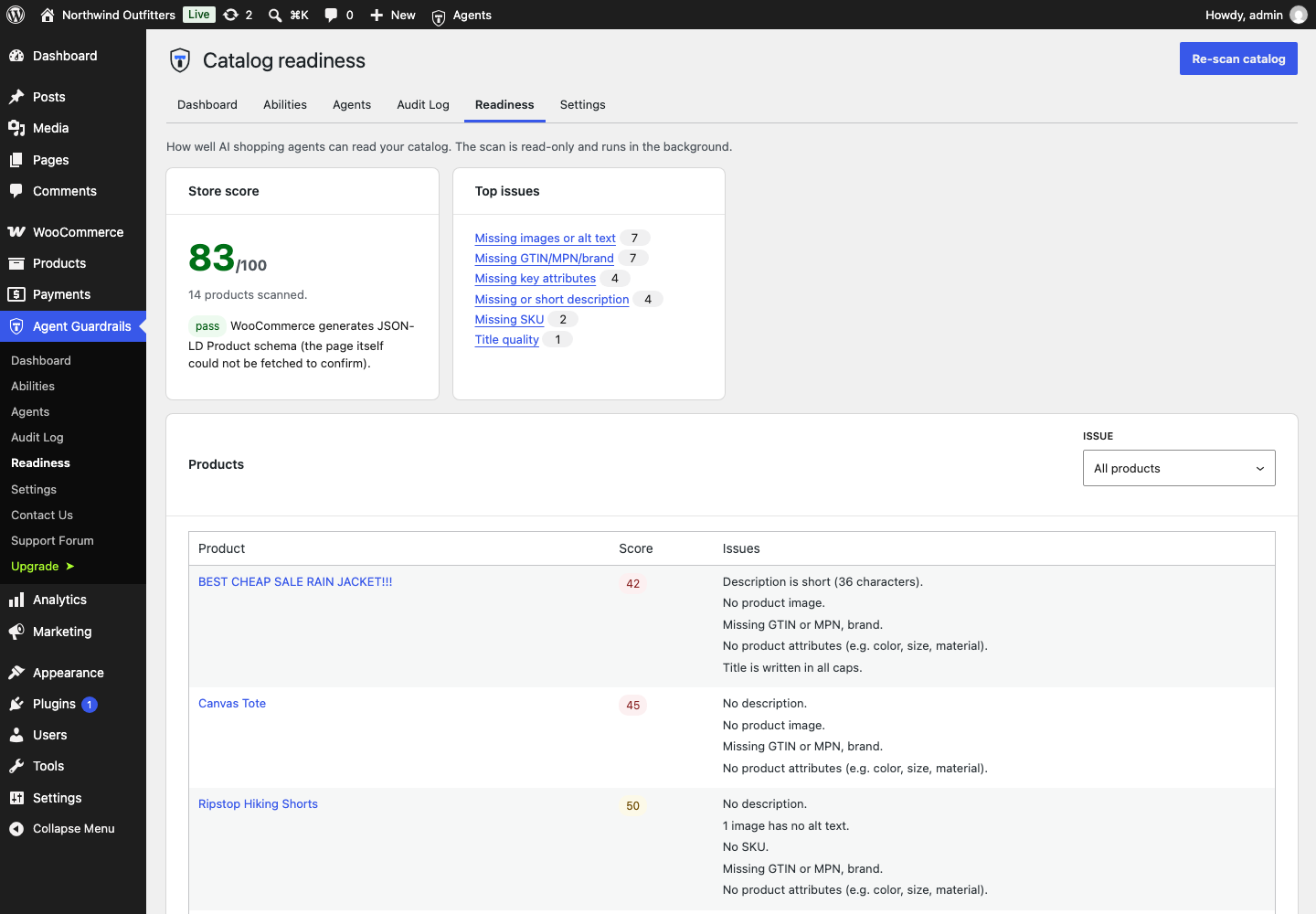
wp-config.phpor environment variables — without Raqvio Agent Guardrails ever reading them — plus which abilities are publicly exposed and which administrators have application passwords. - A catalog readiness score. With WooCommerce, scan your catalog and get a 0–100 score per product and for the store, based on what AI shopping agents need: descriptions, images and alt text, SKU, GTIN/MPN/brand, attributes, variations, price and stock, and title quality. A separate check tells you whether your product pages carry Product JSON-LD.
- Help for well-behaved agents. The
raqvio-ag/get-my-permissionsability lets an agent ask what it is allowed to do before it tries. - A refund ability that stays under your control.
raqvio-ag/order-create-refund(WooCommerce 10.9 or newer) lets an agent refund an order by amount or per line item, with optional restock. It is classified as Financial, so no agent can use it until you allow it, and money only goes back through the payment gateway if the agent explicitly asks and the gateway supports automatic refunds. - Works with WooCommerce’s MCP endpoint. Agents that connect with WooCommerce REST API keys are identified by the key’s user, and WooCommerce’s MCP tools show up in the permission matrix like any other ability.
When an agent is blocked it gets a clear error (raqvio_ag_denied, or raqvio_ag_blocked while the kill switch is on) with a reason that starts with “Blocked by Raqvio Agent Guardrails:”, so both the agent and you know why.
Requirements
Raqvio Agent Guardrails needs WordPress 6.9 and PHP 8.1. To actually block agents it needs WordPress 7.1, which added the hook Raqvio Agent Guardrails uses to stop an ability before it runs. On WordPress 6.9 and 7.0 it runs in audit-only mode: it logs every agent call and what it would have decided, and tells you so.
WooCommerce is optional. Governance works for any ability; the catalog readiness score and the refund ability need WooCommerce.
Privacy
Everything Raqvio Agent Guardrails stores stays in your own database:
- Audit log: time, agent, WordPress user ID, channel, ability, risk, decision, status, duration, a short result summary, and the ability input after redaction (see above). Abilities you mark as sensitive never have their input stored. Entries older than the retention period you set in Settings (30 days by default) are deleted automatically.
- Agents: name, description, status, and the ID of the bound application password or user. The application password itself is never read or stored.
- Catalog readiness: a score and a list of issues per product.
Source code and libraries
The compiled admin app in build/ is generated from the readable JavaScript and SCSS sources included in this plugin under assets/src/. The build configuration (package.json and webpack.config.js) is included too. To rebuild it, run npm install and then npm run build in the plugin folder (Node.js 20 or newer). The build uses @wordpress/scripts.
Bundled third-party libraries:
- Action Scheduler 4.2.0 by WooCommerce (GPLv3), in
vendor/woocommerce/action-scheduler/. It runs background jobs when WooCommerce is not active. If another plugin loads a newer copy, Action Scheduler uses that one. - Freemius WordPress SDK 2.13.4 (GPLv3), in
freemius/. Its compiled pricing page script,freemius/assets/js/pricing/freemius-pricing.js, is built from github.com/Freemius/pricing-page. When several plugins bundle the SDK, it loads only the newest copy.
Details
Related plugins
Plugins that also contain the tag ai
SEOPress – On-site SEO & Analytics

AI Engine – The Chatbot, AI Framework & MCP for WordPress

GetGenie – AI Content Writer with Keyword Research & SEO Tracking Tools

SEO Plugin by Squirrly SEO

Website LLMs.txt

Smartsupp – live chat, AI shopping assistant and chatbots


About
Plugin for that tries to help you find the WordPress plugin you are looking for.
| Please enjoy an image of Crush (this awesome turtle) and have a lovely day! |  |
We do not own any plugin listed on this site and do not work for or work with WordPress.com or it's associated companies. We simply provide a searchable list of the available WordPress plugins.