


Seeb Abilities
Seeb Abilities adds 53 new abilities to WordPress, so AI agents can write and edit posts, build pages block by block, manage patterns and templates, moderate comments and more, instead of only reading information about your site.
WordPress 6.9 introduced the Abilities API: a standard way for plugins to describe what they can do, with typed inputs and outputs and permission checks, so that AI assistants, Model Context Protocol (MCP) clients and automation tools can discover and use them. Core registers only a few read-only abilities, such as site and environment information. Seeb Abilities fills the gap with the everyday content-management tasks.
Seeb Abilities is best used with the free MCP Adapter plugin, which turns these abilities into MCP tools that Claude, ChatGPT, Cursor, VS Code and other MCP clients can use directly.
Every ability:
- Uses WordPress’s own functions (
wp_insert_post(),wp_update_post(),wp_set_object_terms()and so on), so hooks, caches, revisions and other plugins behave exactly as they do in the admin. - Checks the current user’s capabilities for that specific object. An agent connected as an Author can edit their own posts, but not someone else’s and not the site settings.
- Declares input and output schemas, and annotations (read-only, destructive, idempotent) that clients use to decide when to ask before acting.
- Is available through the WordPress REST API (
/wp-json/wp-abilities/v1/) and, when the MCP Adapter plugin is active, as MCP tools.
53 new abilities
All abilities use the seeb-abilities/ namespace and are grouped into categories.
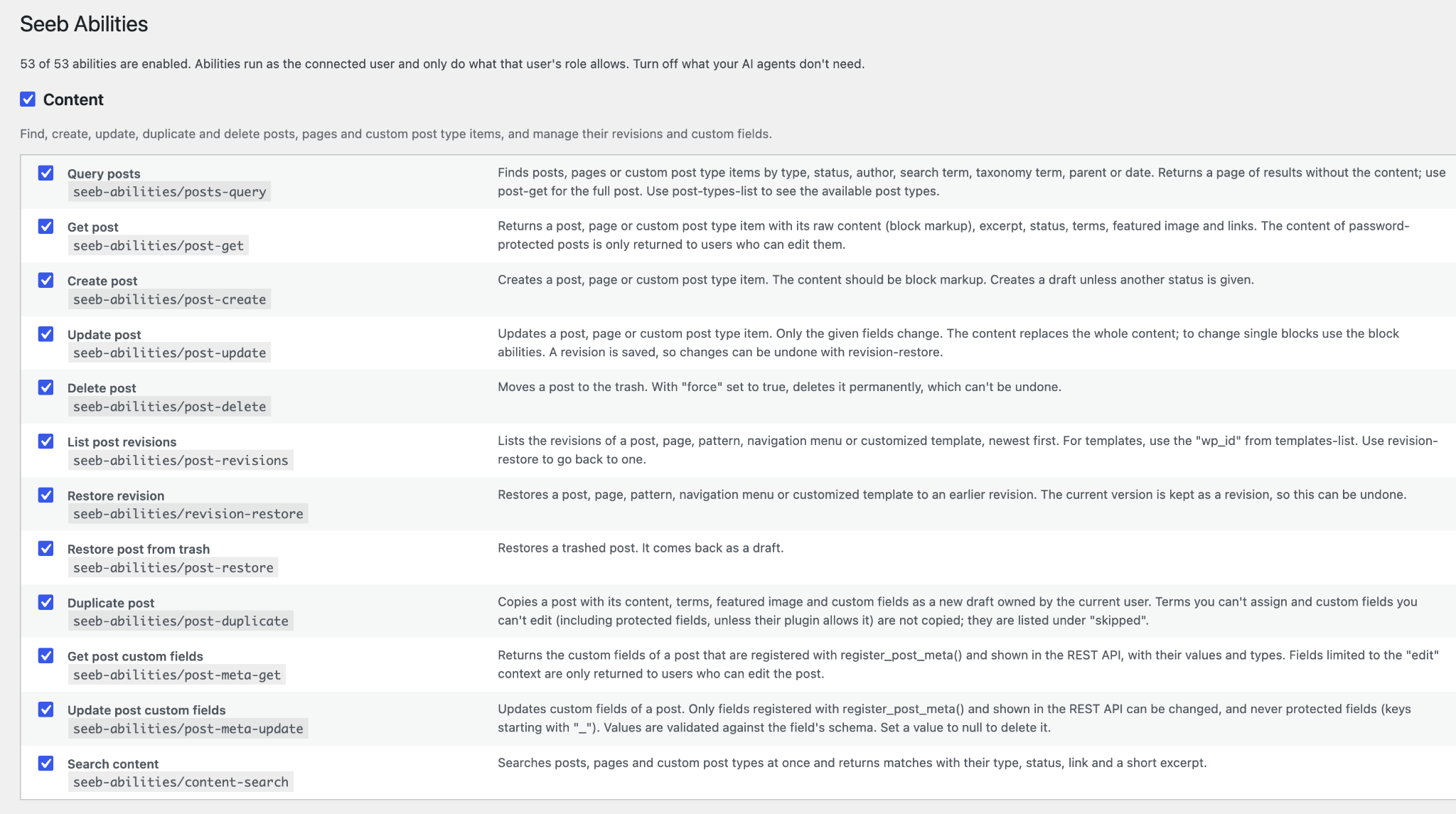
Content (posts, pages and public custom post types)
posts-query: find posts by type, status, author, search term, taxonomy term or datepost-get: get a post with its content, terms and featured imagepost-create: create a post, page or custom post type itempost-update: update title, content, excerpt, status, slug, author, date or featured imagepost-delete: move a post to the trash, or delete it permanently withforcepost-revisions: list the revisions of a post, pattern, navigation menu or customized templaterevision-restore: restore any of these to an earlier revisionpost-restore: restore a post from the trashpost-duplicate: copy a post, with its terms, featured image and the custom fields you’re allowed to edit, as a new draftpost-meta-get: read a post’s custom fields registered withregister_post_meta()post-meta-update: update a post’s registered custom fieldscontent-search: search across all public post types at once
Taxonomies
terms-query: find categories, tags or custom taxonomy termsterm-create: create a termterm-update: rename a term or change its slug, description or parentpost-set-terms: set or append a post’s terms
Blocks and patterns (block editor)
block-types-list: list the registered blocks, with their category, title and descriptionblock-type-get: get one block’s attributes, supports, styles and variations, so an agent can write valid block markuppost-blocks-get: get a post’s content as a tree of blocks, each with its path (for example2.0for the first block inside the third)block-insert: insert one or more blocks at a path, or before or after a blockblock-update: change a block’s attributes or inner content without touching the rest of the postblock-move: move a block to another positionblock-remove: remove a block and its inner blocksblocks-replace: replace every block of one type, or with a given attribute value, across a post (for example turn allcore/quoteblocks intocore/pullquote)blocks-validate: check block markup before saving and report unknown blocks, invalid attributes and broken nestingblock-usage-find: find the posts, pages, templates and patterns that use a block typepatterns-list: list registered and synced patterns, with their categoriespattern-insert: insert a pattern into a post, either as a synced reference or as a copy of its blockspattern-create: save blocks as a new synced or unsynced patternpattern-update: update a synced pattern, which changes it everywhere it is used
All block edits are saved as revisions, so any change can be undone with revision-restore. The first change to a theme template creates a customized copy, which template-reset removes again.
Site editor (block themes)
templates-list: list templates and template parts, and whether they are customizedtemplate-get: get a template or template part as blockstemplate-update: edit a template or template part with the same block abilities as poststemplate-reset: remove customizations and go back to the theme’s versionglobal-styles-get: read the site’s global styles: colors, typography and spacing presets, so new blocks match the theme
Navigation
menus-list: list menus and their locationsmenu-items-query: list the items of a menumenu-item-add: add a page, post, term or custom link to a menu
Media
media-query: find media library itemsmedia-sideload: import an image or file from a URL into the media librarymedia-update: update alt text, caption, title or description
Comments
comments-query: find comments by post, status or authorcomment-moderate: approve, unapprove, mark as spam or trash a commentcomment-reply: reply to a comment as the current user
Users
users-query: list users with their roles (read-only, requires thelist_userscapability, never returns passwords)current-user-get: get the connected user’s role and capabilities, so an agent knows what it is allowed to do
Site
settings-get: read general and reading settingssettings-update: change site title, tagline, timezone, date format and other allowlisted settingsplugins-list: list installed plugins and whether they are activepost-types-list: list registered post types and taxonomiessite-health-get: get the Site Health status and the tests that need attentioncron-events-list: list scheduled (cron) events and when they run nextthemes-list: list installed themes and which one is active
Safe by default
- Deleting moves to the trash. Permanent deletion needs
force: trueand is marked as destructive. - Settings can only be read and changed from a fixed allowlist. Arbitrary options are never touched.
- Protected post meta (keys starting with
_) cannot be written. - Password-protected content is only returned to users who can edit it.
- No ability runs PHP or SQL, edits files, or installs or activates plugins.
- Query results are paginated with a maximum page size.
- Site owners can turn off any ability, or a whole category, under Settings Seeb Abilities.
For developers
- Filter
seeb_abilities_ability_argsto change an ability’s arguments before it is registered. - Filter
seeb_abilities_enabledto enable or disable abilities in code. - Filter
seeb_abilities_allowed_settingsto change which settingssettings-getandsettings-updatecan access.
Details
Related plugins
Plugins that also contain the tag abilities-api
DiveWP – Boost Site Performance with Clear, Actionable Steps

AI Workflow Automation – AI Agent Hub

SudoWP Radar

AbilityGuard – Abilities API Monitor

miniOrange Secure MCP Server

SlyTranslate


About
Plugin for that tries to help you find the WordPress plugin you are looking for.
| Please enjoy an image of Crush (this awesome turtle) and have a lovely day! |  |
We do not own any plugin listed on this site and do not work for or work with WordPress.com or it's associated companies. We simply provide a searchable list of the available WordPress plugins.