


SendFleet
SendFleet is a transactional email API with two sending modes: BYOC sends through your own Amazon SES account, so SendFleet never stores your recipients, subjects or message bodies, and Managed plans send through SendFleet’s own SES with email logs, delivery webhooks and automatic bounce handling.
This is the official SendFleet plugin. It routes every email WordPress sends — password resets, new-user emails, WooCommerce orders, contact form submissions, comment notifications, anything that calls wp_mail() — through the SendFleet API instead of PHP mail() or SMTP.
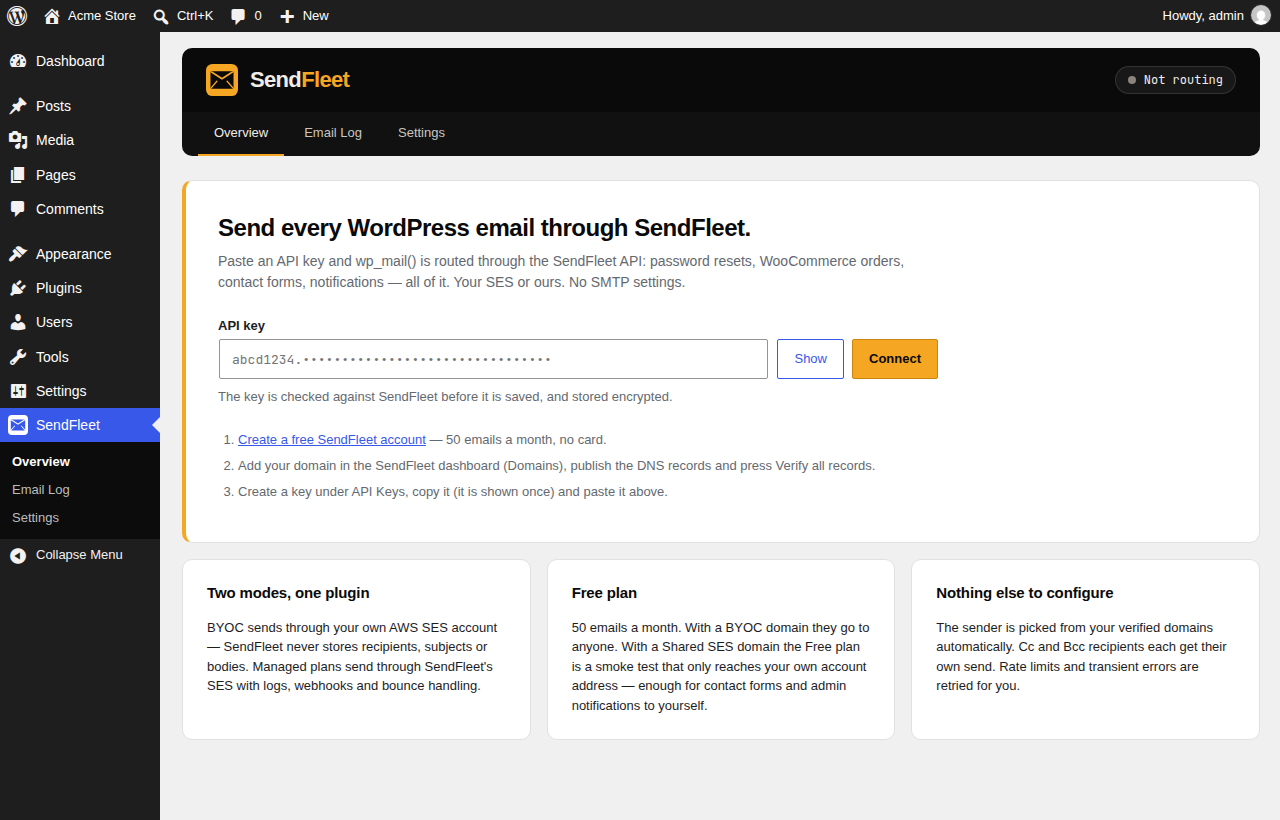
Setup is one field. Paste your API key. The plugin checks it, reads your plan and verified sending domains from SendFleet, and picks a sender address on one of those domains automatically. There are no SMTP hosts, ports or passwords to configure.
What it does for you
- Takes over wp_mail() cleanly. Uses WordPress’
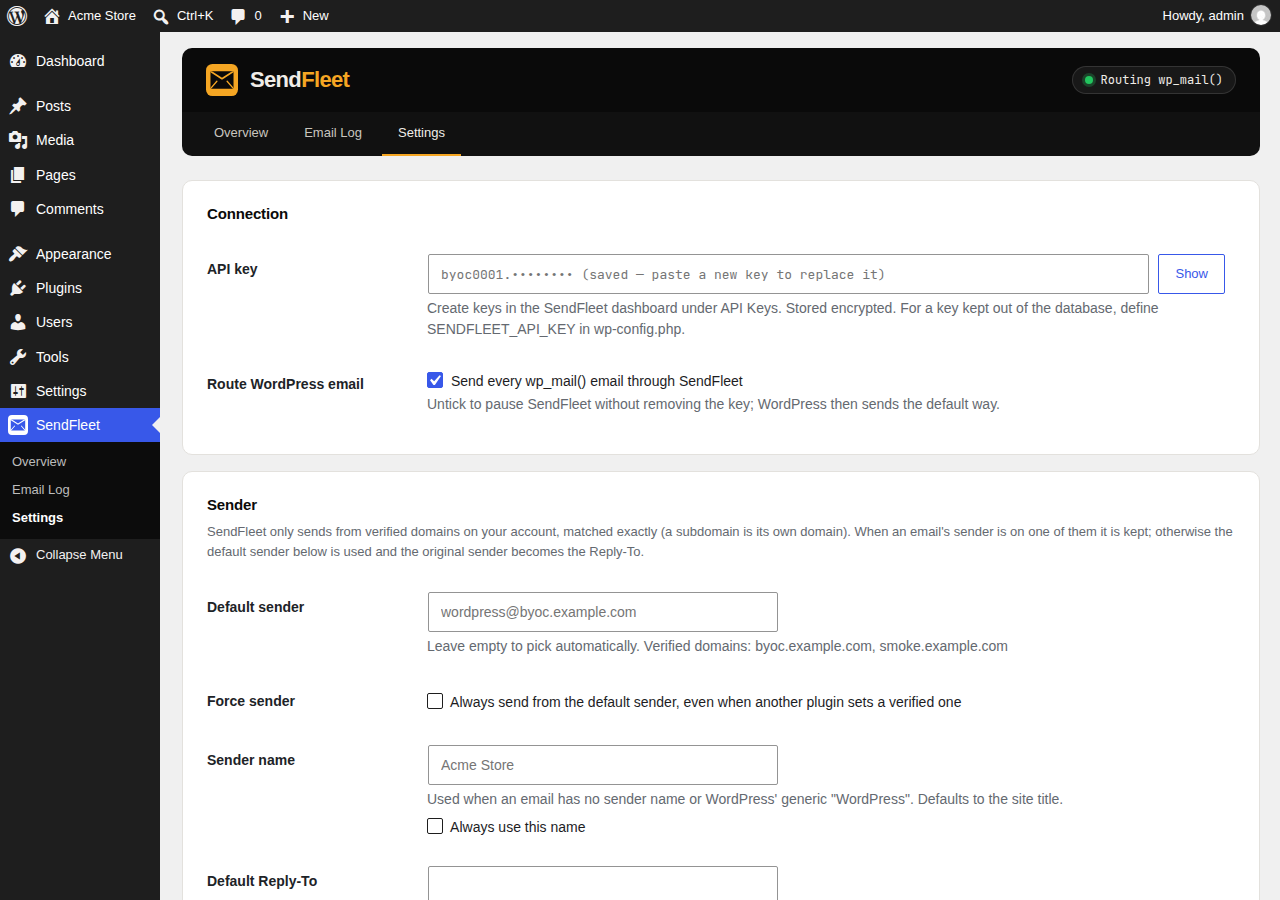
pre_wp_mailfilter rather than replacing the pluggable function, and builds each message exactly like WordPress does, sowp_mail_from,wp_mail_content_type,phpmailer_initand every other mail filter keep working (WooCommerce’s plain-text alternative included). - Always sends from a verified domain. If a plugin sets a sender on a domain your SendFleet account cannot send from, the plugin sends from your default sender instead and puts the original address in Reply-To, so replies still reach the right person.
- To, Cc and Bcc. Each email goes out as one SendFleet message with its To, Cc and Bcc recipients (up to 50 per message on a BYOC domain; larger lists are split). On a Shared SES domain a message is addressed to exactly one recipient, so the first address stays in To and the rest are sent as Cc, and the API’s 5-recipient ceiling applies. Every recipient appears in the log on their own row.
- HTML and plain text. A readable plain-text version is generated for HTML-only emails, as SendFleet recommends.
- Attachments. Checked against SendFleet’s limits (20 files, 25 MB each, 37 MB in total, no executables). A file that would be refused is left out and noted in the log, rather than failing the whole email.
- Retries done right. Rate limits (60 requests a minute per key),
502 queue_errorand other failures where SendFleet confirms nothing was sent are retried automatically from a queue. A timeout is never retried automatically, because the email may already have been accepted and a retry could deliver it twice. - Circuit breakers. A rejected key, a used-up plan or a suspended account stops further API calls straight away instead of hammering the API (and getting your server’s IP blocked for repeated failed authentication).
- Email log. Recipient, sender, subject, status, sending mode, SendFleet message ID and the plugin that sent it. Message bodies are never stored in the log. Entries are deleted after 30 days by default.
- Delivery status and suppressions (Managed plans). Point a SendFleet webhook at the plugin and delivered, bounced and complained statuses appear in the log. Hard bounces, spam complaints and suppressions are added to a local suppression list, so the site stops spending sends on addresses that will never accept mail.
- Background sending (optional). Queue emails and send them from WP-Cron so checkout and form pages respond faster.
- Fallback (optional). If SendFleet cannot take an email, send it the default WordPress way instead.
- Free plan support. The Free plan includes 50 emails a month. With a BYOC domain they go to anyone. With a Shared SES domain, the Free plan is a smoke test that only delivers to your own SendFleet account address — the plugin knows this and sends notifications addressed to you (contact forms, admin notices) while skipping everyone else, with a clear note in the log.
- Built for operations. Site Health checks, a WP-CLI command (
wp sendfleet status|connect|test|queue|refresh|purge-log), wp-config.php constants for every secret, encrypted key storage, multisite support, and personal data export and erasure.
Requirements
- A SendFleet account — create one for free (50 emails a month, no card).
- A sending domain added and verified in the SendFleet dashboard (DNS records for ownership and DKIM).
- An API key from SendFleet API Keys.
External services
This plugin connects to the SendFleet API (https://api.sendfleet.net), operated by SendFleet, to send email. That is its whole purpose; it sends nothing until you save an API key.
- When an email is sent (any call to
wp_mail()while the plugin is connected), the plugin sends a request toPOST https://api.sendfleet.net/v1/sendcontaining the recipient address, the sender address and name, the Reply-To address, the subject, the plain-text and HTML body and any attachments. - When you connect, when you open the plugin’s screens (at most every 10 minutes), after a send fails because of an account or domain problem, and otherwise twice a day, the plugin calls
GET https://api.sendfleet.net/v1/meto read your account’s name and email address, plan, current-month usage and verified sending domains. - Every request carries your API key in the
X-API-Keyheader and identifies the plugin, WordPress and PHP versions in theUser-Agentheader. No other site data is sent. - Webhooks are optional and inbound: if you configure one in the SendFleet dashboard, SendFleet sends delivery events to this site’s REST endpoint (
/wp-json/sendfleet/v1/webhook), which verifies an HMAC signature before accepting them.
Depending on your SendFleet plan, mail is delivered through your own Amazon SES account (BYOC; SendFleet does not store recipients, subjects or bodies) or through SendFleet’s managed Amazon SES infrastructure (Managed plans; SendFleet keeps an email log including content for 14 days).
- SendFleet terms and conditions: https://sendfleet.net/terms-and-conditions/
- SendFleet privacy policy: https://sendfleet.net/privacy-policy/
Details


Related plugins
Plugins that also contain the tag amazon-ses
FluentSMTP – WP SMTP Plugin with Amazon SES, SendGrid, MailGun, Postmark, Google and Any SMTP Provider

WP Offload SES Lite

Daninger's SMTP for Amazon SES

Codo Mailer

Titanium Mail SMTP

Quillrush Newsletter Studio for Sendy


About
Plugin for that tries to help you find the WordPress plugin you are looking for.
| Please enjoy an image of Crush (this awesome turtle) and have a lovely day! |  |
We do not own any plugin listed on this site and do not work for or work with WordPress.com or it's associated companies. We simply provide a searchable list of the available WordPress plugins.