



Shilpi Image Kit
Generating an image with AI takes a minute or more per picture. A landing page needs a dozen. Shilpi Image Kit fills those slots from the free stock libraries instead, in about a second each.
One call to auto_image searches Pexels, Pixabay, Openverse and Wikimedia Commons together, ranks the results against the slot the image has to fill, downloads the winner, resizes it, converts it to WebP, sets the alt text and returns a URL.
Ranking that knows about the slot. Aspect ratio, minimum width and the site’s brand colour all feed the score, so a 16:9 hero gets a wide photograph in the right palette rather than whatever matched the keyword first.
Ranking that knows about the licence. A CC0 photograph outranks one that requires a credit, which outranks one that adds share-alike terms. What lands on a client site is the picture with the fewest obligations attached to it.
One round trip. All four sources are queried together, not one after another, and results are cached for 24 hours.
No duplicates. The same source URL always resolves to the same attachment, so rebuilding a page does not fill the library with copies.
Credits kept. The photographer, the source and the licence are stored on every attachment, shown in a Credit column in the media library and available through the [shilpi_image_credits] shortcode.
Sources
- Pexels and Pixabay need a free API key. Both allow, and Pixabay requires, copying the file to your own server.
- The WordPress Photo Directory is WordPress.org’s own community photo library. No key, and everything in it is CC0, so no attribution is required.
- Openverse, WordPress.org’s own media search, works with no key at all.
- Wikimedia Commons works with no key and covers real places, food, plants and local life far better than the curated libraries.
Shutterstock, Adobe Stock, Envato Elements and Canva are deliberately not supported: their terms do not allow a plugin to license and redistribute their images on your behalf.
Using it by hand
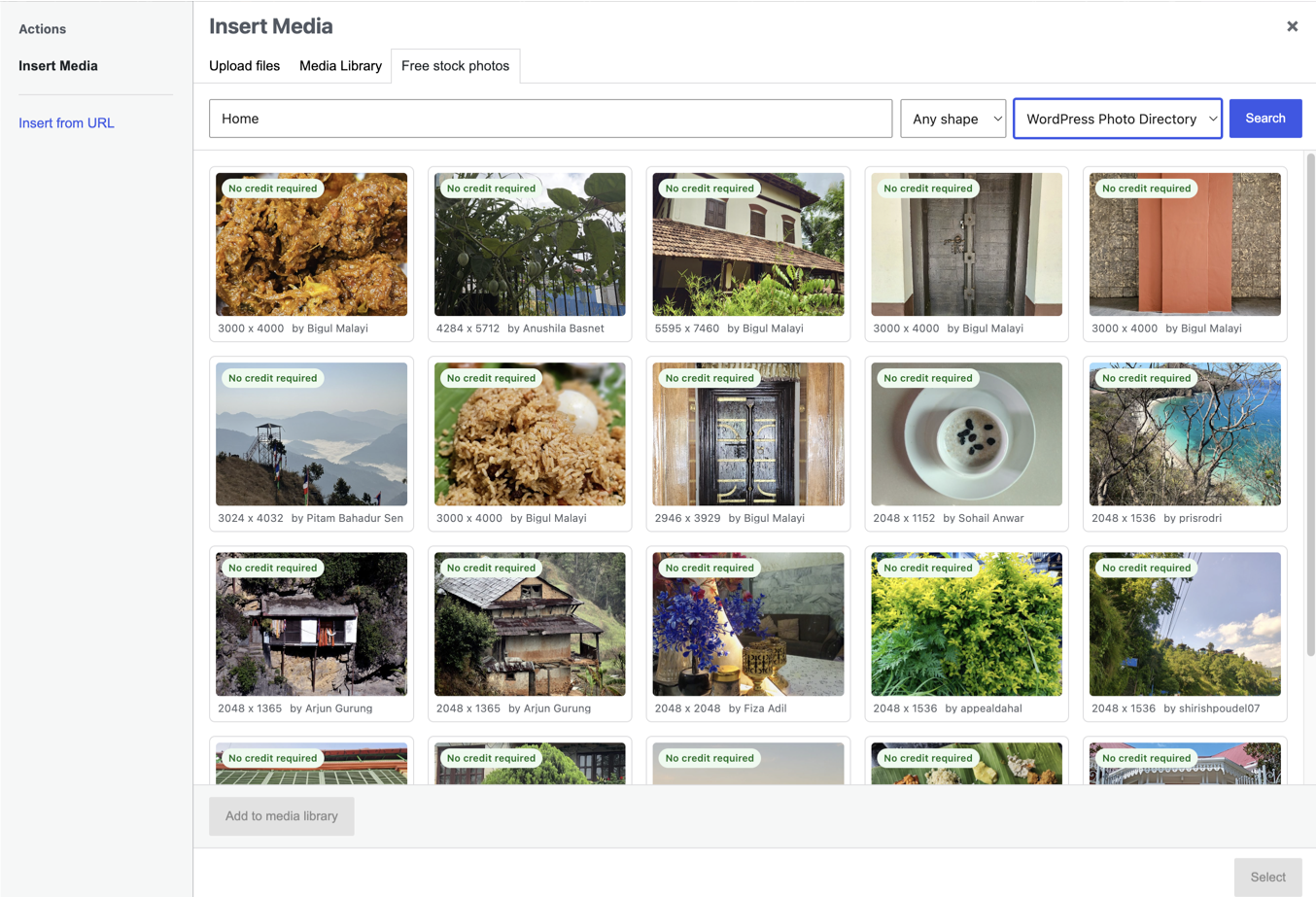
Wherever WordPress opens “Choose an image”, a Free stock photos tab sits
beside “Upload files” and “Media Library”. Search, pick, and the photograph is
downloaded, resized, credited and selected, without leaving the dialog.
REST API
For integrations, authenticated WordPress REST endpoints are available at /wp-json/shilpi-image-kit/v1/. They support searching free images and importing a selected result into the Media Library.
External services
This plugin searches external image services and downloads selected image files. A search is sent only when an authenticated WordPress user with permission to upload files uses the Free stock photos tab or an authenticated integration calls the plugin’s REST API. An image is downloaded only after that user chooses it or requests automatic import. The site server’s IP address and HTTP user agent are necessarily visible to each contacted service.
The plugin does not send WordPress usernames, email addresses, post content, analytics, or tracking identifiers to these services. It does not contact them on ordinary public page views. Search responses are cached on the WordPress site for the configured period.
WordPress Photo Directory
Used to search WordPress.org’s CC0 photo collection and download a selected photo. The plugin sends the search phrase, requested orientation, colour, pagination parameters, and result limit to WordPress.org when a search is performed. No account or API key is required.
- Service: https://wordpress.org/photos/
- Terms of Service: https://wordpress.org/about/terms-of-service/
- Privacy Policy: https://wordpress.org/about/privacy/
Openverse
Used to search openly licensed images. The plugin sends the search phrase, requested image type, orientation, licence filters, page, and result limit to the Openverse API when a search is performed. If the site owner configures an optional Openverse access token, that token is sent in the request authorization header. When an image is imported, its image host receives a download request.
- Service: https://openverse.org/
- Terms of Use: https://docs.openverse.org/terms_of_service
- Privacy Policy: https://openverse.org/privacy
Wikimedia Commons
Used to search freely licensed media. The plugin sends the search phrase, file-type restriction, pagination parameters, and result limit to the Wikimedia Commons API when a search is performed. No account or API key is required. When an image is imported, Wikimedia’s image server receives the download request.
- Service: https://commons.wikimedia.org/
- Terms of Use: https://foundation.wikimedia.org/wiki/Policy:Terms_of_Use
- Privacy Policy: https://foundation.wikimedia.org/wiki/Policy:Privacy_policy
Pexels
Used to search and import stock photographs when the site owner enables Pexels and supplies a Pexels API key. The plugin sends that API key in the authorization header together with the search phrase, requested orientation, page, and result limit when a search is performed. When an image is imported, Pexels’ image server receives the download request and the source page is sent as the HTTP referrer.
- Service and API: https://www.pexels.com/api/
- Terms of Service: https://www.pexels.com/terms-of-service/
- Privacy Policy: https://www.pexels.com/privacy-policy/
Pixabay
Used to search and import stock photographs and illustrations when the site owner enables Pixabay and supplies a Pixabay API key. The plugin sends that API key, the search phrase, image type, orientation, safe-search choice, colour, page, and result limit to the Pixabay API when a search is performed. When an image is imported, Pixabay’s image server receives the download request and the source page is sent as the HTTP referrer.
- Service and API: https://pixabay.com/api/docs/
- Terms of Service: https://pixabay.com/service/terms/
- Privacy Policy: https://pixabay.com/service/privacy/
Details
Related plugins
Plugins that also contain the tag free-images
Instant Images – One-click Image Uploads from Unsplash, Openverse, Pixabay, Pexels, and Giphy

EB Openverse Block

Free images pictures

Tattoo Images

GoalPrevail Stock Image Importer


About
Plugin for that tries to help you find the WordPress plugin you are looking for.
| Please enjoy an image of Crush (this awesome turtle) and have a lovely day! |  |
We do not own any plugin listed on this site and do not work for or work with WordPress.com or it's associated companies. We simply provide a searchable list of the available WordPress plugins.