



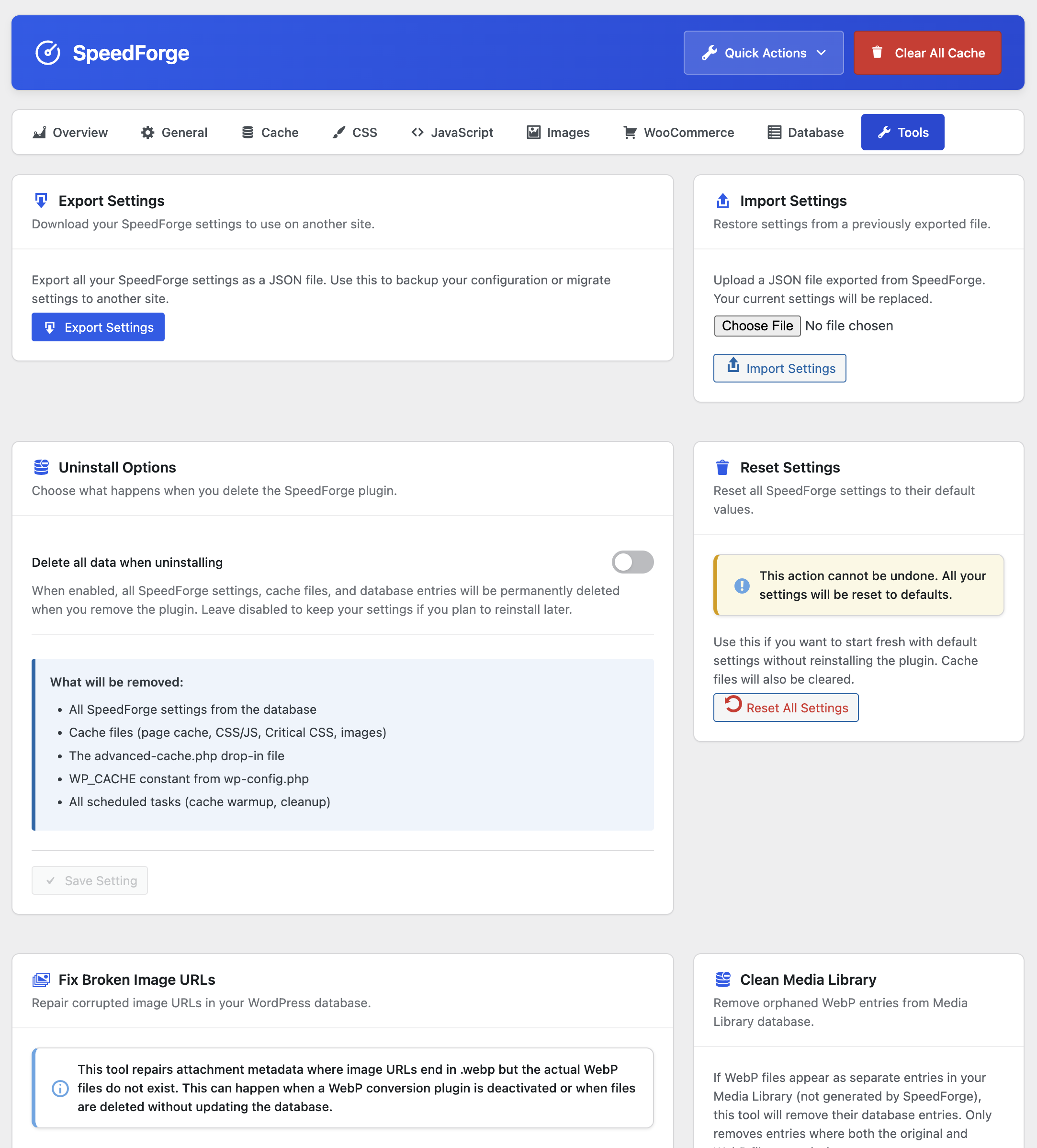
SpeedForge
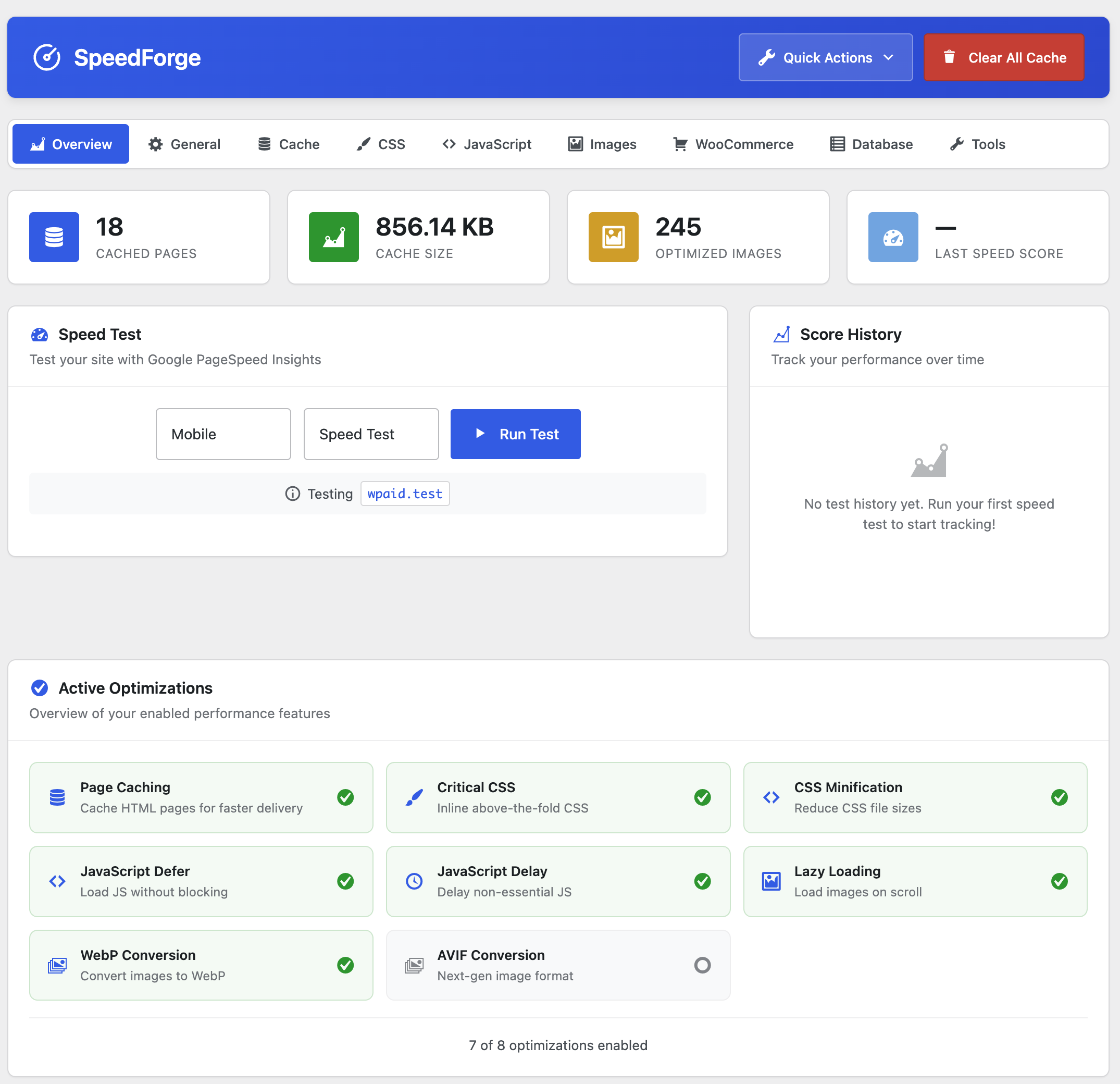
SpeedForge is a performance optimization plugin for WordPress and WooCommerce websites. All optimization processes run locally on your server with no cloud dependencies, no external API keys, and no monthly subscription fees. SpeedForge helps improve Core Web Vitals scores and overall page load times through a comprehensive suite of optimization techniques.
Page Caching
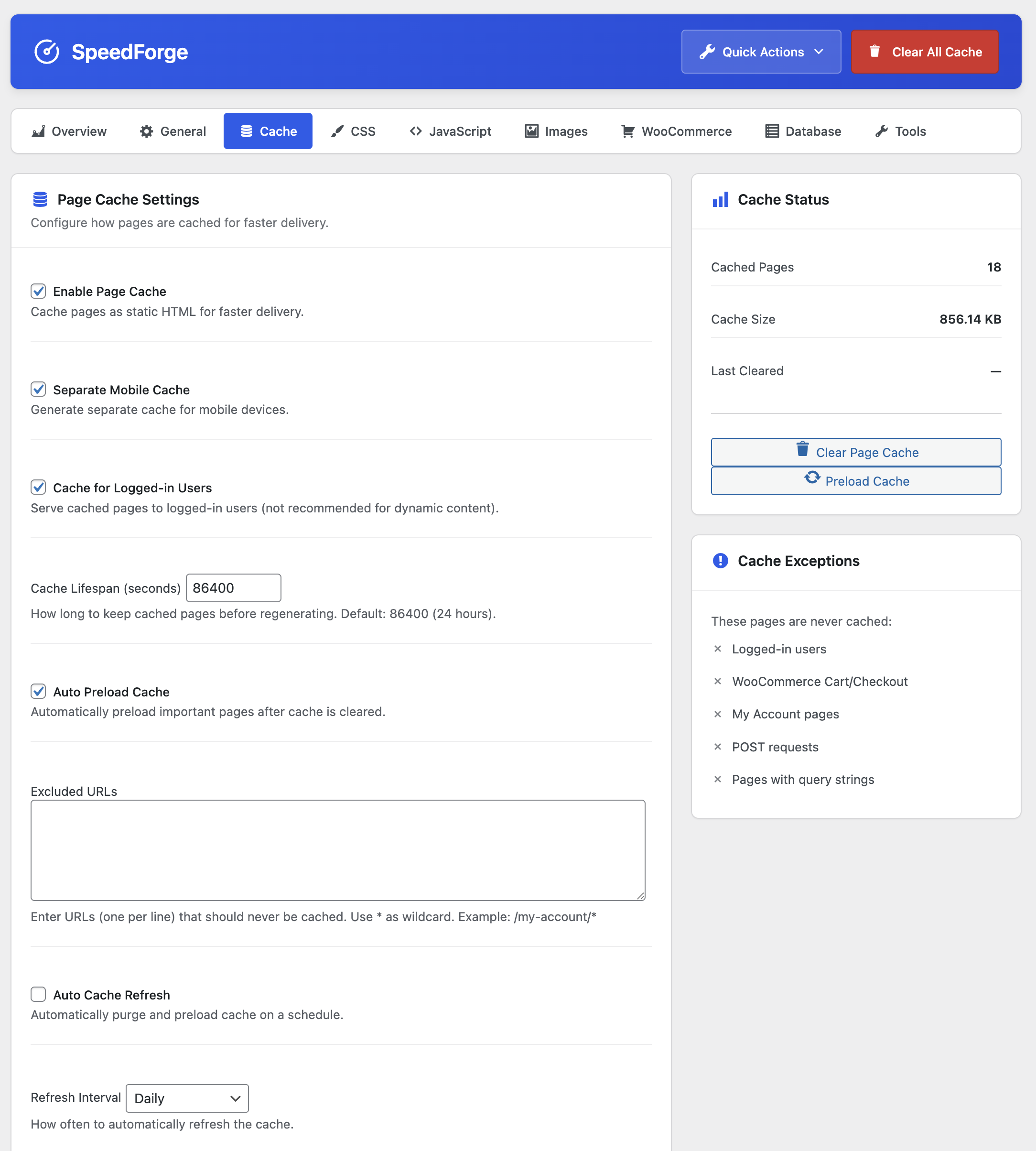
SpeedForge generates static HTML files with GZIP compression for faster page delivery. The caching system creates separate cache files for mobile and desktop visitors to serve optimized content for each device type. Cache invalidation happens automatically when you update posts, pages, or products. SpeedForge also includes cache preloading to generate cached versions of your important pages before visitors arrive.
- Static HTML generation with
GZIPcompression. - Separate cache for mobile devices.
- Automatic cache invalidation when content changes.
- Cache preloading for important pages.
- Compatible with managed hosting cache systems.
- Tag-based cache invalidation for precise purging.
- Stale-while-revalidate for zero-downtime cache rebuilds.
- Adaptive cache TTL per content type.
- Browser cache policy headers (Cache-Control, Vary).
- Cache hit/miss statistics dashboard.
- Smart warmup with priority queue and pause/resume.
- WP-CLI commands for cache management.
- HTML minification (conservative and aggressive modes).
CSS Optimization
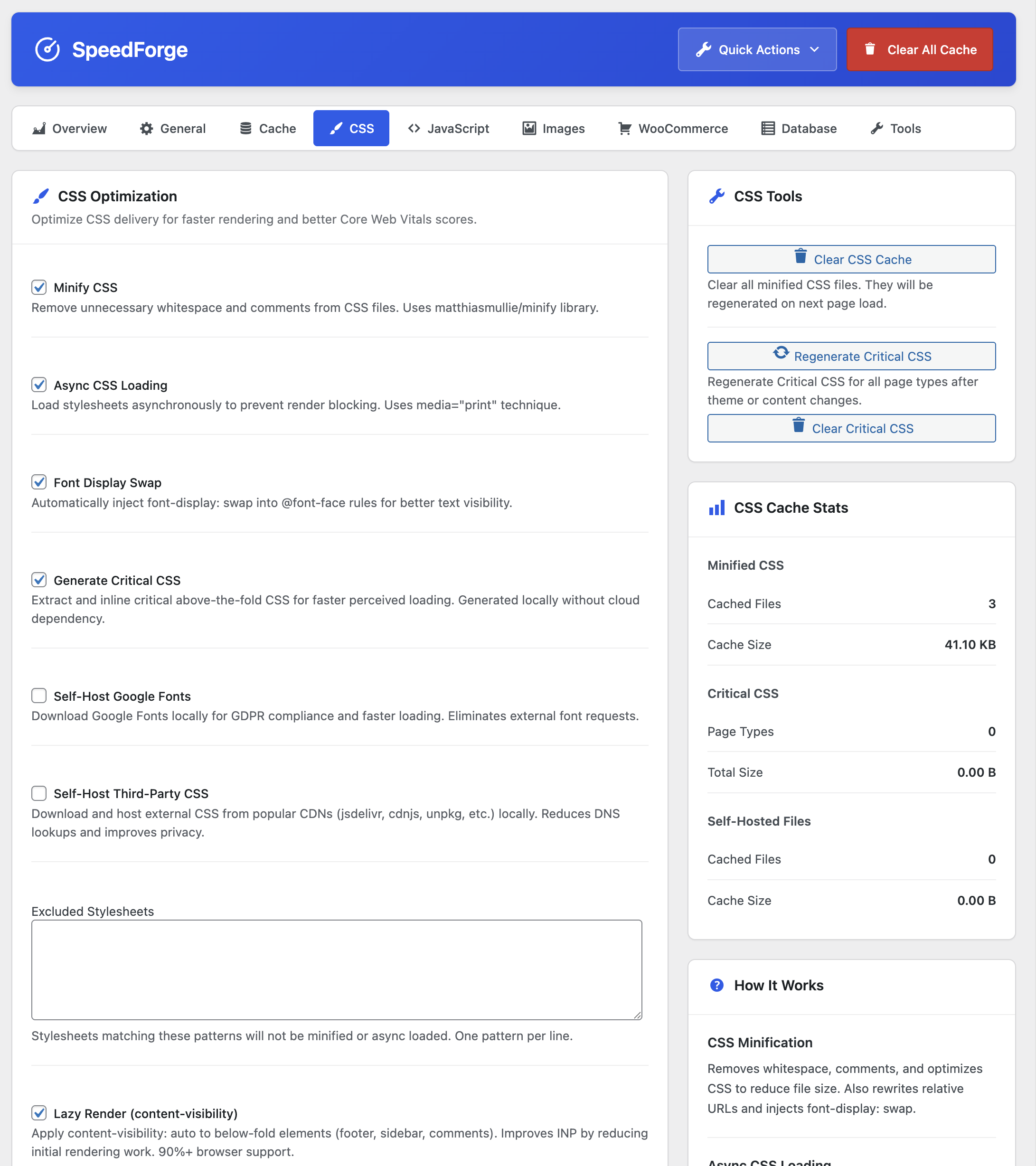
SpeedForge generates Critical CSS locally to eliminate render-blocking stylesheets. The Critical CSS extraction identifies above-the-fold styles and inlines them directly in the page head, allowing the rest of your CSS to load asynchronously. SpeedForge also minifies and combines CSS files to reduce HTTP requests and file sizes.
- Local Critical CSS generation.
- CSS minification and combination.
- Unused CSS removal per page.
- Async loading for non-critical styles.
- Self-host Google Fonts locally for GDPR compliance.
- Self-host third-party CSS from popular CDNs.
- Pre-built critical CSS templates for WooCommerce.
JavaScript Optimization
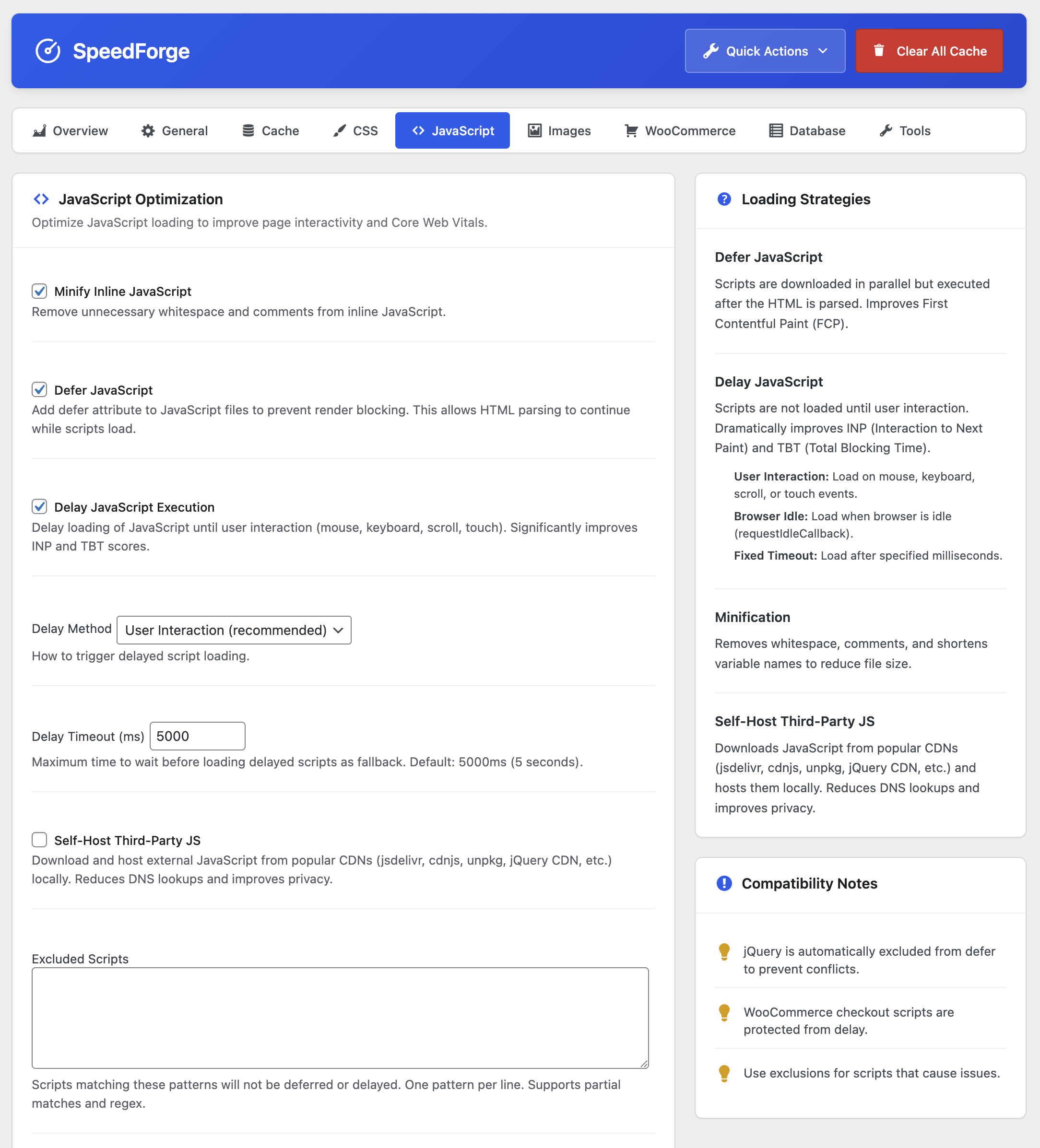
SpeedForge defers render-blocking JavaScript to improve page load times and interactivity metrics. Third-party scripts like analytics, chat widgets, and social embeds can be delayed until the user interacts with the page. SpeedForge analyzes scripts to identify which files are safe to defer or delay without breaking functionality.
- Defer loading for render-blocking scripts.
- Delay loading for third-party scripts until user interaction.
- JavaScript minification and combination.
- Smart script analysis to identify safe-to-delay files.
- Self-host third-party JavaScript from popular CDNs.
- Inline script grouping to reduce DOM parsing overhead.
Image Optimization
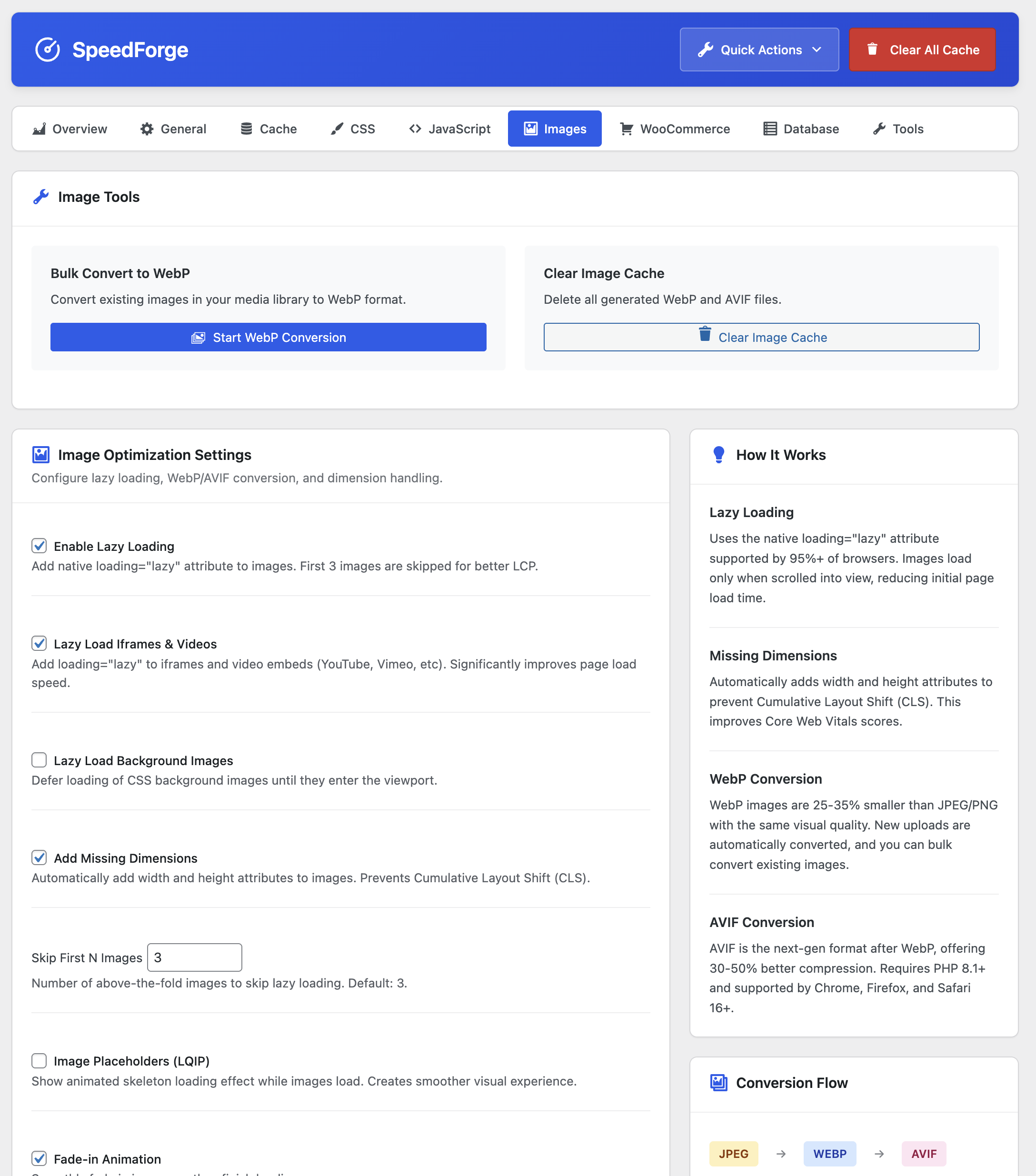
SpeedForge converts images to WebP and AVIF formats using PHP GD or ImageMagick libraries available on your server. The compression algorithm analyzes image complexity to apply appropriate quality settings without visible degradation. SpeedForge implements native browser lazy loading with Low Quality Image Placeholder support to improve perceived performance.
- WebP and AVIF conversion using
GDorImageMagick. - Smart compression based on image complexity.
- Native lazy loading with
LQIPplaceholders. - EXIF metadata removal.
- Auto-resize large uploads.
- LCP image preloading with responsive srcset for product, shop, and category pages.
WooCommerce Optimization
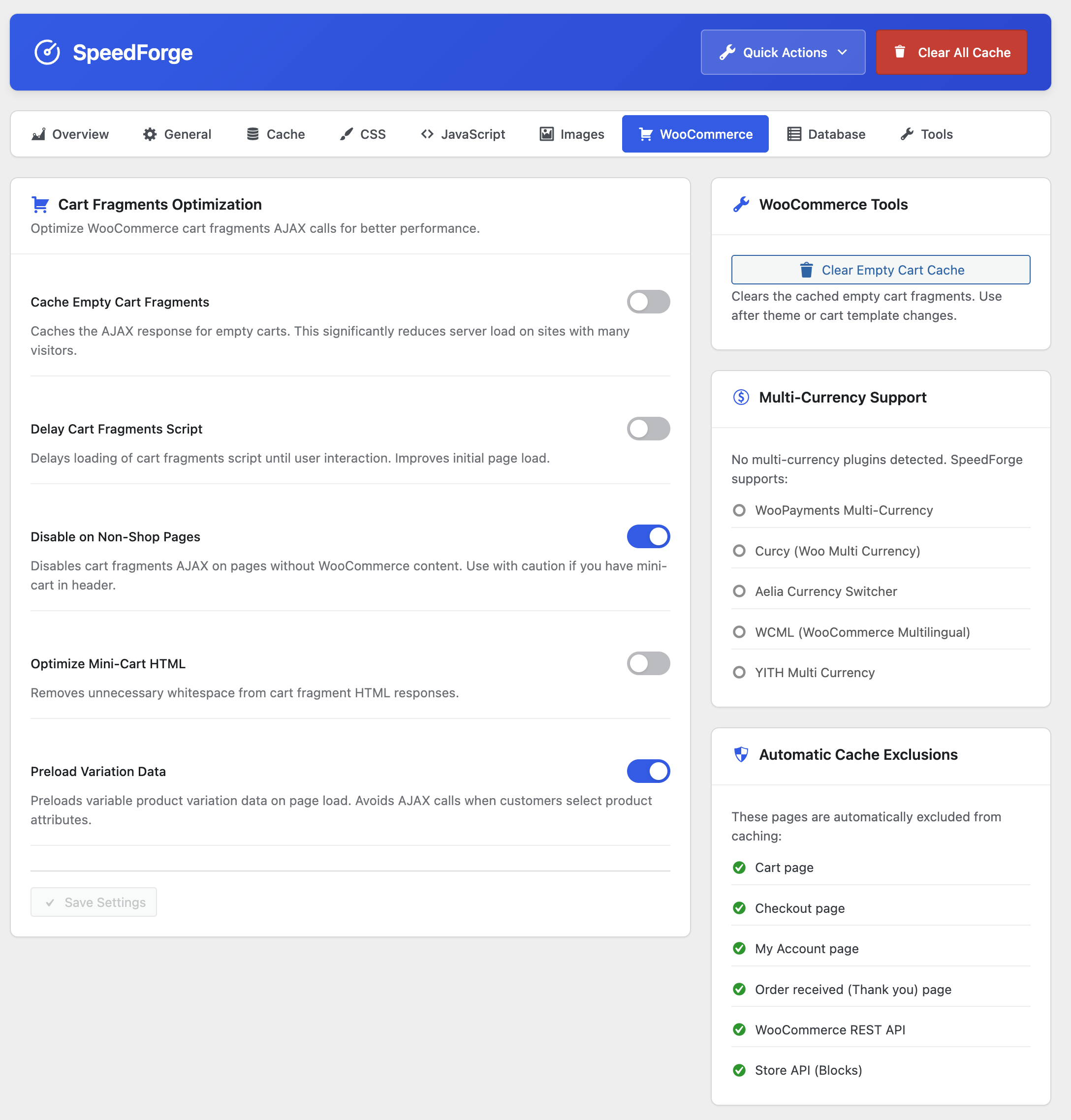
SpeedForge includes specific optimizations for WooCommerce stores. Cart Fragments, which normally load on every page, are disabled when the cart is empty to reduce unnecessary AJAX requests. Variable product data preloads on hover so attribute changes feel instant. Checkout scripts defer until the payment step, and mini-cart content loads only when visitors hover over the cart icon.
- Smart Cart Fragments that disable when cart is empty.
- Variable product data preloading on hover.
- Checkout script deferral until payment step.
- Mini-cart lazy loading on icon hover.
- Store API response caching with ETag support.
- HPOS-aware database maintenance (sessions, stock, order items, Action Scheduler).
CDN Integration
SpeedForge integrates with major CDN providers for automatic cache purging when content changes. URL rewriting serves static assets through your CDN for global performance. Provider-specific cache tag headers enable surgical CDN invalidation.
- Cloudflare API integration with URL and zone purging.
- Fastly with Surrogate-Key and soft purge support.
- Bunny.net pull zone purge API.
- Generic Webhook with HMAC-SHA256 signatures.
- Automatic CDN purge when local cache is cleared.
- Provider-specific cache tag headers (Cache-Tag, Surrogate-Key, CDN-Tag).
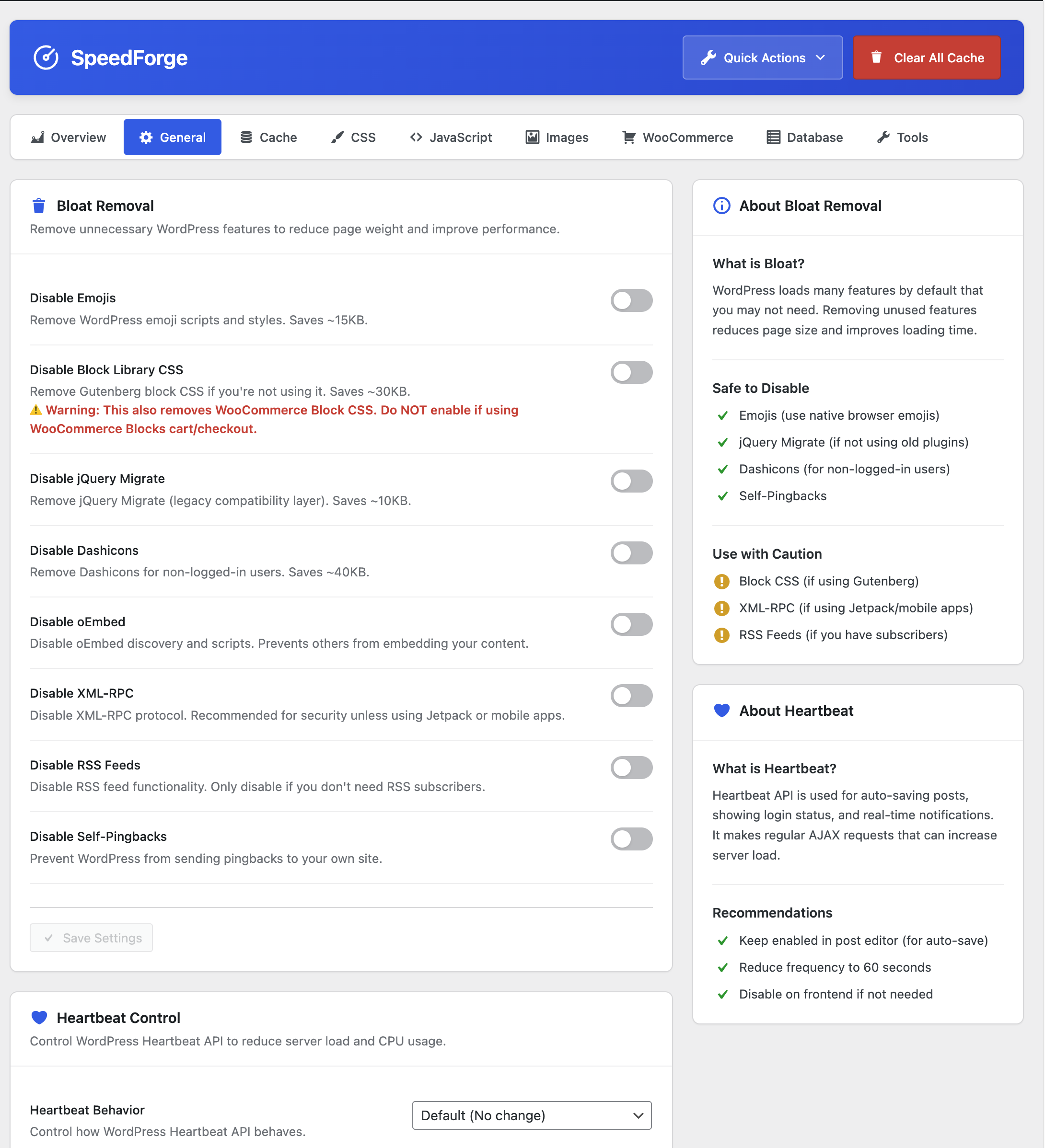
Bloat Removal
WordPress loads several features by default that many sites do not need. SpeedForge provides granular control to disable these unused features and reduce page weight. Each option can be toggled independently so you can keep features your site actually uses while removing the rest.
- Disable WordPress emoji scripts and styles.
- Remove Gutenberg block library CSS for classic themes.
- Disable jQuery Migrate legacy compatibility layer.
- Remove Dashicons for non-logged-in visitors.
- Disable oEmbed discovery and scripts.
- Disable XML-RPC for improved security.
- Remove RSS feed links from page headers.
- Prevent self-pingbacks on internal links.
Heartbeat Control
The WordPress Heartbeat API sends AJAX requests every 15-60 seconds for features like autosave and login session management. SpeedForge lets you control or disable Heartbeat in different contexts to reduce server load and improve admin performance.
- Disable Heartbeat on frontend pages.
- Control Heartbeat frequency in the post editor.
- Adjust or disable Heartbeat in the admin dashboard.
- Set custom intervals from 15 to 120 seconds.
Preloading & Prefetching
SpeedForge implements modern browser preloading techniques to speed up navigation. DNS prefetch resolves domain names before users click links. Preconnect establishes early connections to important third-party origins. The Speculation Rules API prefetches entire pages when users hover over links for near-instant transitions.
- DNS prefetch for external domains.
- Preconnect to critical third-party origins.
- Custom domain configuration for prefetch and preconnect.
- Speculation Rules API for link prefetching on hover.
- Configurable speculation eagerness levels.
- Hover prefetch for near-instant navigation.
Cloudflare Integration
SpeedForge integrates with Cloudflare to automatically purge cached content when you update your site. Connect your Cloudflare account using your Zone ID and API Token to enable automatic cache invalidation. Development mode can be toggled directly from the SpeedForge dashboard when you need to bypass Cloudflare caching temporarily.
- Automatic Cloudflare cache purging on content updates.
- Purge entire cache or specific URLs.
- Toggle Development Mode from WordPress admin.
- Compatible with Cloudflare APO for WordPress.
Database Cleanup
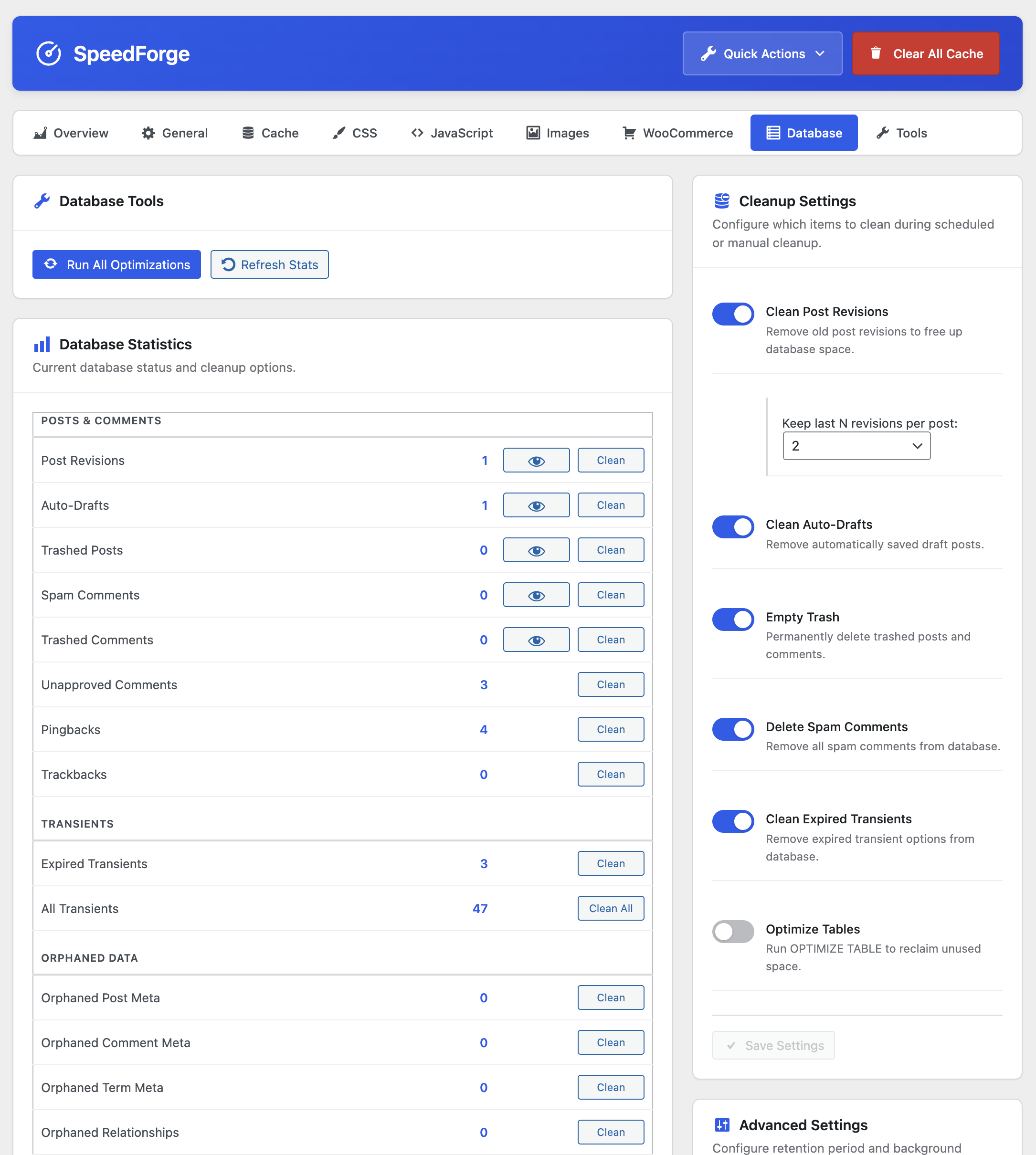
SpeedForge removes database bloat that accumulates over time. Post revisions, auto-drafts, trashed content, spam comments, and expired transients consume database space and slow down queries. SpeedForge provides manual cleanup tools and scheduled automatic cleanup to maintain database efficiency.
- Remove post revisions, auto-drafts, and trashed posts.
- Clean spam and trashed comments.
- Delete expired transients.
- Schedule automatic cleanup routines.
Speed Testing
SpeedForge integrates with Google PageSpeed Insights API to provide speed testing directly from your dashboard. Core Web Vitals metrics are tracked over time so you can measure the impact of optimization changes. SpeedForge maps PageSpeed audit results to specific features and offers one-click fixes for common issues. A/B testing lets you compare different optimization settings to find the best configuration for your site.
- Built-in Google PageSpeed Insights integration.
- Core Web Vitals tracking with history.
- Audit-to-feature mapping with one-click fixes.
- A/B testing to compare optimization settings.
Managed Hosting Compatibility
SpeedForge automatically detects managed hosting environments and adjusts its behavior accordingly. On hosts like WordPress.com, Pressable, WP Engine, Kinsta, SiteGround, Cloudways, and Flywheel that provide their own caching systems, SpeedForge disables its page cache feature to avoid conflicts. CSS, JavaScript, image, and WooCommerce optimizations continue to work alongside the host-provided caching.
External Services
SpeedForge connects to the following external services. All connections are initiated only by admin actions or explicit feature configuration. No data is sent without user consent, and no visitor tracking occurs.
Google PageSpeed Insights API
When you run a speed test from the SpeedForge dashboard, your site URL is sent to the Google PageSpeed Insights API to analyze page performance and Core Web Vitals metrics. This connection only occurs when you manually initiate a speed test from the admin dashboard. No data is sent automatically and no visitor data is transmitted.
- What the service does: Analyzes web page performance and provides Core Web Vitals metrics.
- What data is sent: The public URL of the page being tested.
- When data is sent: Only when an admin manually clicks “Run Speed Test” in the SpeedForge dashboard.
- Service: Google PageSpeed Insights
- Terms of Service: Google Terms of Service
- Privacy Policy: Google Privacy Policy
Cloudflare API (Optional)
If you enable Cloudflare integration and provide your API credentials (Zone ID and API Token), SpeedForge connects to the Cloudflare API to purge cached content and toggle development mode. This connection only occurs when you configure Cloudflare settings, when cache purging is triggered by content updates, or when you manually purge Cloudflare cache from the dashboard.
- What the service does: Manages Cloudflare CDN cache for your domain.
- What data is sent: Your Cloudflare API credentials (stored locally), zone ID, and URLs to purge.
- When data is sent: When content is updated (automatic cache purge) or when an admin manually triggers a Cloudflare action.
- Service: Cloudflare
- Terms of Service: Cloudflare Terms of Service
- Privacy Policy: Cloudflare Privacy Policy
Self-Hosting Third-Party Assets (Optional)
When the “Self-Host Google Fonts” or “Self-Host Third-Party CSS/JS” features are enabled, SpeedForge downloads font files, CSS, and JavaScript from external CDNs (such as Google Fonts, Font Awesome, jsDelivr, cdnjs, and similar public CDNs) and stores them locally on your server. This eliminates external requests from your visitors’ browsers, improving both privacy and performance. The download occurs once (server-side, not visitor-triggered) and the files are cached locally for subsequent page loads.
- What the service does: Provides publicly available font, CSS, and JavaScript files.
- What data is sent: Standard HTTP GET requests to download public assets. No visitor data is sent.
- When data is sent: When an admin enables self-hosting and a previously uncached asset is encountered during a page load.
- Services: Google Fonts, Font Awesome, jsDelivr, cdnjs, and other public CDNs.
- Google Fonts Terms: Google Fonts FAQ
- jsDelivr Terms: jsDelivr Terms
Gravatar Self-Hosting (Optional)
When the “Self-Host Gravatars” feature is enabled, SpeedForge downloads Gravatar avatar images from gravatar.com and stores them locally on your server. This eliminates external Gravatar requests from your visitors’ browsers, improving both privacy and performance. The download occurs server-side when a page containing Gravatar images is first loaded and the avatars are cached locally for subsequent page loads.
- What the service does: Gravatar provides user avatar images based on email address hashes.
- What data is sent: Standard HTTP GET requests to download public avatar images from
gravatar.com. No visitor personal data is sent beyond the Gravatar URL hash that is already present in the page HTML. - When data is sent: When the self-host Gravatars option is enabled and a page with Gravatar images is loaded for the first time (or when the local cache has expired).
- Service: Gravatar (operated by Automattic)
- Privacy Policy: Automattic Privacy Policy
- Terms of Service: WordPress.com Terms of Service
DNS Prefetch and Preconnect (Optional)
When DNS Prefetch or Preconnect features are enabled, SpeedForge adds resource hints to your page HTML headers. These hints tell visitors’ browsers to perform early DNS resolution or connection establishment to common third-party origins (such as Google Analytics, Google Tag Manager, Facebook, and popular CDNs). No data is sent from your server; the browser handles these connections natively. These hints only affect page load performance for visitors.
- What happens: HTML
<link rel="dns-prefetch">and<link rel="preconnect">tags are added to the page head. - What data is sent: None from your server. The visitor’s browser performs standard DNS/connection operations.
- When it happens: On every frontend page load when the feature is enabled.
Varnish Cache Purging (Automatic, Localhost Only)
When SpeedForge detects a Varnish reverse proxy on the server, it sends HTTP PURGE requests to 127.0.0.1 (localhost) to clear cached pages after content updates. These requests never leave the server — they are sent to the local Varnish instance running on the same machine. No external network calls are made and no visitor data is involved.
- What the service does: Varnish is a local reverse proxy cache running on the same server.
- What data is sent: HTTP PURGE requests to
127.0.0.1containing the URL path to purge. - When data is sent: Automatically when post/page content is updated or when an admin manually clears the cache.
- Note: These are strictly localhost requests that do not leave the server.
Nginx Cache Purging (Automatic, Same-Server Only)
When SpeedForge detects an Nginx FastCGI cache or proxy cache setup, it sends HTTP purge requests to the server’s own domain to clear cached pages. These requests are directed at the server itself via its own hostname. No external services are contacted and no visitor data is involved.
- What the service does: Nginx cache is a local caching layer running on the same server.
- What data is sent: HTTP GET requests to the server’s own purge endpoint containing the URL path to purge.
- When data is sent: Automatically when post/page content is updated or when an admin manually clears the cache.
- Note: These requests are directed at the same server and do not contact external services.
Privacy
SpeedForge processes all optimization locally on your server. CSS minification, image compression, Critical CSS generation, and all other optimization features run entirely on your hosting environment with no external dependencies.
The only external connections are:
- Google PageSpeed Insights API when you manually run a speed test.
- Cloudflare API if you enable and configure Cloudflare integration.
- External CDN servers when self-hosting feature downloads assets to serve locally.
- Gravatar servers when self-host Gravatars feature downloads avatar images to serve locally.
SpeedForge does not include any tracking, analytics, or telemetry. No visitor data is collected or transmitted by the plugin.
Details
Related plugins
Plugins that also contain the tag cache
WP Super Cache

WP-Optimize – Cache, Compress images, Minify & Clean database to boost page speed & performance
SpeedyCache – Cache, Optimization, Performance

Breeze Cache

OMGF | GDPR/DSGVO Compliant, Faster Google Fonts. Easy.

Jetpack Boost – Website Speed, Performance and Critical CSS


About
Plugin for that tries to help you find the WordPress plugin you are looking for.
| Please enjoy an image of Crush (this awesome turtle) and have a lovely day! |  |
We do not own any plugin listed on this site and do not work for or work with WordPress.com or it's associated companies. We simply provide a searchable list of the available WordPress plugins.