

Statinform: Cookieless Analytics (No Consent Banner)
StatInform is a self-hosted analytics plugin for WordPress that keeps all data on your own server. It does not use cookies, does not send data to third parties (Google, Yandex, or anyone else), and has a minimal impact on your site’s performance.
Key features
- No cookies. Session identification uses
sessionStorage, which is cleared when the browser tab closes. No long-lived identifiers, no cross-visit tracking. - No external services. All data is stored in your own MySQL database. Nothing is sent anywhere.
- Minimal server load. The collection endpoint runs outside of WordPress core. It does not load
wp-load.php, does not touch the database, and simply appends a line to a buffer file. - Page-level detail. Tracks entry/exit pages, full session page chains, time on each page, and transitions between pages.
- Source detection. Classifies traffic by referrer and UTM tags. Recognizes search engines, social networks, and messengers (Telegram, WhatsApp, Viber, and others).
- Outbound link tracking. Tracks clicks on external links,
mailto:, andtel:links. - Bot filtering. Detects known bots by User-Agent and
Accept-Languageheaders. - Bounce rate. A session is a bounce when it has <= 1 unique page and total time < 15 seconds.
- Data export. Export any table to CSV for a chosen period. Create ZIP archives on the server. Delete old data with optional pre-archiving.
- No cookie consent banner required for this plugin’s own data collection, because no cookies are used and no personal data is stored in identifiable form.
Performance and architecture
StatInform’s collection endpoint intentionally runs outside of WordPress core. This means:
- No
wp-load.php. The endpoint is a standalone PHP script. It does not load WordPress, does not connect to the database, and does not fire any hooks. - The endpoint lives in
wp-content/uploads/eistat/. It is copied there on activation from a template file inside the plugin folder. WordPress.org guidelines require plugins to store user data inuploads/, not in the plugin directory. - No SQL in the collection path. Events are appended to hourly
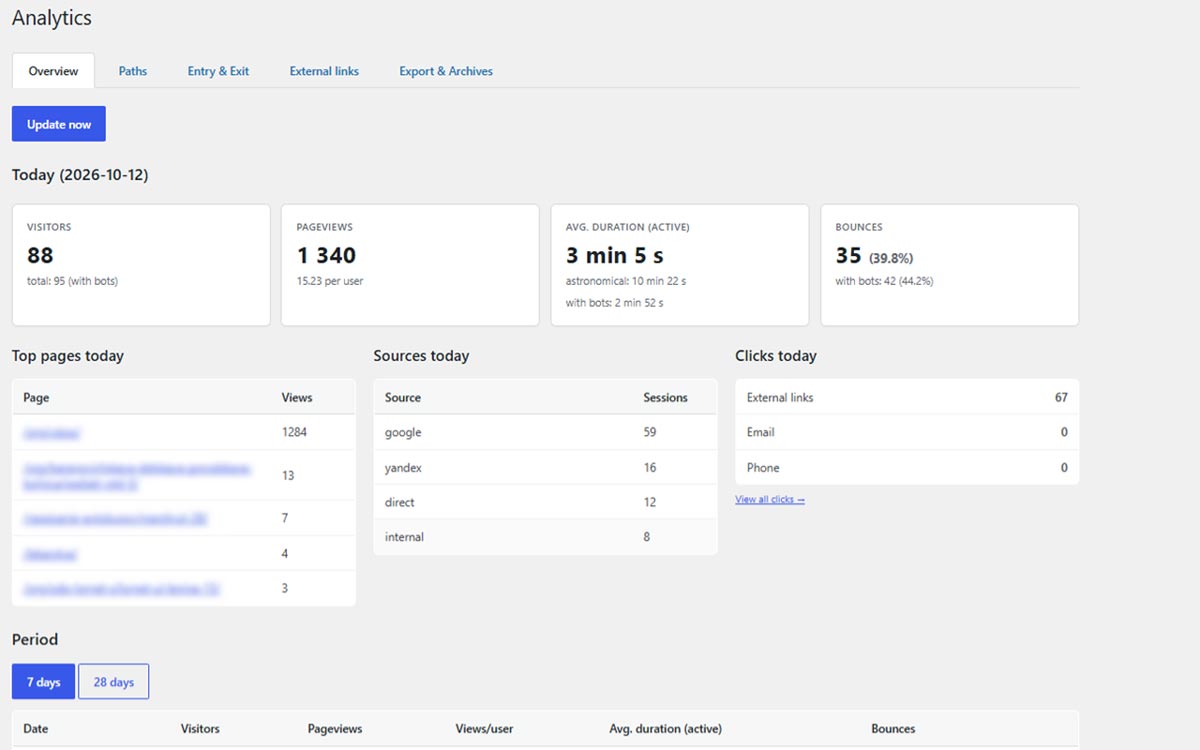
.jsonlbuffer files. Aggregation into the database happens separately via WP-Cron or the manual “Update now” button. - Data files are protected from direct access.
.htaccessfiles in the buffer and archives folders block direct HTTP access. On Nginx, these files are ignored and equivalent server-level rules should be configured.
Notes for reviewers
A few static-analysis warnings appear when running Plugin Check (PCP) on this plugin. They are false positives:
-
InterpolatedNotPreparedon SQL queries. All queries use$wpdb->prepare()for values. Table names are built as$wpdb->prefix . 'eistat_'and cannot be parameterized throughprepare(). The table prefix is a controlled value that never comes from user input. -
NonceVerification.Recommendedon GET parameters. The admin views read filter parameters (days,view,date,source,link_type,paged) directly from$_GET. These are read-only filters that do not change state, so a nonce is not required. All values are sanitized withsanitize_text_field(),sanitize_key(), orabsint(). -
DirectDatabaseQueryandNoCaching. The plugin uses custom tables with the prefixwp_eistat_. These tables are not part of the WordPress object cache, so caching them would provide no benefit.
The plugin does not write any PHP code to user files. The buffer path is stored as plain JSON in uploads/eistat/buffer-path.json and read with file_get_contents() + json_decode().
Details
Related plugins
Plugins that also contain the tag analytics
Site Kit by Google – Analytics, Search Console, AdSense, Speed

MonsterInsights – Google Analytics Dashboard for WordPress (Website Stats Made Easy)

WP Statistics – Simple, privacy-friendly Google Analytics alternative

GA Google Analytics – Connect Google Analytics to WordPress

Head, Footer and Post Injections

ExactMetrics – Google Analytics Dashboard for WordPress (Website Stats Plugin)


About
Plugin for that tries to help you find the WordPress plugin you are looking for.
| Please enjoy an image of Crush (this awesome turtle) and have a lovely day! |  |
We do not own any plugin listed on this site and do not work for or work with WordPress.com or it's associated companies. We simply provide a searchable list of the available WordPress plugins.