


Sunshine UTM Builder
Sunshine UTM Builder makes the UTM-tagged links you put in emails, ads and social posts, so Google Analytics can tell you where your visitors came from. It also keeps your tags spelled the same way every time, since one stray capital letter or space is enough to split a campaign into two rows in your reports.
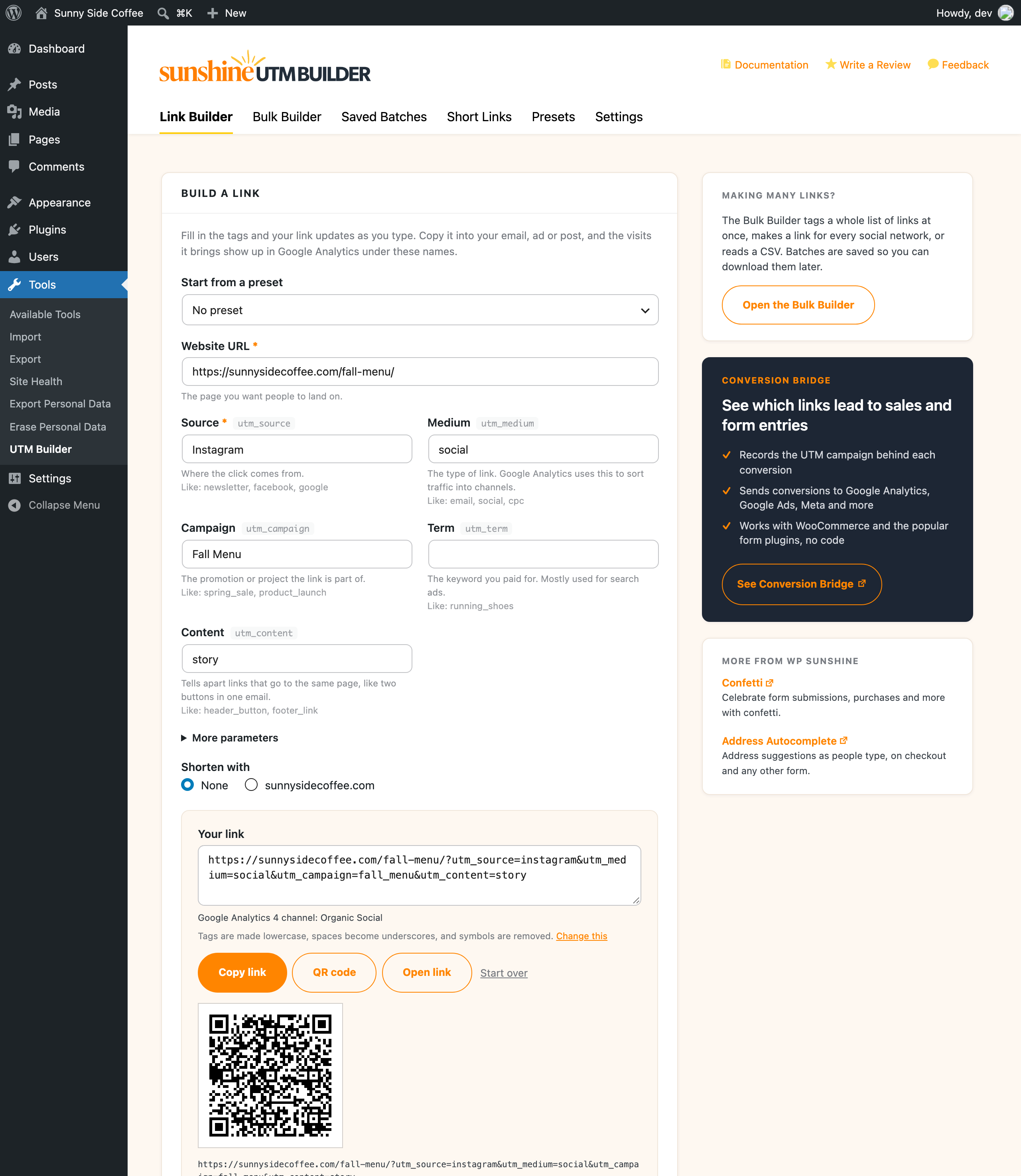
It lives under Tools UTM Builder. Paste a page, fill in the tags, and your link updates as you type. Everything is free, with no paid version and no account to sign up for.
Build a link as you type
- All five tags: source, medium, campaign, term and content
- The link updates on every keystroke, with copy and open buttons
- Pick a shortener for the link: your own domain, Bitly or Rebrandly
- Add other parameters too, like
ref=partnerorutm_id - UTM tags already on a link are replaced, and the link’s other parameters are kept
- Tags go before any
#anchorin the link, where Google Analytics can read them - Suggestions for common sources and mediums, spelled the way Google Analytics expects
- See which Google Analytics 4 channel the link will land in, before you share it
- A QR code for any link, to download as PNG or SVG for flyers, menus and signs
No more “Unassigned” in Google Analytics 4
Google Analytics 4 sorts visits into channels like Organic Social, Email and Paid Search using fixed rules. A medium it doesn’t know, like fb, newsletter or qr, sends those visits to “Unassigned”, where they’re hard to make sense of. The builder shows the channel for every link as you type, and warns you when it would be Unassigned, with a medium to use instead. The Bulk Builder’s preview shows it for every link too.
Consistent tags, every time
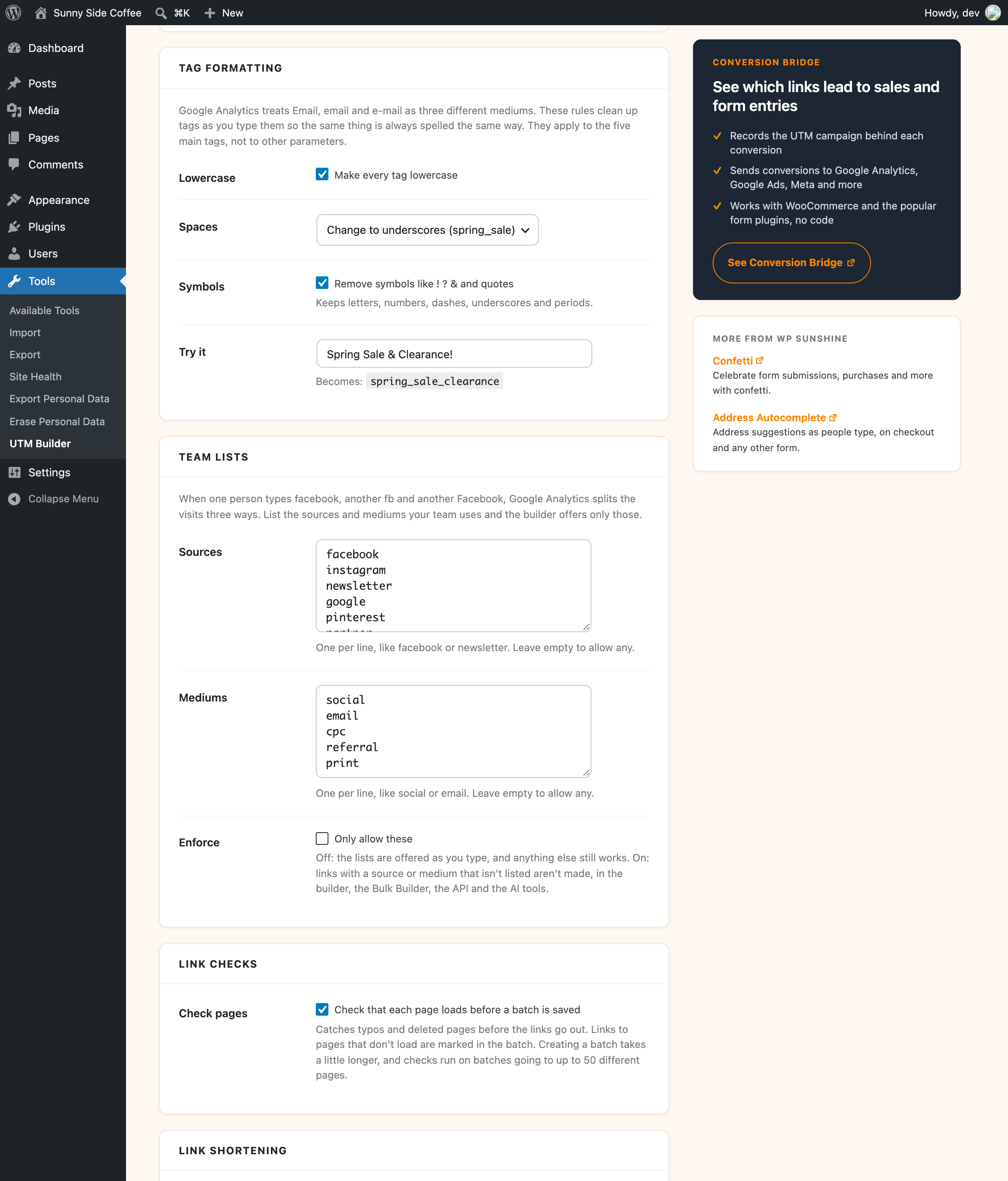
Google Analytics treats “Email”, “email” and “e-mail” as three different mediums. The formatting rules clean up tags as you type them, so the same thing is always spelled the same way:
- Make every tag lowercase
- Change spaces to underscores or dashes
- Remove symbols like ! ? and &
Each rule can be turned off in Settings, and the Settings screen shows what a tag will look like before you save.
When one person types facebook, another fb and another Facebook, your reports split three ways. Team lists fix that. List the sources and mediums your team uses in Settings, and the builder offers those as you type. Turn on “Only allow these” and links with anything else aren’t made, in the builder, the Bulk Builder, the REST API and the AI tools.
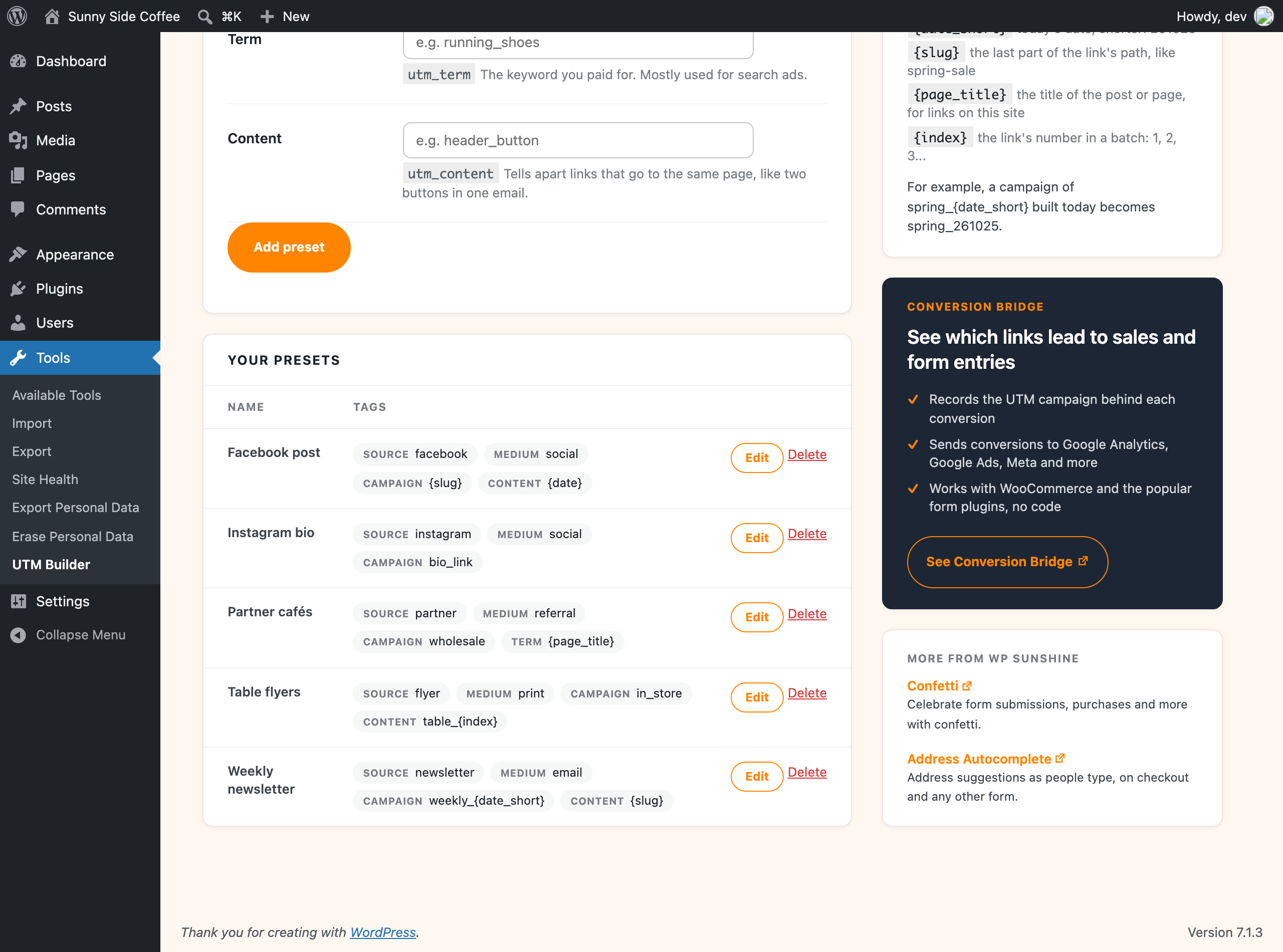
Presets
Save the tags you use a lot, like your newsletter or a partner’s links, and pick the preset to fill them in. Presets can hold tokens that are filled in for each link:
{date}and{date_short}for today’s date{slug}for the last part of the link’s path{page_title}for the title of the post or page, for links on your own site{index}for the link’s number in a batch
Bulk Builder
Make many links at once, four ways:
- A list of links. Paste them in and they all get the same tags.
- Social networks. One link per network, with the network as the source and social as the medium. Facebook, Instagram, X, LinkedIn, Threads, Bluesky, Pinterest, YouTube, TikTok and Reddit are built in.
- Every combination. List a few values for any tag and get a link for every mix, which is handy for testing ad versions.
- A CSV file. One row per link with its own tags. Blank cells use the shared tags, and any extra column (like
ref) is added to that row’s link as its own parameter. Commas, semicolons and tabs all work, so files saved from Excel in any language are fine.
A preview shows how many links you’ll get and the first 20 of them before anything is saved. Lines that aren’t web addresses are listed so you can fix them.
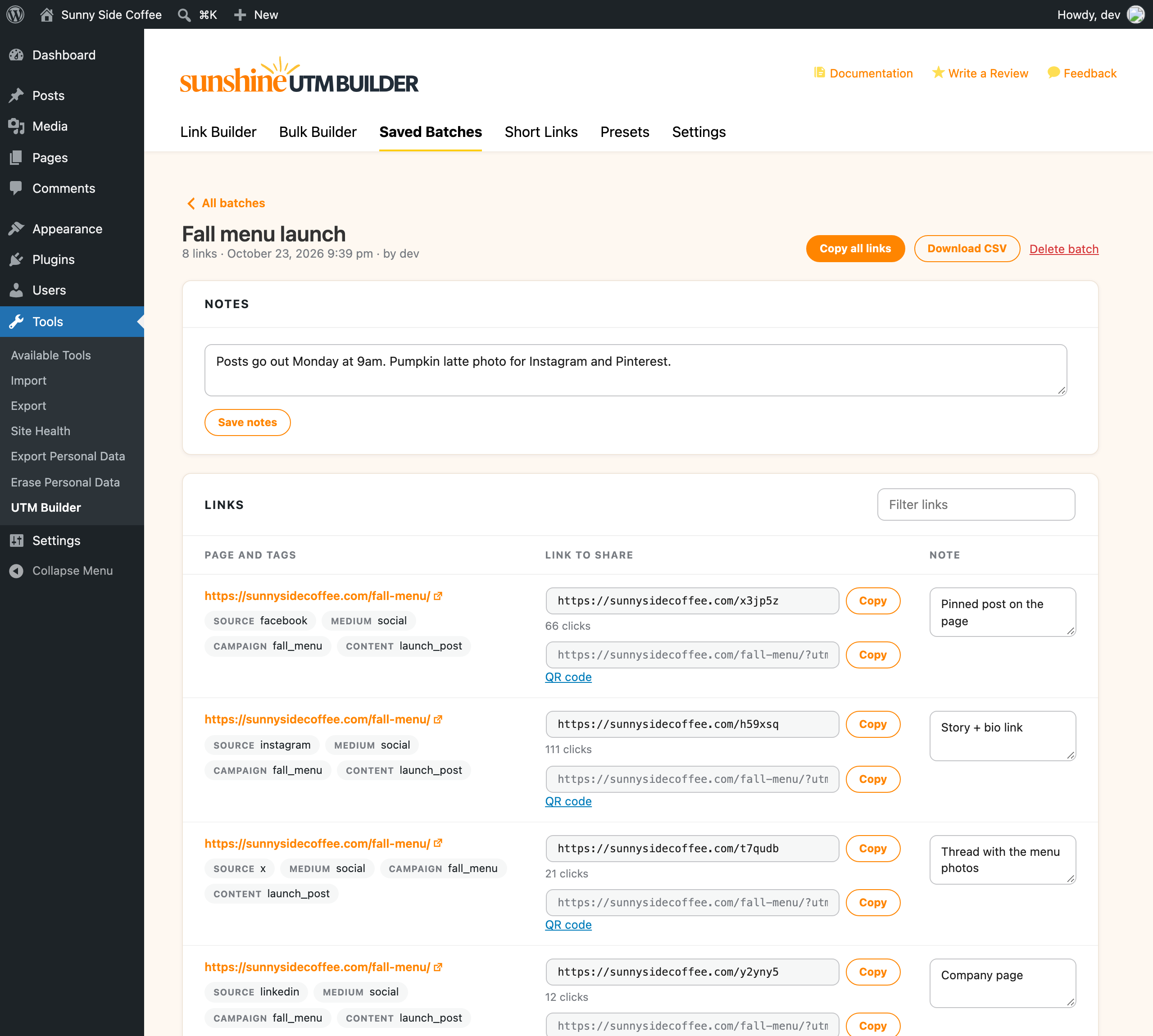
Saved batches
Every bulk batch is saved, so you can find those links again later.
- Search batches by name or notes
- Notes for the batch, and a note on each link (where it’s used, who asked for it)
- Copy one link or every link at once
- Download the batch as a CSV file that opens cleanly in Excel and Google Sheets
Link checks
Turn on link checks and each page is loaded before a batch is saved. Links to pages that don’t load, like a typo or a deleted post, are marked in the batch so you can fix them before they go out.
Short links on your own domain
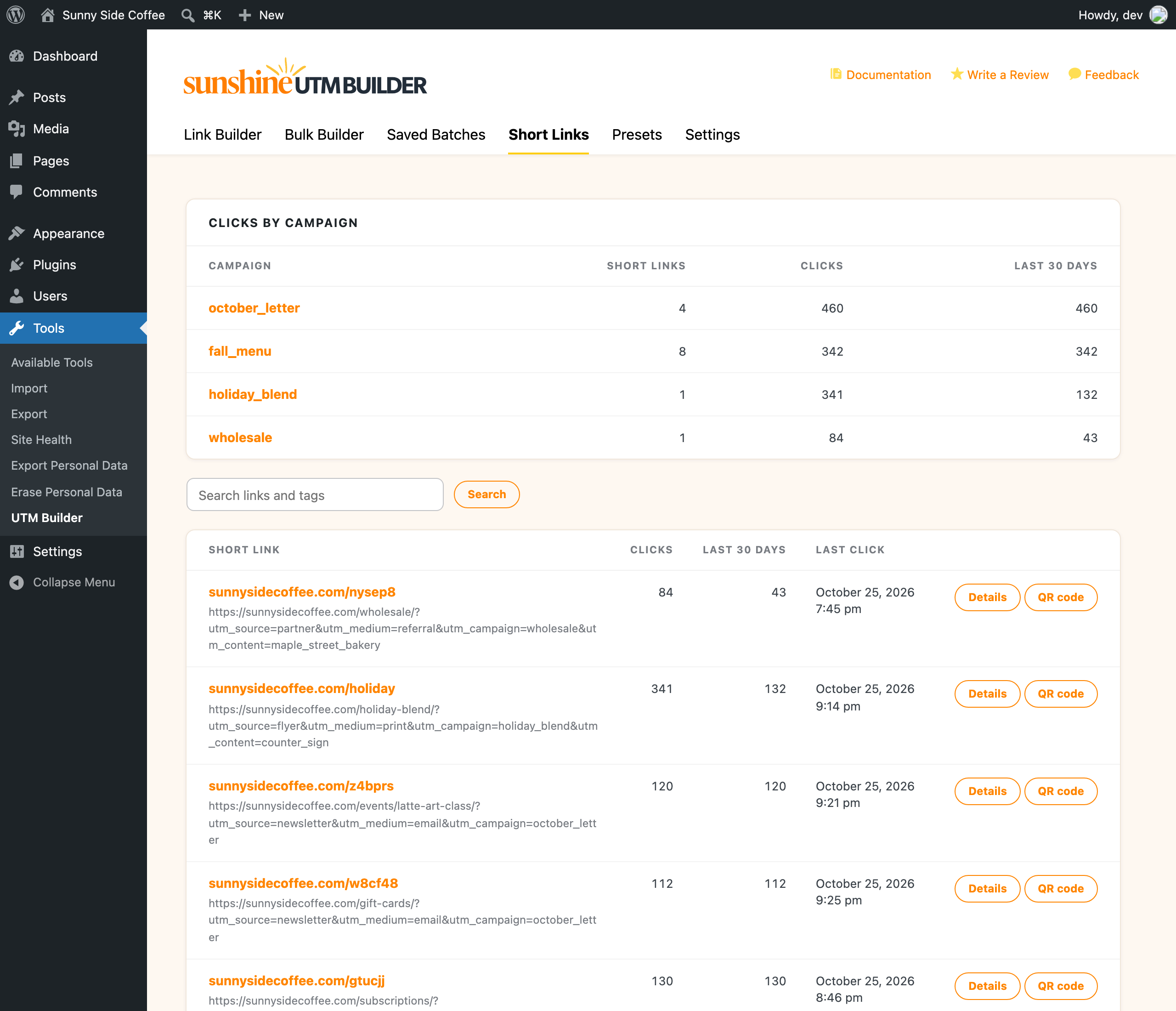
Long tagged links look messy in social posts and text messages. Short links turn yourdomain.com/sale/?utm_source=facebook&utm_medium=social&utm_campaign=spring_sale into yourdomain.com/x8d89c, which sends visitors on to the full link so the tags still reach Google Analytics. There’s no account to sign up for, and the same long link always gets the same short link. Each one counts its clicks, so you can see which posts people actually clicked.
Short links don’t slow down the rest of your site. A short link is only looked up when no page exists at that address, so normal page views never touch it, and a real page always wins over a short link. If you’d like them answered even faster, add a short word in front, like yourdomain.com/g/x8d89c, and they’re handled before WordPress looks for a page. Links you’ve already shared keep working if you change that word later.
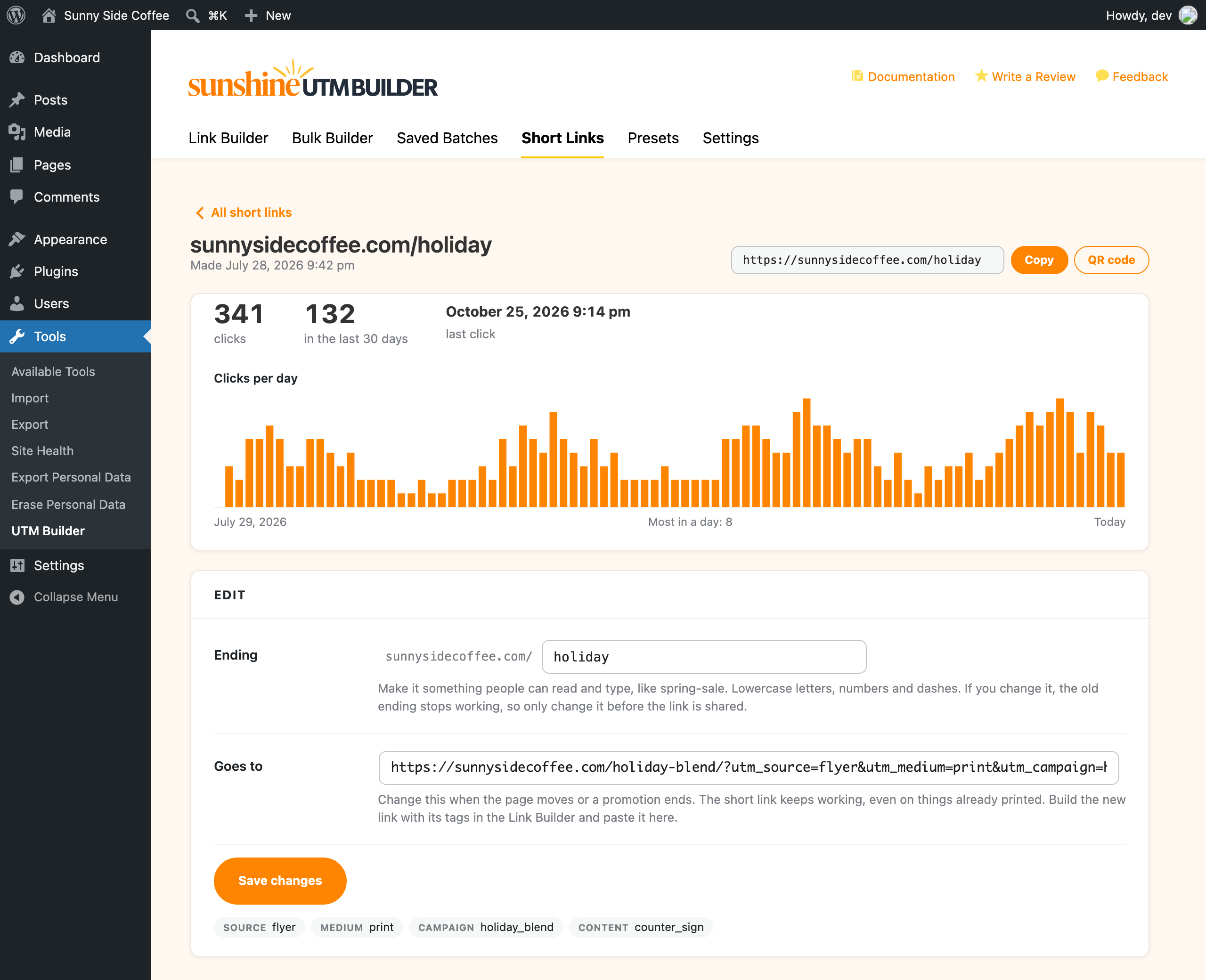
Each short link has its own page under Tools UTM Builder Short Links:
- Clicks per day for the last 90 days, plus totals and the last click
- Change where it goes when a page moves or a promotion ends, and links already printed keep working
- Choose your own ending, like
yourdomain.com/spring-sale, so people can read and type it - A QR code, and a delete button
The Short Links tab also totals clicks by campaign, so you can see how a whole campaign did at a glance.
You can also connect your own Bitly or Rebrandly account. Set up as many as you like, and pick one each time under “Shorten with”, right above your link.
Shortcuts
- A “UTM link” button in the admin bar opens the builder with the page you’re looking at already filled in
- A “UTM link” action under each published post and page does the same from your post lists
- A “UTM link” panel in the block editor’s sidebar, with a button to build a link to the post and the post’s short links with their clicks
- Choose which post types get them
Let AI build your links
Ask an AI assistant for “a tagged link to the spring sale page for our Facebook post” and it can make the link on your site, with your presets, your formatting rules and your short links, so its links match yours. The plugin adds three abilities through the WordPress Abilities API (WordPress 6.9 and later):
- Build a UTM link for one page, with an optional short link from any shortener you’ve set up
- Build many UTM links with any of the Bulk Builder’s four ways, and save them as a batch
- List UTM presets, so the AI uses the tag spellings you already use
AI tools like Claude connect to them through the MCP Adapter plugin. Scripts and other tools can run them at /wp-json/wp-abilities/v1/abilities/sunshine-utm/build-link/run. Both need an administrator login, and an Application Password works well for that.
REST API
Send a POST to /wp-json/sunshine-utm/v1/links with a list of urls and the tags (source, medium, campaign, term, content) to get tagged links back. Add "save": true to keep them as a batch. The endpoint only answers requests from administrators.
See which links lead to sales
This plugin makes the links and counts clicks on your short links, and Google Analytics shows the visits they bring. If you’d like to see which campaigns turn into sales and form entries on your WordPress site, Conversion Bridge records the UTM tags behind each conversion. When both plugins are active, the Short Links tab shows conversions next to clicks for each short link, and Conversion Bridge’s own small UTM builder steps aside for this one.
Credits
QR codes are made with QRCode for JavaScript by Kazuhiko Arase (MIT license). “QR Code” is a registered trademark of DENSO WAVE INCORPORATED.
External services
This plugin only contacts other services for the features below, and only when you use them.
Bitly
If you choose Bitly as your link shortener in Settings, the link being shortened is sent to Bitly’s API (api-ssl.bitly.com) along with your access token. That happens when you pick Bitly under “Shorten with” in the builder, when you create a batch with shortening on, and when the AI tools or the API ask for a short link. Bitly sends back the short link. Terms of service, privacy policy.
Rebrandly
If you choose Rebrandly as your link shortener in Settings, the link being shortened is sent to Rebrandly’s API (api.rebrandly.com) along with your API key, at the same times as for Bitly above. Rebrandly sends back the short link. Terms and conditions, privacy policy.
Link checks
If you turn on link checks in Settings, each page a batch links to is requested once when the batch is created, to see whether it loads. The request goes to whatever site that page is on, and nothing is sent besides the request itself. Link checks are off by default.
Details


About
Plugin for that tries to help you find the WordPress plugin you are looking for.
| Please enjoy an image of Crush (this awesome turtle) and have a lovely day! |  |
We do not own any plugin listed on this site and do not work for or work with WordPress.com or it's associated companies. We simply provide a searchable list of the available WordPress plugins.