



Synth Antispam
Synth Antispam connects your site to Synth for WordPress, the hosted AI spam-checking service
built on Synth — the same platform that already reads more than three million messages a year.
Every comment is judged on what it is trying to sell, not matched against a keyword list you have
to keep current, and not scored by code running on your site. To get started: install the plugin,
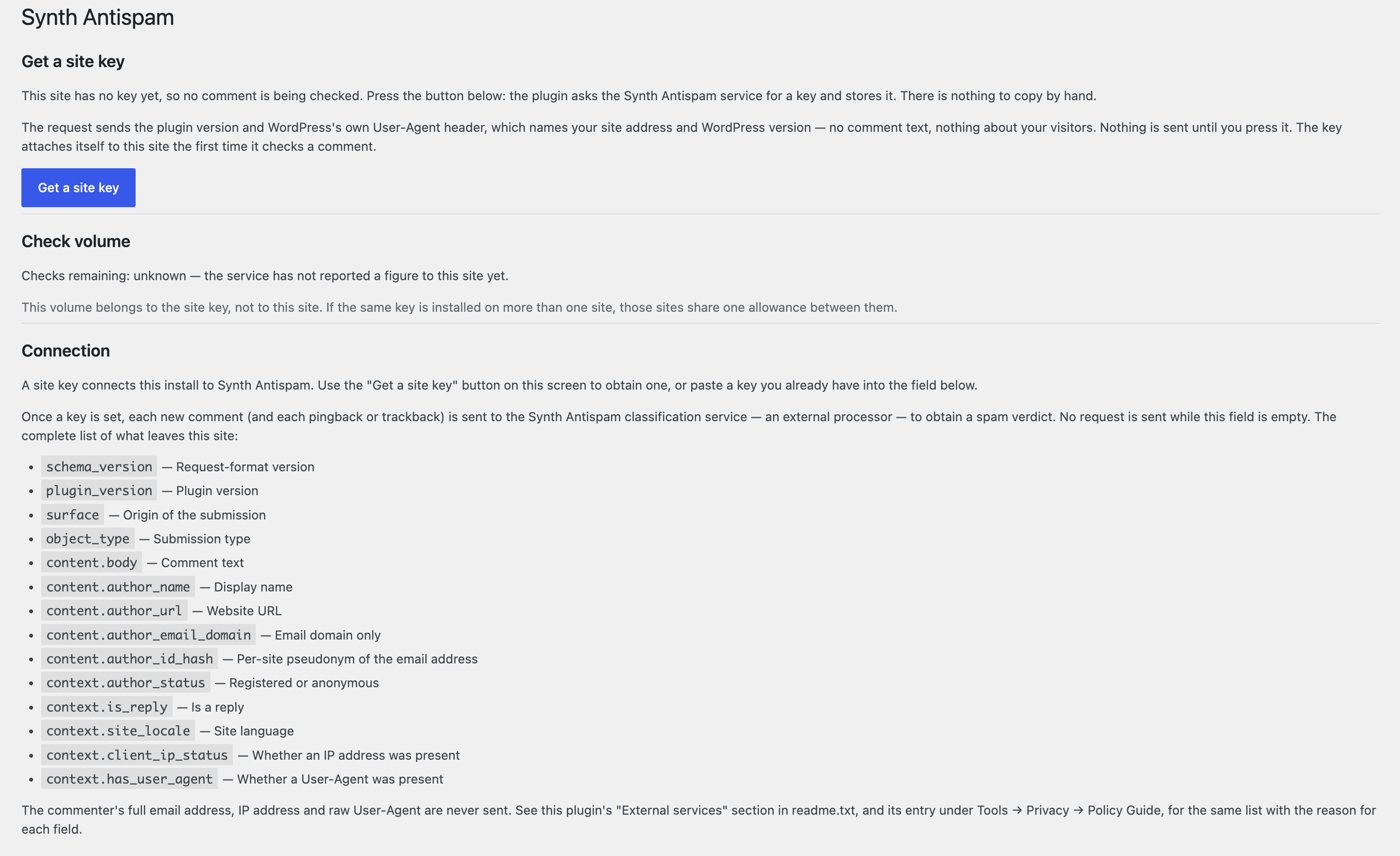
open Settings Synth Antispam and press Get a site key — there is nothing to copy by hand.
The visitor never waits: the verdict comes back a moment after the comment is submitted, not in the
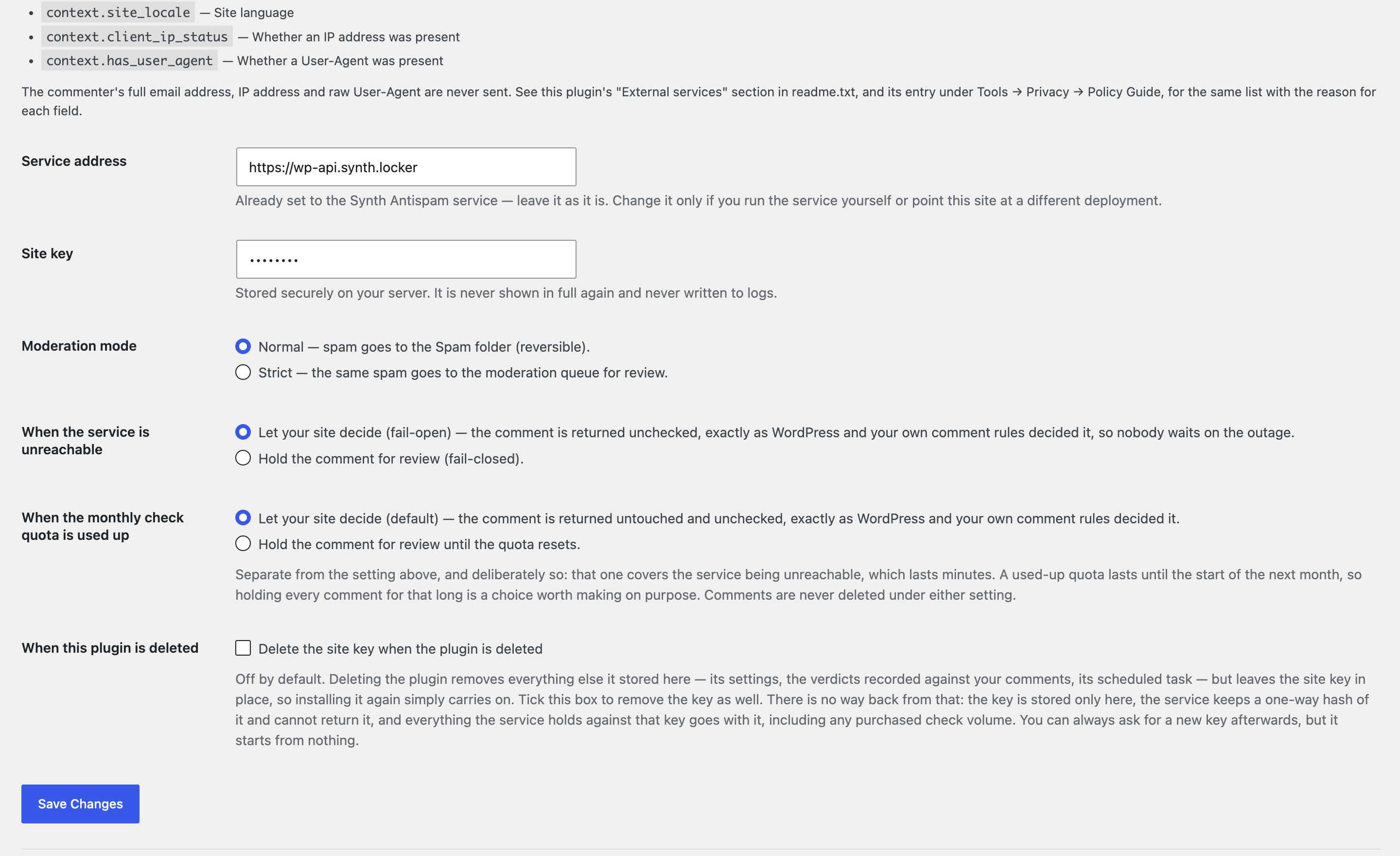
middle of the request. Spam lands in the Spam folder, or in the moderation queue in strict mode.
Nothing is ever deleted. The plugin never removes a comment and never puts one in Trash, so a
comment filed as spam by mistake stays recoverable for as long as you keep it. WordPress’s
scheduled cleanup empties Trash, not Spam.
Why a model instead of a rule list
- Rewording does not help the spammer. A rule list matches strings, so the spammer edits the
string. A model reads the message — and the message is the thing being sold. - Nothing to maintain. No keyword lists, no blocklists, no regular expressions to update when
the wording shifts. - Every surface, not just the form. The comment form, the REST API and XML-RPC are all checked,
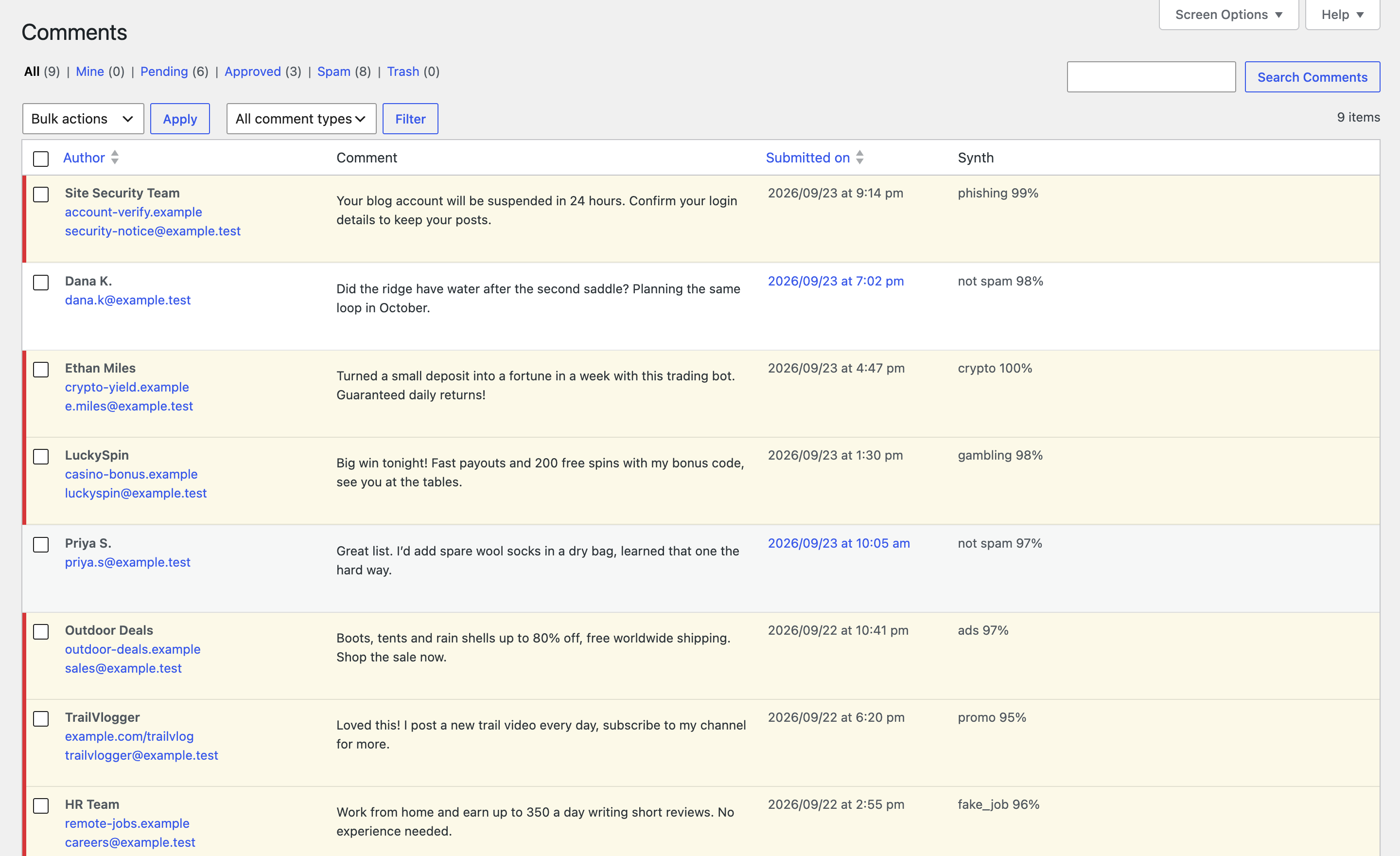
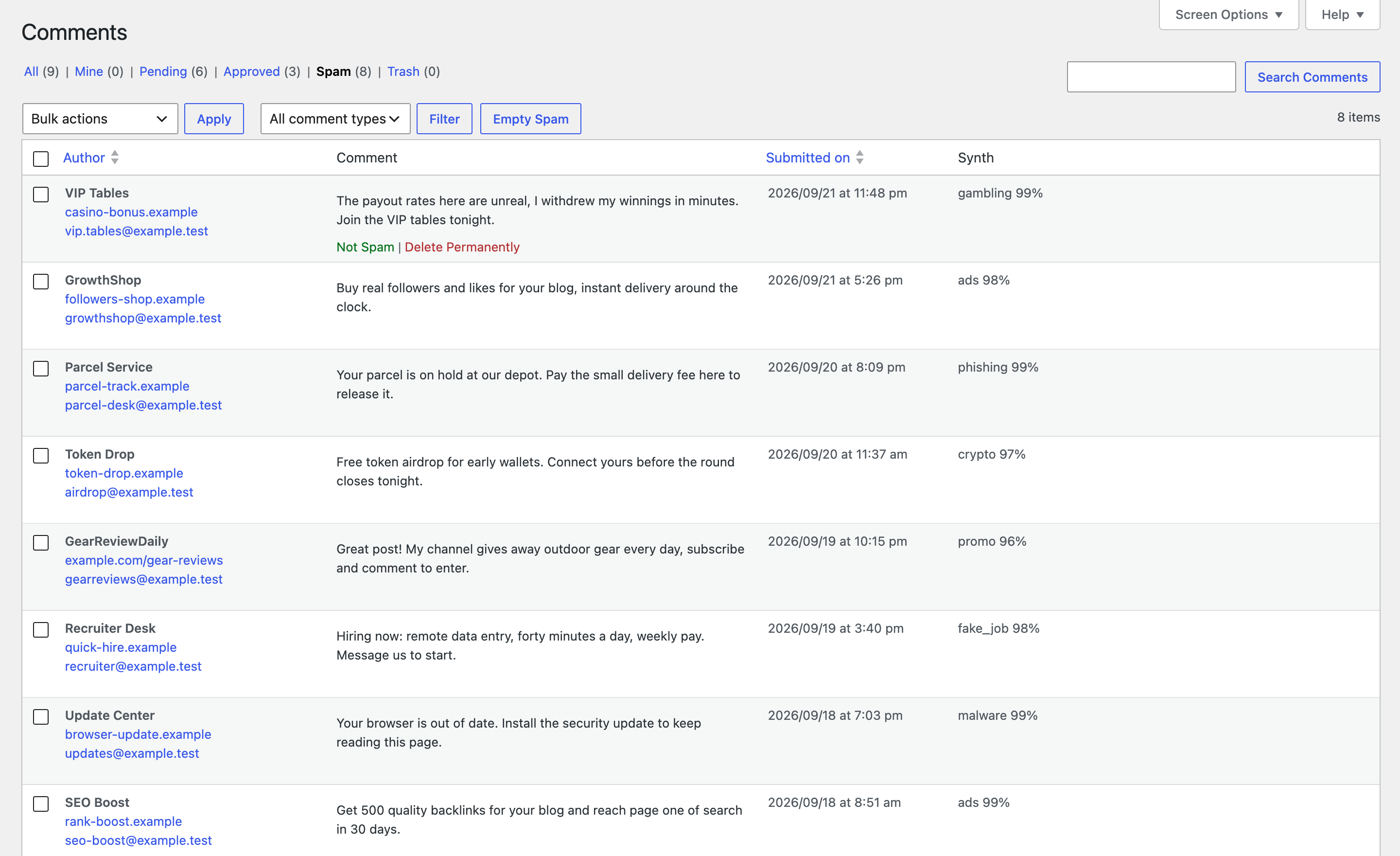
and so are pingbacks and trackbacks. - You can see why. The verdict appears as its own column in the comments list, so a comment in
the Spam folder is explainable instead of mysterious. - Your judgement wins. A decision you or another moderation plugin already made is left alone.
Marking a comment as not-spam sends that correction back and teaches the filter. - Your site works when ours does not. If the service is unreachable you choose what happens:
publish as usual (the default) or hold for review. Running out of your monthly allowance does not
switch the plugin off either. - Nothing runs on your visitors. No detection logic on your server, no scripts on your pages,
no visitor tracking. Only what a verdict needs is sent, listed field by field under “External
services”.
You supply one thing: a site key. Until a key is entered the plugin sends no request at all, and
comments publish exactly as they would without it.
External services
This plugin is a thin client for the Synth Antispam classification service, an external,
cloud-hosted processor. It sends each new comment (and pingback or trackback) to that service to
obtain a spam verdict, and applies the verdict using WordPress’s own moderation tools (Spam folder
or moderation queue — see “Description” above). It also asks that same service for this site’s key
when you press Get a site key. No request serves any other purpose; the full list is below.
The service is operated by LightApps OÜ (Estonia). Its terms and its privacy policy for this
plugin — including the controller/processor split described below, where the data is processed, and
who else it reaches — are published here:
- Terms of Use: https://synth.locker/assets/legal/wordpress-terms-of-use.html
- Privacy Policy: https://synth.locker/assets/legal/wordpress-privacy-policy.html
- Pricing: https://wordpress.synth.locker/pricing
Both legal documents cover the WordPress service specifically. Synth also operates a Telegram
service under separate general documents, which do not apply to this plugin.
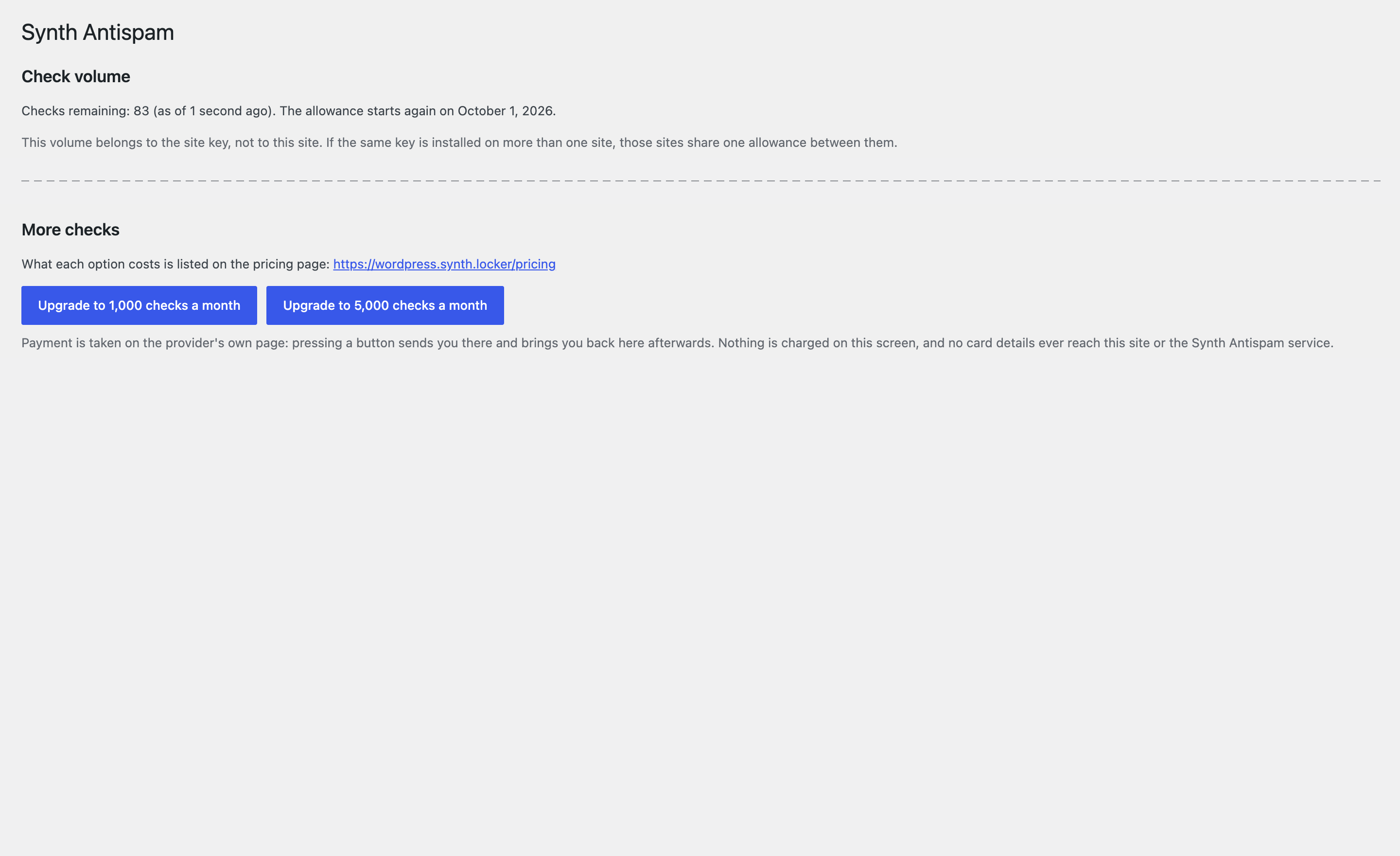
This is a paid, cloud-hosted service. Every site that registers is given a starting allotment
of checks at no charge, and higher volumes are available on paid subscription tiers above it.
Every paid tier applies to one site — a site’s key covers checks made for that site, not a group of
sites. Current check volumes and prices are on the pricing page linked above, not in this file:
this file ships frozen inside the build and is not corrected between releases, while they change.
Running out of checks does not turn off anything this plugin does. When a site has used its
checks for the current period, the classification service simply stops answering new requests for
that site until the period resets — the plugin does not lock, gate, or disable any of its own
functionality in response, and it never has: no feature, mode, or setting in this plugin is gated
behind a tier or a payment state, at any usage level. Comments continue to be handled by
WordPress’s own native moderation tools, the same as whenever the service is briefly unreachable
for any other reason.
Every request this plugin can make, in full. Each one goes to the one service named above and to
nothing else — see “Payments” below for the single case where your browser, rather than this plugin,
is sent somewhere else:
- Submitting a comment for a verdict. One request per comment, carrying the fields listed
below, field by field. - Collecting the verdict. A verdict is not returned immediately, so the plugin asks for it a
short time later. This second request carries only the identifier the service issued for that
comment in step 1, and nothing else — no comment text, no commenter details, nothing about
your site. - Reporting a moderator correction — off by default, and it makes no request unless you turn it
on. If you switch it on, then when a moderator marks one of our decisions as wrong, the plugin
sends the identifier from step 1 together with what the moderator decided (spam or not spam) —
and nothing else. This is controlled by thesynth_wp_send_feedbackfilter, which ships
returningfalse; with no code added to your site, this request never happens. - Asking for a site key — only when you press the button. Get a site key sends one request
carrying the plugin version and nothing else: nothing about your site, nothing about a comment
or a commenter. It never fires on its own, and only the key is kept from the answer. Your site’s
address reaches the service with the first comment it checks — that is the request in step 1,
which already carries it, and it is what ties the key to this site. - Checking the remaining allowance — only while an administrator has the settings screen
open. Sends your site key and site address, nothing else. Read-only; costs no check. - Starting a purchase — only when you press an upgrade button. Sends your site key, site
address and the option pressed, then takes you to the provider’s own payment page.
No card details reach your site, this plugin, or this service.
Payments — the only time your browser leaves your site, and only if you press an upgrade button.
Payment is taken by Stripe (Stripe Payments Europe, Ltd.), not by us. This plugin sends nothing
to Stripe: it asks the Synth Antispam service for a payment page address, checks that the address
really is Stripe’s checkout page, then opens it in your browser. What you type there, card details
included, goes from your browser to Stripe and reaches neither your site, nor this plugin, nor the
Synth Antispam service. Stripe’s own documents govern that page:
- Stripe Terms: https://stripe.com/legal
- Stripe Privacy Policy: https://stripe.com/privacy
Press no upgrade button and Stripe is never involved.
Entering a site key is not a subscription step and does not put your site on a plan: no feature,
mode, or setting in this plugin is gated behind a tier, a payment state, or a trial. Everything the
plugin can do, it does for every configured site.
Nothing is sent until you opt in. The plugin attaches no comment-checking hooks until both a
service address and a site key are set; with either missing it behaves as with no key at all, and
the service is never contacted for any comment. Setting that pair — on the Settings Synth
Antispam screen, or at network level on multisite — is the act of opting in and is the consent
gate; there is no separate checkbox.
Exactly what is sent, field by field. This list matches the plugin’s request builder field for
field — nothing beyond it leaves your site:
schema_version— the version of the request format, so the service stays compatible with older and newer plugin versions at once.plugin_version— the installed plugin version, for the same compatibility reason.surface— a fixed label saying the request comes from the comment form (wp_commentin this version; a hook for future integrations such as forms outside comments).object_type—comment,pingback, ortrackback: the latter two are machine-submitted and the service weighs them differently.content.body— the comment text as submitted, before any of WordPress’s own HTML filtering runs, so a link the filtering would otherwise strip is still visible to the classifier.content.author_name— the display name the commenter typed into the comment form.content.author_url— the website URL the commenter typed into the comment form. On the traffic this plugin was built against, this field carries a very strong share of the spam signal — most of it is not visible in the comment text at all.content.author_email_domain— only the domain part of the commenter’s email address (for examplegmail.com), used to recognise disposable or throwaway email patterns. The email address itself is never sent — see “What is never sent” below.content.author_id_hash— a one-way SHA-256 hash of the commenter’s email address combined with a secret value generated for your site alone (your site’s own “salt”). It lets the service recognise that two comments on your site came from the same email address without ever receiving that address. Because the salt is unique to your site and known only to it, the same commenter cannot be linked across two sites using this plugin — impossible by construction, not merely disabled. It is a per-site pseudonym, not an anonymised identifier: uninstalling the plugin destroys the salt (see “Retention” below), after which even this site can no longer connect a previously sent hash back to an email address.context.author_status— eitherregistered(a logged-in registered user of your site) oranonymous(everyone else). Only these two values are ever sent: a commenter who already has an approved comment on your site is trusted and skipped before any request is built, so their comment is never sent at all and no status is transmitted for them.context.is_reply— whether the comment is a reply to another comment.context.site_locale— your site’s configured language (for exampleen_US), used as a hint for language-specific handling.context.client_ip_status—absentif the request carried no IP address, ordirectif it did. This tells the service only whether one was present — the address itself is never sent, in either case — see “What is never sent” below. The plugin never reconstructs a “real” visitor IP from proxy or CDN forwarding headers: those are only as trustworthy as whoever sent the request, and a site behind a proxy cannot tell the difference.context.has_user_agent—trueorfalse, whether the browser sent a User-Agent string at all. The User-Agent string itself is never sent — see “What is never sent” below.
What is never sent, under any circumstances:
- The commenter’s full email address — only the domain (
content.author_email_domain) and a salted one-way hash (content.author_id_hash) ever leave your site. - The commenter’s IP address — only the two-value status above (
context.client_ip_status) leaves your site; the address itself never does. - The commenter’s raw User-Agent string — only whether one was present (
context.has_user_agent) leaves your site. - The post’s title or body, the HTTP referrer, cookies, or any form field other than the comment fields listed above.
Retention. Two separate things are kept, for two different lengths of time.
The verdict record. The verdict for each comment is retained by the Synth Antispam service for 24
hours and then expires automatically. That is the record your site collects its verdict from.
The training record. Separately, the service keeps its own copy of each request your site sends —
the comment text and the commenter fields listed above, exactly as sent — together with the verdict
its classifier produced and any later correction you make with the Not spam / Spam buttons in
your Comments list. It uses those copies to train and improve the Synth spam-classification models. These copies
are kept indefinitely: they have no expiry date. They are stored as sent — not anonymised, not
aggregated, and not reduced to statistics. This applies to every site that uses the service; there is
no setting, on this screen or anywhere else, that turns it off. If that is not acceptable for your
site, the choice available to you is not to install the plugin.
Deletion on request. To have your site’s stored copies deleted, write to support@synth.locker with
your site’s address. The service can delete them by site key, so a request covers every copy taken
from your site rather than one comment at a time. An operator tool for this deletion is being built
alongside this release; until it is in place the deletion is performed by hand on request, and the
address above is the route either way.
Uninstalling this plugin permanently deletes your site’s secret salt; after that, no
author_id_hash it previously sent can be linked back to an email address, by this site or by the
service. Uninstalling does not by itself delete copies already taken — use the address above for
that. Your site key is the one thing deliberately left behind, so that reinstalling the plugin
does not cost you the checks attached to it. Tick
Delete the site key when the plugin is deleted on the settings screen if you want it removed too.
Your own obligations under privacy law — see “For site owners: your obligations under GDPR
and similar privacy laws” in the Frequently Asked Questions above.
Every address that appears in the source
A search of this plugin’s files finds these addresses and no others:
wp-api.synth.locker— the Synth Antispam service above. The shipped default; changeable on the
settings screen or inwp-config.php. The only address this plugin sends a request to.checkout.stripe.com— Stripe’s payment page. No request is sent there; the address is present
only so the plugin can check that the payment page it was handed really is Stripe’s (see
“Payments” above).synth.lockerandwordpress.synth.locker— the terms, privacy, pricing and plugin home pages
linked above. Links for you to follow; nothing is sent to them.www.gnu.org— the GPL licence text.your-synth-endpoint.exampleandhttps://x— not addresses: a greyed-out example in the empty
settings field, and an example inside a code comment.
Details
Related plugins
Plugins that also contain the tag antispam
Akismet Anti-spam: Spam Protection

Antispam Bee

reCaptcha by BestWebSoft

hCaptcha for WP

Titan Anti-spam & Security

Maspik – Ultimate Spam Protection


About
Plugin for that tries to help you find the WordPress plugin you are looking for.
| Please enjoy an image of Crush (this awesome turtle) and have a lovely day! |  |
We do not own any plugin listed on this site and do not work for or work with WordPress.com or it's associated companies. We simply provide a searchable list of the available WordPress plugins.