



Visibility Flux – AI SEO Editor
Most SEO plugins grade the page you are already editing. Visibility Flux starts from your real
Google Search Console data and tells you which page to open first — the one quietly
losing the most clicks.
Upload your Search Console CSV export and Visibility Flux scores every page against the
click-through rate its ranking position should be earning. The gap multiplied by
impressions gives you estimated lost clicks per month: a worklist sorted worst-first,
not a traffic light.
It also covers the half of search that changed recently — whether AI assistants can reach
your site at all, and whether they send you readers.
The Problem Map
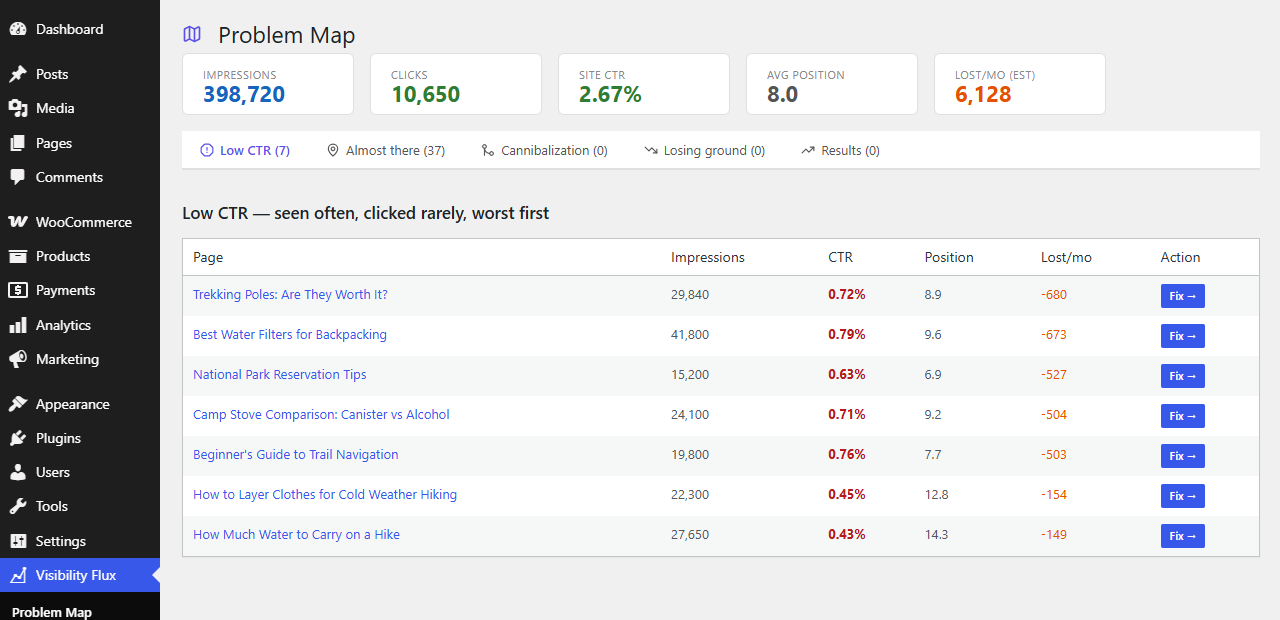
Five views over your whole site, built from your own data:
- Low CTR — seen often, clicked rarely, sorted by the clicks that gap is costing you
- Almost there — page-two pages and queries a small edit could lift onto page one
- Cannibalisation — your own pages competing, with keep and merge recommendations
- Losing ground — pages sliding down between your last two imports, before it hurts
- Results — what changed on the pages you already fixed, before and after
Search Console exports are parsed in any language — English, French, German, Spanish,
Dutch, Arabic and more, comma or semicolon separated. Nothing to reformat.
Can ChatGPT actually read your site?
Editing robots.txt tells you what you wrote. It does not tell you what a crawler receives.
The common failure is a CDN or firewall refusing the request before WordPress is ever
reached, and no robots.txt editor can show you that.
Visibility Flux requests your site using the real user-agent strings of GPTBot,
OAI-SearchBot and PerplexityBot, and reports the status code that actually comes back.
It checks nine AI crawlers, plus the settings that would remove your whole site from
search and AI answers, with one-click fixes.
It also generates an llms.txt from your best performing pages, served virtually at
/llms.txt — no file written to disk.
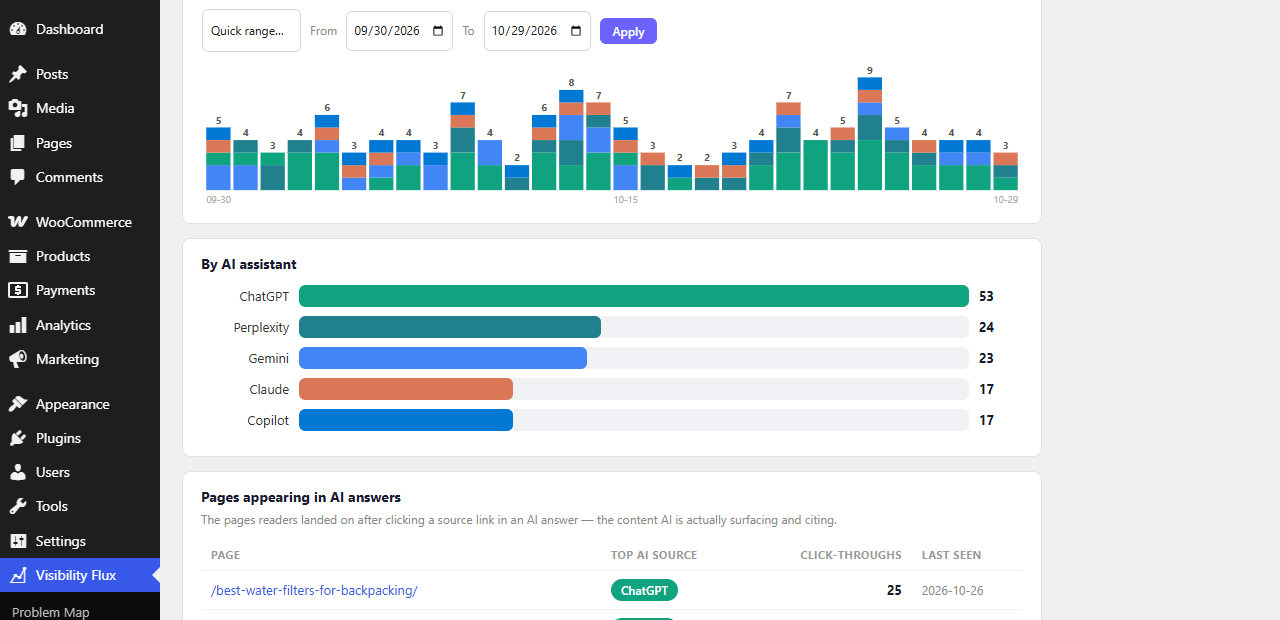
AI traffic, counted
When someone clicks through from an AI answer, most analytics tools file the visit under
“direct”. Visibility Flux counts those visits properly, across twelve assistants: ChatGPT,
Perplexity, Gemini, Claude, Copilot, Meta AI, You.com, Poe, Phind, DeepSeek, Mistral and
Grok.
No cookies. No accounts. No visitor identity in your stored traffic: only which assistant
sent the reader and which page they landed on. Daily totals are kept for 90 days, monthly
totals for 36 months, the 200 most visited pages, and a log of the last 100 visits, each
with its time, the assistant, the landing path and the referring site’s hostname. Nothing
leaves your site — the count is made by your own WordPress. On by default, with a switch in
Settings to turn it off; switching it off stops the counting and keeps the figures already
collected.
A small flag in the browser’s session storage stops one visit being counted twice. It is not
a cookie, it is never sent anywhere, and it goes when the tab closes.
The tracking endpoint is throttled so it cannot be spammed to inflate your numbers. That
check salts the visitor IP with your own site key and keeps a counter under the resulting
hash for ten minutes. It is never reversible and never reaches your stored data.
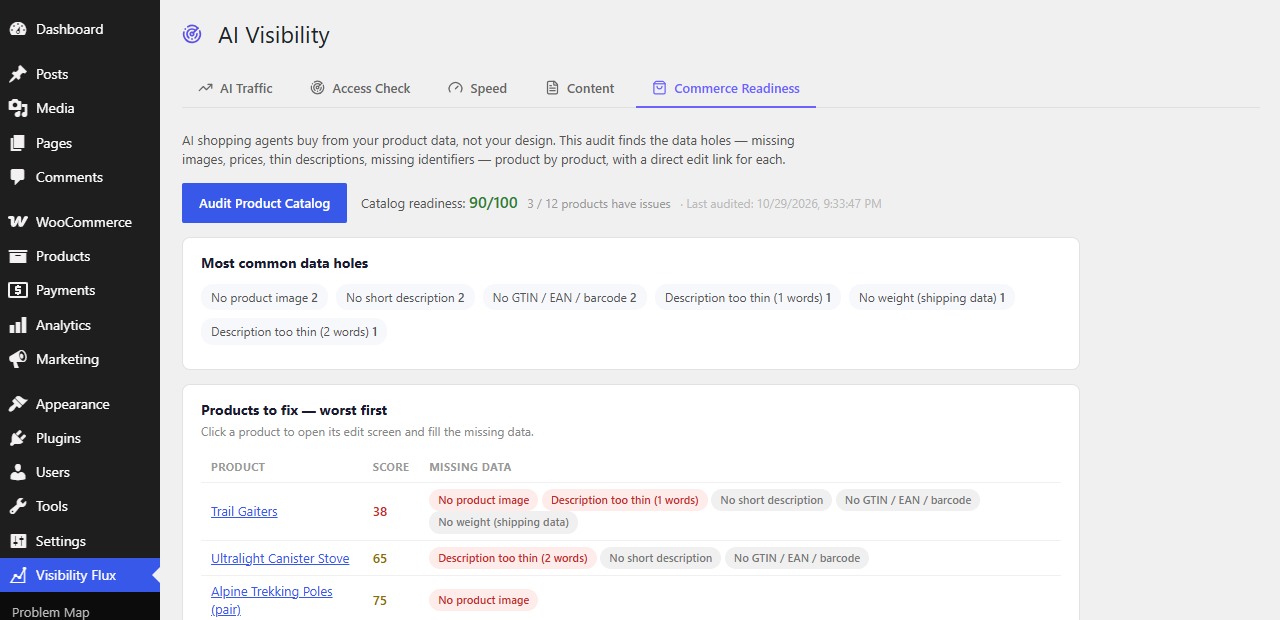
AI Commerce Readiness (WooCommerce)
AI shopping agents buy from structured product data, not from your page design. Visibility Flux
audits every product for missing images, prices, thin descriptions, missing categories,
GTIN, brand and weight — a score per product, worst first, with a direct edit link.
Fully deterministic: no AI calls, no API key, no cost.
Also included
- Content audit — one sweep for missing, duplicate and truncated titles and
descriptions, thin pages, and images with no alt text. Duplicates can only be found
site-wide: no single page knows its title is shared - Speed audit — fetches your busiest pages and names the actual files slowing them:
which image gates the first paint, which scripts block rendering and which plugin
shipped them, how much JavaScript you carry. Real files, real sizes, no API key - Answer readiness — whether each page has the JSON-LD, freshness, structure and
verifiable author that assistants lift answers from - hreflang validation — self-reference, x-default and language tags, on multilingual
sites only - Instant indexing via IndexNow — Bing, Yandex, Naver and Seznam. Off until you switch it on in Settings; no account or key needed
- Internal link suggestions scored by real keyword relevance
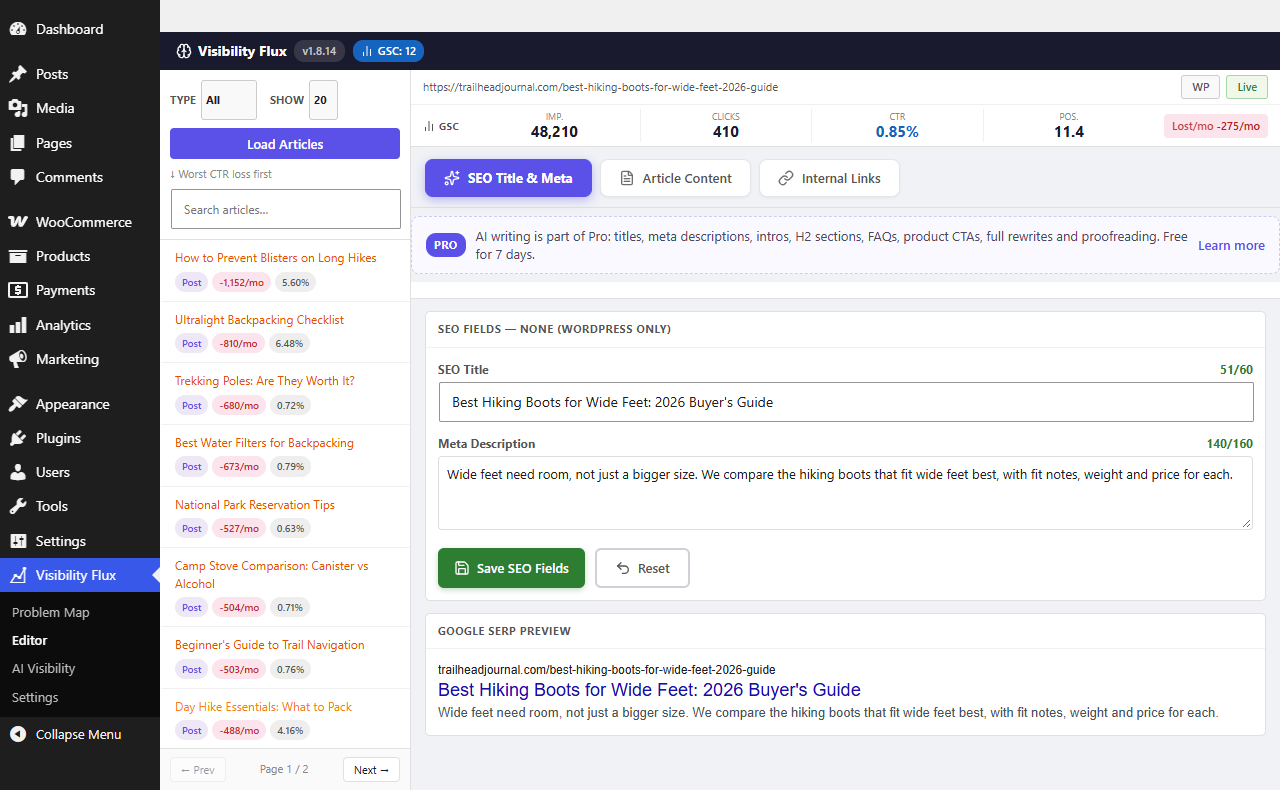
- Manual SEO title and meta editing with a live Google preview
- Thin-content detection that reads page-builder content, not just the classic editor
- Writes into Yoast SEO, Rank Math, All in One SEO, SEOPress, The SEO Framework or Slim SEO, or sets the title and meta description itself when none is installed
- Works in any language, including right-to-left scripts
Visibility Flux Pro
Everything above is free, forever, with no time limit. Visibility Flux Pro adds the writing:
- AI-generated SEO titles and meta descriptions, written against the page’s real ranking queries
- Content generation — intros, H2 sections, FAQ blocks, product CTAs and full rewrites
- Two-pass proofreading that does not break your HTML
- JSON-LD schema generation and a 0–100 quality score per article
- AI internal link insertion
- Competitor gap research
- A five-layer site memory that learns your brand voice
- Batch processing across your whole site
- Submitting pages to Google through the Indexing API
Pro is available with a 7-day free trial at infinacode.com.
It uses your own Anthropic API key, so you pay Anthropic directly for what you use and
every action shows its exact cost. When a trial ends, the plugin returns to the free
features — nothing is deleted.
External services
This plugin has one service of its own, IndexNow, and contacts it only when you enable it.
The speed audit can also reach the hosts your own pages already load files from; that is
described in the last paragraph of this section.
IndexNow (instant indexing)
- Service: IndexNow via
https://api.indexnow.org/indexnow,
a shared endpoint that notifies Bing, Yandex, Naver and Seznam at once - Data sent: the address of the page, your site’s host name, and a key file name that this
plugin generates. No content, no personal data, no visitor data - When: on publish or update, only while instant indexing is switched on in Settings, and
never for a page marked noindex - Terms: https://www.indexnow.org/faq · Bing’s terms and privacy policy apply:
https://www.bing.com/webmasters/indexnow
Requests to your own site
The AI crawler test, speed audit, answer readiness and hreflang checks fetch your own
public pages over HTTP — the same pages any visitor loads. The crawler test sends the real
user-agent strings of GPTBot, PerplexityBot and others so your server and CDN answer them
exactly as they would the real crawler. Nothing about your content or your visitors leaves
your hosting.
Files your pages load from other hosts
When you start the speed audit, it asks each image and script your pages reference how large
it is (a HEAD request), and reads the first few stylesheets to check how fonts load. Some of
those files are hosted by other companies – a font service, an analytics script, a CDN – and
for those the request goes to that company’s server. It carries the file’s address and
nothing else: no page content, no visitor data and no identifier from this plugin. It only
happens while you run the audit, and requests to private or loopback addresses are refused.
Google Search Console
Visibility Flux does not connect to Google. Search Console data reaches the plugin only through
CSV files you export and upload yourself.
Third-party libraries
Lucide (the icons on the plugin’s screens)
- Bundled file:
assets/vendor/lucide/lucide.min.js– Lucide 1.39.0, ISC licence; the licence
text is beside it inassets/vendor/lucide/LICENSE - It is the
dist/umd/lucide.min.jsbuild of thelucidenpm package at that version. The
human-readable, unminified build of the same version is published in the same package:
https://unpkg.com/lucide@1.39.0/dist/umd/lucide.js - Project source at that version: https://github.com/lucide-icons/lucide/tree/1.39.0
Details

Related plugins
Plugins that also contain the tag ai
SEOPress – On-site SEO & Analytics

AI Engine – The Chatbot, AI Framework & MCP for WordPress

GetGenie – AI Content Writer with Keyword Research & SEO Tracking Tools

SEO Plugin by Squirrly SEO

Website LLMs.txt

Smartsupp – live chat, AI shopping assistant and chatbots


About
Plugin for that tries to help you find the WordPress plugin you are looking for.
| Please enjoy an image of Crush (this awesome turtle) and have a lovely day! |  |
We do not own any plugin listed on this site and do not work for or work with WordPress.com or it's associated companies. We simply provide a searchable list of the available WordPress plugins.