


Wonderful SMTP Mailer and Log
A small SMTP plugin that does three things and nothing else: it sends your mail
over SMTP, it writes down what happened, and it tells a webhook when a message
fails.
We built it because the SMTP plugin we had relied on for years kept growing.
More features, more integrations, more settings — most of which we simply
didn’t need. Eventually, that added complexity started causing problems on
production sites.
Many alternatives had gone the same way: email logs behind paid tiers, API
providers, OAuth flows, deliverability dashboards, upgrade banners, and entire
mail suites around what should be a simple job.
We wanted the opposite: connect to a mail server, send the email, log the
result, and stay out of the way.
Email is critical infrastructure. Every additional feature is another dependency
and another potential failure point — and when mail breaks, customers notice
immediately.
So we built the slim alternative we wanted ourselves, and we run it in our own
production environment and on our client sites.
What it does
- Routes every
wp_mail()call over your SMTP server — WooCommerce, contact
forms, core password resets, all of it, without touching their code. - Host, port, encryption (STARTTLS, SSL/TLS or none), optional authentication.
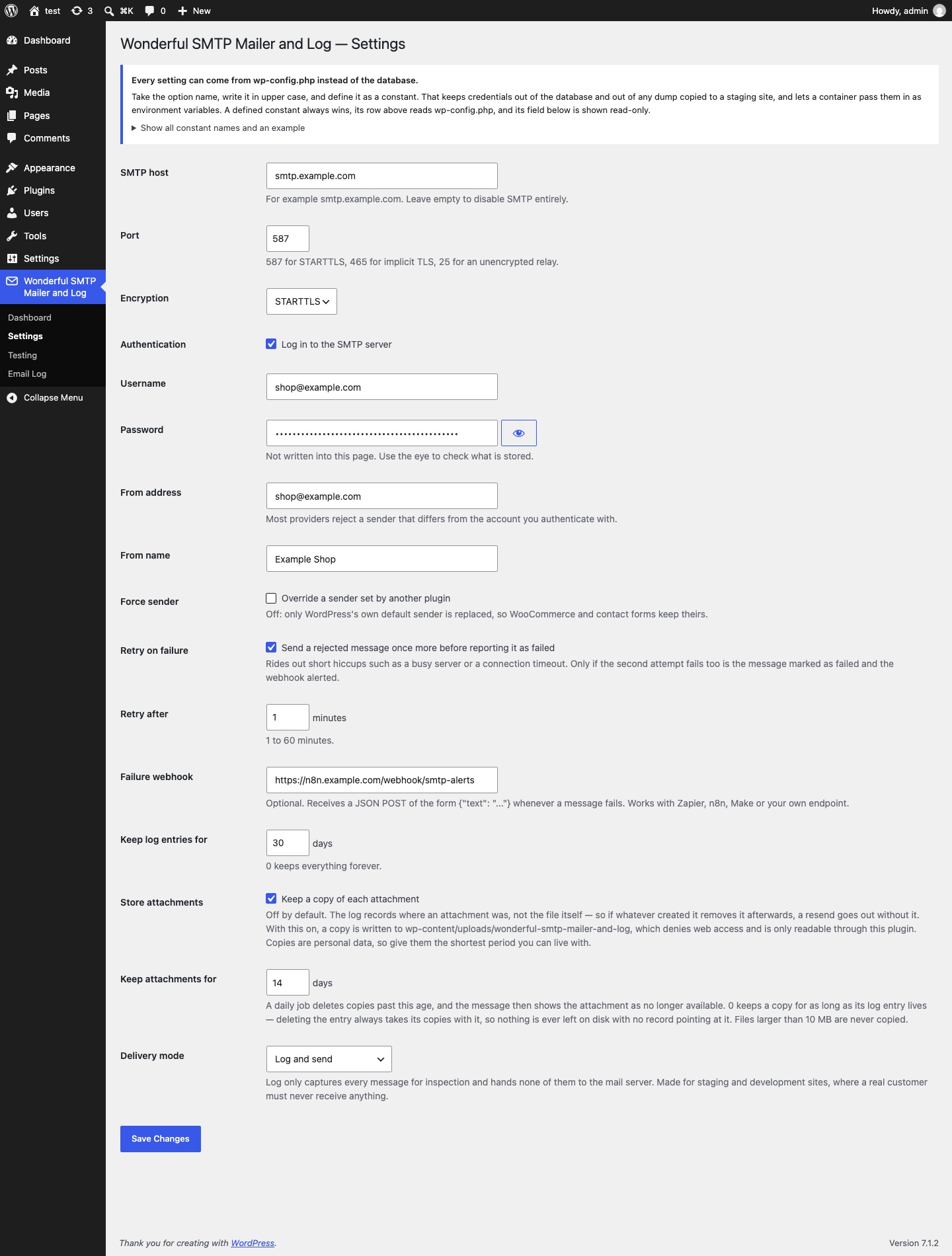
- Sender address and name, with an explicit switch for whether they override a
sender another plugin already set. - A connection check that logs in to your mail server and hangs up without
sending anything — the safe way to find out whether the settings are right. - A test message that shows you the actual SMTP conversation — when a server
answers “535 5.7.139 Authentication unsuccessful”, you read that line instead
of guessing. - A detail view for every logged message: the full server response, the headers,
the attachments and the message body as source, so you can see exactly what a
resend would deliver. - An email log: date, recipient, subject, status and the server’s response,
with its own menu entry rather than another item buried under Settings. - A date range filter, so an entry from six months ago is two clicks away
instead of forty pages down. - Full-text search across recipient, subject and message body, scoped to the
period you filtered — “find the mail that mentioned invoice 0912”. - Attachments listed on every logged message, downloadable in one click and
re-attached automatically when you resend. - Attachment storage — the part most email logs leave out. A log that records
a filename cannot resend the file, and plenty of plugins delete theirs the
moment the message is sent. Switch storage on and a copy is kept for as many
days as you choose, in a directory that denies web access, so a message resent
three weeks later still carries what it was sent with. Off by default, and
every copy is deleted again on schedule. - Delivery counts for the filtered period, next to the all-time totals.
- A resend button on every logged message, which asks before it sends and lets
you correct the address first — the usual reason to resend is that the
original one was mistyped. - A log-only mode that records every message and hands none of them to the
mail server — the setting a staging site needs so a real customer can never
receive anything. - A dashboard as the landing screen: delivery counts for the last seven days,
the active delivery mode, and every setting with its current value and where
it came from — the database, or a constant yourdocker-composepassed in. - An optional webhook that fires on failure, so Zapier, n8n, Make or your own
endpoint can raise an alert.
What it deliberately does not do
No API providers, no OAuth, no fallback connections, no deliverability score, no
dashboard widget, no newsletter integration, no pro tier, no advertising for
one, and no upsell notices. If you need those, one of the big plugins will serve
you better, and that is a fine outcome.
Safety rails
- With no SMTP host configured the plugin stays out of the way entirely and
WordPress keeps using PHPmail()— installing it cannot take your email
down. -
Every setting can be defined as a constant in
wp-config.php, following
one mechanical rule: the option name in upper case. That keeps credentials out
of the database and out of any dump copied to a staging site, and lets a Docker
container pass them in as environment variables:define( ‘WONDERFUL_SMTP_MAILER_AND_LOG_HOST’, getenv( ‘SMTP_HOST’ ) );
define( ‘WONDERFUL_SMTP_MAILER_AND_LOG_PASSWORD’, getenv( ‘SMTP_PASSWORD’ ) );A defined constant wins over the settings field, and the field is then shown
read-only so the two cannot silently disagree. - No runtime dependencies. The plugin uses the PHPMailer that ships with
WordPress itself — there is no vendor directory and nothing to keep patched. - The stored password is never written into the HTML of the settings form. A
toggle next to the field fetches it on request, so it stays out of the page
source, the browser cache and any screenshot until you deliberately ask. - Log-only mode is announced on every admin screen, not just this plugin’s own.
It is a silent state by design —wp_mail()keeps reporting success — and the
person who needs the warning is the one wondering why a customer never got
their confirmation. - Stored attachments are deleted when the plugin is deactivated, not just when it
is uninstalled — switching it off should not leave a folder of customer
documents on the server. - “Force sender” is off by default, so plugins that set their own sender on
purpose keep it. - Resending is a manual button. Nothing retries by itself, so a failing server
can never turn into a mail loop.
How it is built
Development is test driven, and the suite covers the behaviour that decides
whether your mail actually leaves the building: that an unconfigured plugin keeps
its hands off PHPMailer entirely, that “none” really disables TLS instead of
quietly upgrading, that a sender another plugin set on purpose survives, that a
corrupt delivery-mode value falls back to sending rather than silently swallowing
your mail, that log-only mode never once reaches the mailer, that the retention
purge deletes what is past the cutoff and nothing else, and that a webhook fires
with the failure details but no credentials.
Those tests run together with the WordPress coding standards, a PHP 7.4
compatibility lint and WordPress.org’s own Plugin Check every single time, before
a release is built at all. An error in any of them stops the release — the
pipeline refuses, it is not a checklist someone waves through.
The tests themselves stay in the repository and are not part of this download.
Nothing ships here that your site does not need at runtime: a small set of PHP
classes and four assets, with no vendor directory and no framework.
That discipline is also why the feature list is short. Every feature is a promise
that has to keep working.
External services
This plugin contacts two kinds of external endpoints, both of which you
configure yourself. It has no vendor backend, sends no telemetry, and phones
home nowhere.
1. Your SMTP server
The host you enter in the settings receives your outgoing messages: sender,
recipients, subject, body, attachments, and — if authentication is enabled — the
username and password you configured. This is the entire purpose of the plugin.
Which company that server belongs to, and which terms and privacy policy apply,
is determined by you when you enter the host name. No connection is made until
you configure one.
2. Your failure webhook (optional, off by default)
If, and only if, you fill in the webhook field, a JSON request of the form
{“text”: “…”} is sent to that URL whenever a message fails. It contains your
site URL, the recipient address, the subject and the error the mail server
returned. It contains no message body and no credentials. Nothing is sent while
the field is empty. The receiving service is one you choose — Zapier, n8n, Make,
Slack or your own endpoint — and its terms and privacy policy apply to what you
send it.
Message contents and log entries stay in your own database. No data is
transmitted to Wonderful Plugins.
Details



Related plugins
Plugins that also contain the tag email
MC4WP: Mailchimp for WordPress

Post SMTP – Complete Email Deliverability and SMTP Solution with Email Logs, Alerts, Backup SMTP & Mobile App

WP Mail Logging

Creative Mail – Easier WordPress & WooCommerce Email Marketing

Mailchimp for WooCommerce

SureMail – SMTP and Email Logs Plugin with Amazon SES, Postmark, and Other Providers


About
Plugin for that tries to help you find the WordPress plugin you are looking for.
| Please enjoy an image of Crush (this awesome turtle) and have a lovely day! |  |
We do not own any plugin listed on this site and do not work for or work with WordPress.com or it's associated companies. We simply provide a searchable list of the available WordPress plugins.